Context study / HAUSTUS
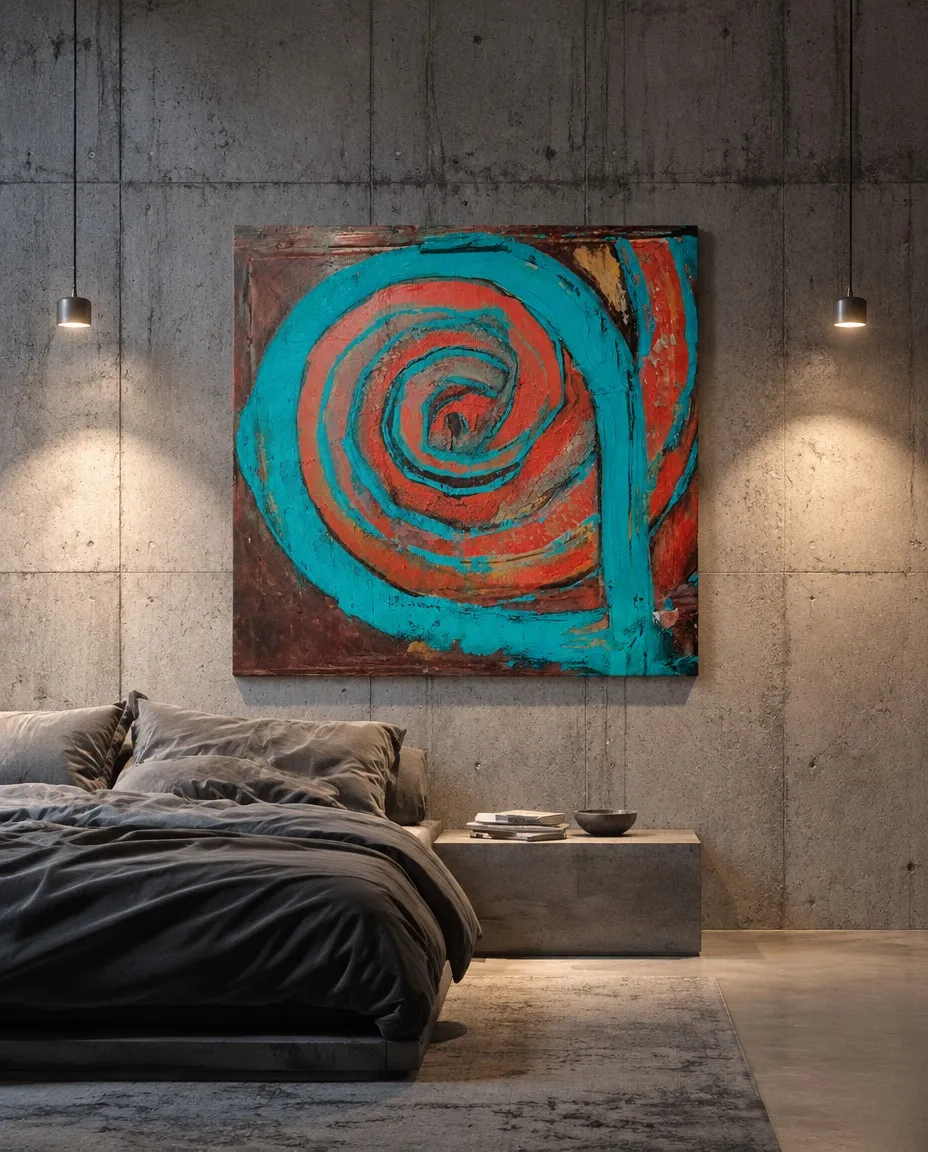
HAUSTUS by Maurizio Valch - Painting in Brutalist Bedroom
When facing the imposing surface of HAUSTUS, the first thing that arrests the eye is a turquoise whirlwind of almost geological density, unfolding as an off-center spiral over a convulsive background of fiery reds, oxides, and deep browns. This centrifugal force does not seek harmony or rest; on the contrary, it introduces a formal tension that challenges the stillness of the square support measuring two meters on each side. If we contemplate this turn from the perspective of Carl Gustav Jung, whose study of mandalas as archetypal representations of internal order and psychic centralization revolutionized the understanding of concentric iconography, we perceive here a violent transgression of that protective balance. Valch's stroke does not unify or pacify the surrounding chaos, but instead seems to crack the pictorial surface with a wild asymmetry. This concentric dynamic, far from being a refuge of spiritual integration, evokes the relentless mechanical nature of the sleeping man theorized by George Gurdjieff, who argued that ordinary human consciousness is trapped in an automated and unconscious repetition. The spiral of HAUSTUS is thus presented as a visual paradox: a desperate attempt of consciousness to awaken through friction, or a chromatic acknowledgment of the mechanical loop from which we cannot escape.
When I confront a format of these dimensions, I am not looking to illustrate an idea, but to unleash a physical force through the relentless accumulation of layers of acrylic and oil. With the weight of my body thrown onto the canvas, I drag the palette knife loaded with material to open that great circular incision—a real trench in the pictorial tissue that resists being a simple flat drawing. In that dragging process, the color shifts and accumulates at the edges like turned earth, revealing the resistance of the support. As I execute this circular movement, I am often struck by the doubt of whether this turquoise whirlwind is acting as a sinkhole that absorbs outer space and swallows it into the vacuum of its center, or if, on the contrary, it functions as an escape valve designed to expel the volcanic and magmatic energy that beats contained within that crimson background. It is a physical struggle against the inertia of the pigment, where each turn is an attempt to find a crack in the solidity of the color so that the painting can begin to breathe on its own.
The monumental scale of the piece, which expands in a strictly quadrangular format of 210 x 210 centimeters, intensifies the physical quality of its title, HAUSTUS, a Latin term that refers to the primitive act of drawing water, drinking deeply, breathing in the air, or being inevitably swallowed by a superior force. This baptism of matter connects us with the deepest memory of the European and Mediterranean territory, where the spiral does not emerge as a decorative or abstract exercise, but as the first mark that human beings engraved on stones and in the darkness of Paleolithic and Neolithic caves. Observing this ancestral stroke, it is fruitful to turn to the vision of Osho, whose thought questions the rigidity of social structures and institutionalized rituals that have historically domesticated life force to subject it to collective control. From this perspective, one wonders if the vortex of HAUSTUS acts as a channeler of that domesticated and patterned energy, or if it is the representation of a wild and chaotic drive that rebels violently against any attempt at social ordering and conceptual domestication, reclaiming its right to flow indomitably over the rough surface of existence.
For me, HAUSTUS is a direct return to the physicality of my own Mediterranean memory, a landscape where the dryness of the Andalusian land imposes a constant search for what remains hidden beneath the dust. Painting this picture was like excavating the parched surface of the countryside, scratching the limestone crust searching for a thread of water or a breath of fresh air in the midst of the summer rigor. The turquoise color does not burst in here with an ornamental intention, but as an organic necessity for survival—a humid, dense, and cold current that collides violently with the suffocating heat of the oxides and reds accumulated in my visual memory of the coast. Each circular stroke is a gulp of that reclaimed humidity, an attempt to assimilate the freshness of the sea and the easterly wind in an environment of scorched earth. It is the expression of that extreme contrast between the aridity of the clay exposed to the sun and the fluidity of the water that bores through stone, a thermal and material shock that defines my relationship with the environment and that I seek to fix definitively upon the canvas.
Turning our gaze away from the centripetal force of the turquoise core toward the extreme edges of the canvas, we observe how the rigidity of the spiral begins to crumble and lose its linear definition. There, at the margins of the cloth, the color fragments, the earthy tones gain ground, and the underlying layers of oil and acrylic reveal themselves in all their material imperfection, showing the seams of the creative process. At its limits, the painting renounces offering a mystical refuge of salvation or a definitive map for ordering mental chaos. Instead of providing closed answers, HAUSTUS consolidates itself as a territory in perpetual rotation where memory and matter relentlessly wear each other down. The work leaves us suspended in that zone of friction where water and earth collide, reminding us that true awakening does not consist in reaching an immutable center, but in sustaining our gaze before the continuous wearing down of the forces that constitute us.
- Original artwork
- HAUSTUS
- Actual dimensions
- 82.7 × 82.7 in / 210 × 210 cm
- Presentation
- Digital contextual visualization
Context references
concrete bedroom paintings · turquoise and red abstract painting · large industrial style paintings · brutalist decor with art · maurizio valch vortex artworks
About this visualization
This visualization places the artwork within an architectural context to help collectors and viewers imagine its presence in a real space. It is an interpretive reference, not an exact reproduction: the original work remains the sole authority for scale, color, surface and material presence.