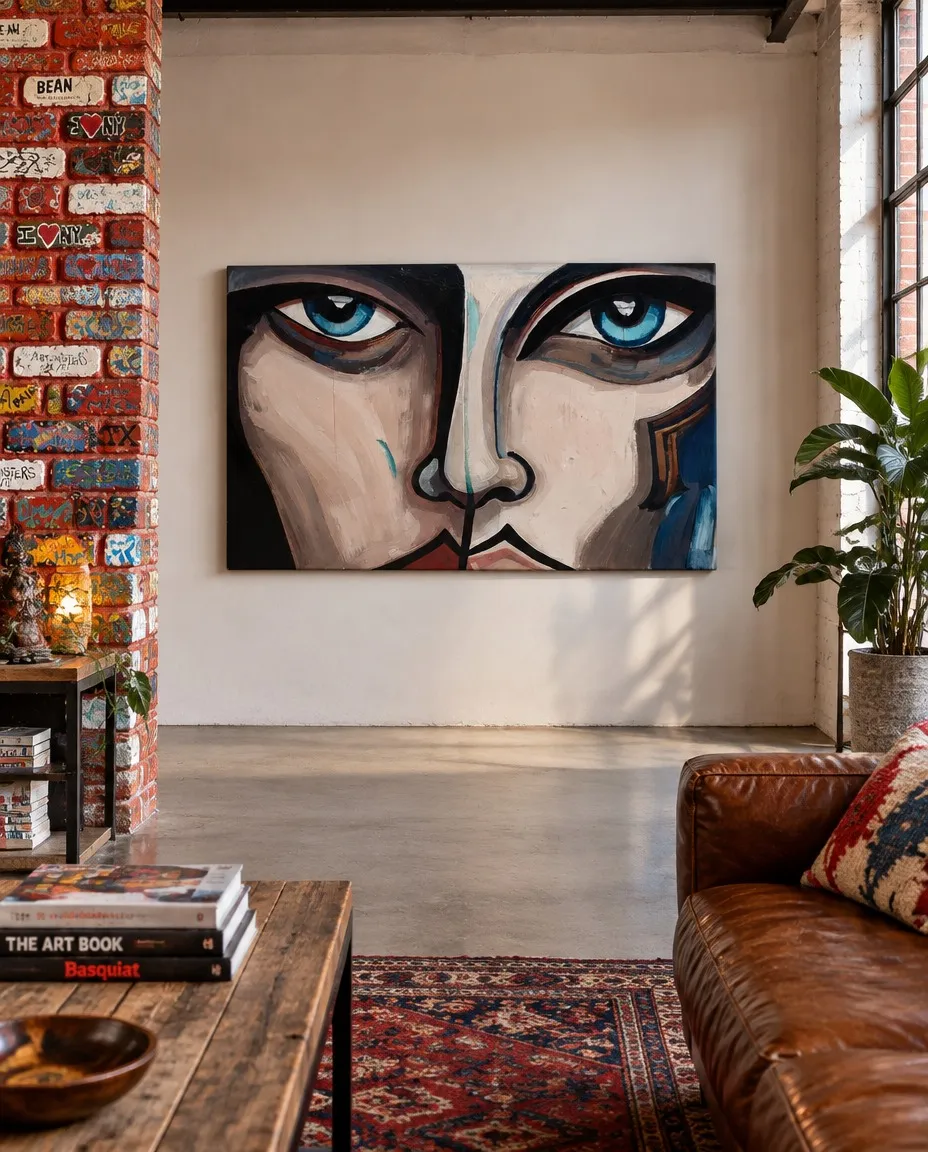
Context study / CUTIS
CUTIS by Maurizio Valch in a Loft Living Room
At the monumental scale of CUTIS, space is immediately reordered by a two-and-a-half-metre-wide two-dimensional presence that asserts itself with the severity of a load-bearing wall. Two immense blue eyes, in broken symmetry, dominate the horizontal plane. A severe vertical line divides the face, not as a merely compositional element, but as a tectonic joint articulating two halves of the same exposed surface. Deprived of auricles or other organs of external acoustic perception, the whole face assumes a receptive function. It becomes a purely somatic and tactile membrane that performs a silent, spatial form of listening. It is not the ear that registers the surroundings, but the entirety of this painted skin, which seems to absorb gravity, air currents, and the emptiness of the surrounding architecture, returning to the observer a fixed gaze that records their presence without judging or addressing them.
In moving from my earlier abstract landscapes and monoliths to the configuration of this face-territory in CUTIS, I did not seek to represent an identity, but to excavate the material until I found its inner temperature. I worked the canvas surface intending to give it a strictly organic, almost sanguine warmth, in contrast with the rigidity of the support. Through the systematic layering of oil glazes, sienna earth pigments, and the violent yet controlled friction of the palette knife, I built a density that imitates the weathered texture of vegetal or animal dermis. This warmth of clay and mud accumulated in the cheeks remains in constant tension with the mineral coldness of the blue eyes and the thickness of the charcoal black that defines the contours; it is a thermal vibration born of material friction, where paint ceases to be colour and becomes temperature accumulated beneath the canvas.
The compositional order of this large face is sharply interrupted by a visual anomaly: a turquoise and pale-blue incision descending vertically across the left cheek. This subtractive gesture, which cuts through the density of the earth-toned oil layers, introduces the dimension of abandonment. Here, abandonment does not appear as emotional defeat or figurative melancholy, but as a constructive detachment, a conscious renunciation of the sterile integrity of the mask. By scoring the cheek with that cold, discordant pigment, the painting abandons its claim to perfect mimesis and sealed symmetry. The cut reveals that the face is, in fact, an accumulation of temporal strata: a wounded yet structurally resilient crust that exposes its inner vulnerability in order to acquire, precisely through this crack, its true physical consistency.
There is a precise moment in the studio when a format of these dimensions requires me to step back and accept the definitive abandonment of my intervention in it. Letting go of a work such as CUTIS means accepting that its autonomy no longer depends on my gesture, but on its own resistance in space. In this release, the painting activates its own capacity for listening. When it rests against the floor or is fixed to an unfamiliar wall, the picture begins to react independently: it absorbs the thermal variations of daylight, is altered by suspended dust, and enters into dialogue with the passage of time apart from me. I am no longer the executor of its order, but another witness watching that massive surface settle into its new environment, responding with solid muteness to the sounds and currents of the room it now inhabits sovereignly.
Ultimately, CUTIS operates as a synthesis of forces in which the warmth of organic material, the abandonment of symmetry through incision, and the persistent attitude of listening in its divided gaze merge into a single spatial experience. The painting relinquishes the mere representation of a physiognomy in order to establish itself as a “tactile shoreline”: a physical limit where the viewer does not encounter an intellectualised concept, but a direct friction with raw painted matter. By eliminating all rhetorical artifice, Maurizio Valch places us before a vertical body that endures, a presence that neither seeks to please nor explain anything, but remains suspended and imperturbable, reminding us of the dense and silent materiality from which we are made.
- Original artwork
- CUTIS
- Actual dimensions
- 82.7 × 55.1 in / 210 × 140 cm
- Presentation
- Digital contextual visualization
Context references
large painting for loft living room · wall art for industrial interior · abstract face painting for living room · contemporary painting on white wall · large-scale artwork for living room
About this visualization
This visualization places the artwork within an architectural context to help collectors and viewers imagine its presence in a real space. It is an interpretive reference, not an exact reproduction: the original work remains the sole authority for scale, color, surface and material presence.