Context study / CLIVUS
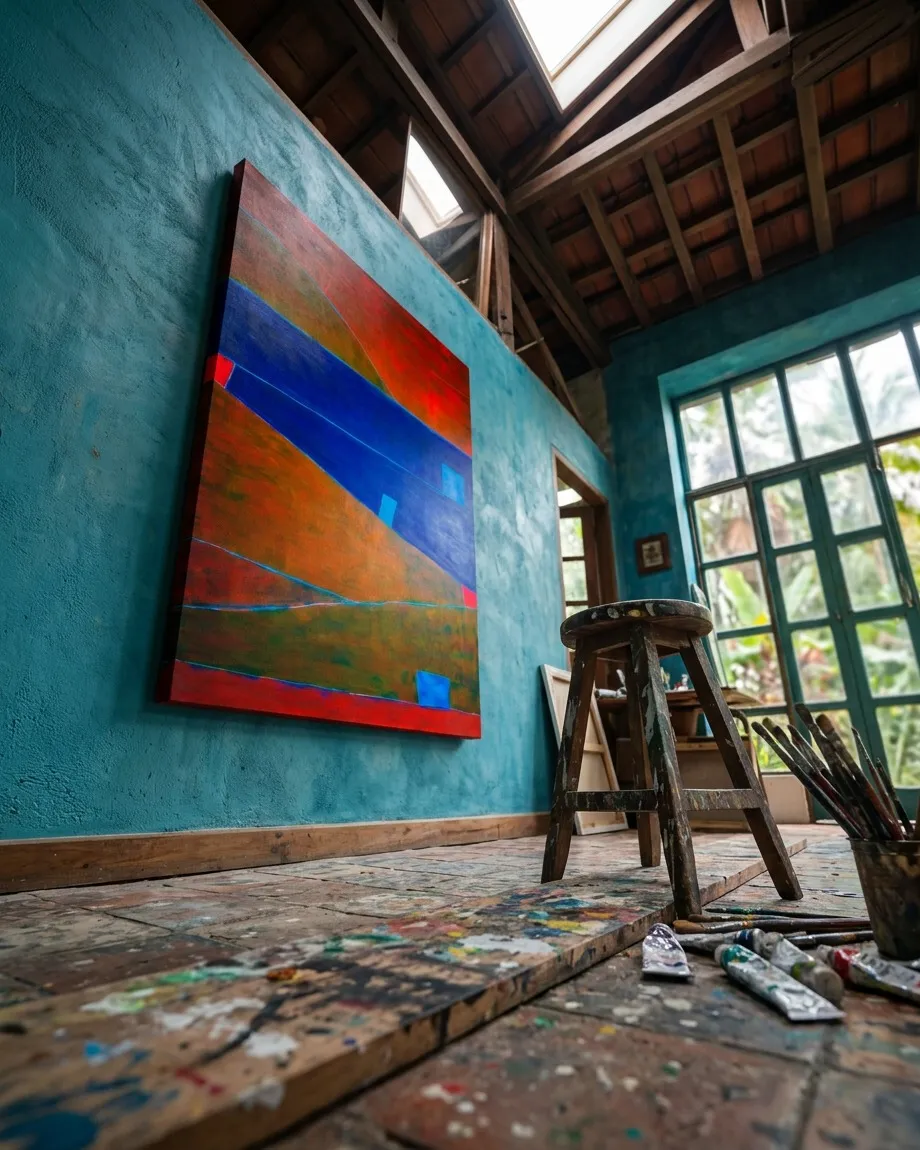
CLIVUS by Maurizio Valch Hanging in Studio | Abstract Art
To ascend the surface of CLIVUS is to traverse a topography that challenges the stability of the plane; the gaze is forced to climb slopes of ochre earth, crossing a dense channel of indigo blue that cuts through the composition, until reaching the latitude of a crimson sky that crowns the work. In this visual ascent, the rigidity of the small geometric blocks—the situs, or the urge to delimit a place of one's own—enters into constant friction with the dynamic instability of the clivus, the slope that threatens to slide the matter. This formal tension evokes the first settlements of the Mediterranean, where the transition from nomadism to Neolithic architecture required tracing the first dividing lines on the rough ground, a physical and conceptual effort to establish order against the wild elements.
When I sink the palette knife or the brush to trace the upper red line or define the blue profile of the hill, I am not seeking to add a decorative contour, but to make a true incision in the pictorial matter. I conceive these lines as open scars on the accumulated color, marks that refer to my memory of the landscape of Nerja, where the dryness of the Andalusian earth reveals strata of civilizations that have left their trace on the bare rocks. Observing these small blue rectangles emerging on the canvas, I often wonder if I have built shelters to safeguard the vibration of color or if, on the contrary, I have raised hermetic prisons that suffocate the expansion of matter.
This struggle between imposed order and latent overflow places the work in a territory of conflict that reverberates with the analytical psychology of Carl Gustav Jung, pioneer of the exploration of the collective unconscious and psychic geography, and the vision of Osho, the Indian mystic who denounced the mechanisms of social domestication that stifle vital force. The painting operates as a battlefield where the attempt at psychic integration, represented by those geometric blocks seeking their fit, faces the organic pulse of the large chromatic masses pushing from the edges. Following archetypal psychologist James Hillman, who proposed decentralizing the psyche into multiple voices, CLIVUS does not aspire to a harmonic resolution or a healing balance, but rather to keep the dramatic tension between the weight of the earth and the void that sustains it alive and exposed.
Standing in front of the work's hundred and thirty centimeters of height, I perceive how that deep blue dividing the canvas in half acts as an abyss or a mental plain demanding silence. I did not want it to be a clean plane; I applied successive glazes so that the underlying red would subtly soil the blue, letting the chromatic vibrations contaminate each other, just as occurs in the flow of memory where the past never remains isolated. This blue is not a sterile border but a permeable wall, a transitional space I painted with the patience of someone building a stone dike to contain the red tide pressing from the depths.
Finally, the contemplation of CLIVUS brings us back to the thought of George Gurdjieff, the mystic philosopher who warned of the mechanical sleep of the human being and the need for a conscious awakening. The blue block wedged in the lower red base presents itself as a visual enigma: is that shape submerged in the inertia of its own stability, or does it function as an indispensable conscious pivot to avoid being swept away by the torrent of color? Without offering reassuring answers, the work suspends the observer on a threshold where the Andalusian slopes transform into an inner topography, revealing that each dividing line on the canvas is but the trace of tireless human effort to give structure to chaos.
- Original artwork
- CLIVUS
- Actual dimensions
- 31.5 × 51.2 in / 80 × 130 cm
- Presentation
- Digital contextual visualization
Context references
large abstract painting bright living room · large scale abstract art · blue wall interior design decor · maurizio valch situs series · artist studio with skylight
About this visualization
This visualization places the artwork within an architectural context to help collectors and viewers imagine its presence in a real space. It is an interpretive reference, not an exact reproduction: the original work remains the sole authority for scale, color, surface and material presence.