Context study / ASCENSUS
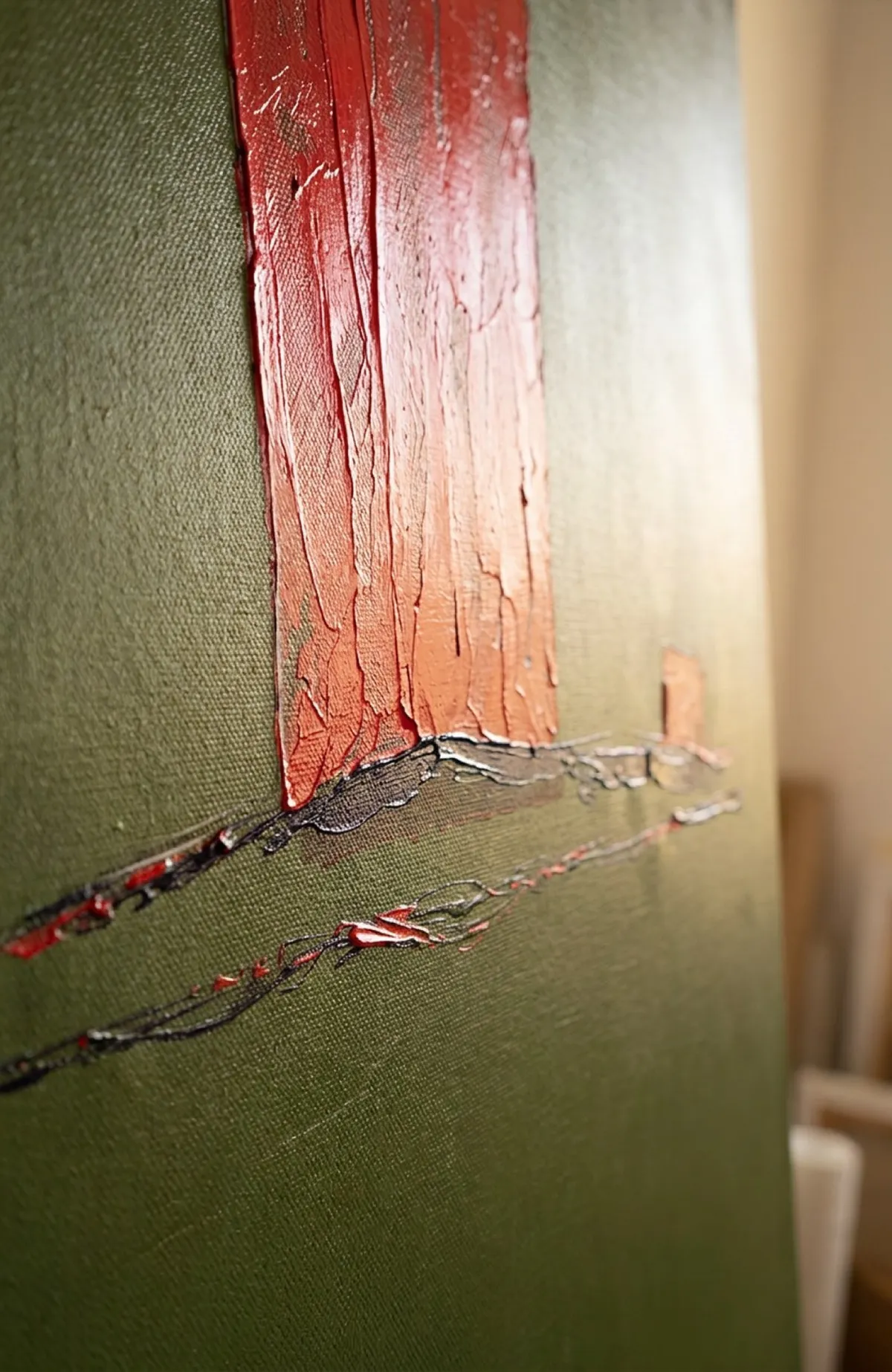
Close-up of Textures and Reliefs in ASCENSUS | Maurizio Valch
To contemplate "ASCENSUS" is to enter a system of strictly vertical forces, where gravity and elevation contest the dominion of a deep, dense olive-green surface. At the base of the canvas, a dark block, of a dense black pierced by subtle glints of indigo blue, rests heavily, claiming the inertia of the most terrestrial matter. In opposition, suspended over an extremely thin black line that acts as a horizon of absolute fragility, a large rectangular block of burning crimson red emerges. Faced with this arrangement, it is inevitable to recall the ideas of Gaston Bachelard (the French philosopher who explored the poetics of space and how the psyche inhabits cellars and attics), whose analysis of verticality invites us to ask whether this composition acts as a true axis mundi connecting the underworld with the sky, or if, conversely, it materializes an impassable border where matter has been permanently fractured into two incompatible states that only manage to coexist through the mediation of a silent abyss.
When confronting the canvas to bring this "ascent" to life, my main obsession was not to represent a path, but to physically construct the tension of its journey. I chose that vibrant, thick olive green to function as an absolute silence, an atmosphere that floods the entire pictorial space and presses the forms from the sides. When I incised the horizontal black line, I did not seek to divide the landscape into two symmetrical halves, but to establish a threshold of minimal support, a tightrope upon which matter could hold itself in suspense. I needed the crimson block to possess a tactile, almost heraldic presence, a thickness of oil paint demanding its own three-dimensional space to counteract the heavy, downward force of the lower block. This is not a mystical elevation achieved without effort; it is a purely physical conquest, where each trace of the palette knife betrays the effort of the color not to be devoured by the density of the background.
This struggle of textures opens a deep psychological fissure regarding the friction between inner awakening and the rigidity of the structures trying to contain it. From an analytical perspective, if we refer to the framework proposed by Carl Gustav Jung (the Swiss psychiatrist who mapped the journey of individuation and the integration of archetypes), the dark lower block could be interpreted as the Shadow or the primal unconscious, that repository of unintegrated impulses lying at the base of being, while the upper red monolith would stand as the unified Self that has achieved sovereignty. Yet, this luminous reading must be immediately confronted with the suspicion sown by George Gurdjieff (the Armenian mystic who denounced human automatism and the sleep of consciousness). One must wonder if that upper crimson block truly represents a state of "self-remembering" and a fully awakened consciousness, or if it is, in reality, another rigid, monumental, and illusory structure built by the sleeping man himself to convince himself of his supposed spiritual elevation—a red stone idol concealing the same mechanical lethargy beneath a guise of geometric order and triumph.
While working on the structure of the painting, my mind kept returning to the raw, silent forms of the ancient Mediterranean, to those dolmens, watchtowers, and dry stone monoliths that endure the passage of centuries under an unyielding sun. A profound vertigo assaults me when painting pure elevation: to raise a form on a stripped plane means leaving it unprotected, exposed to the absolute vacuum of that green background that seems to wait for the slightest hesitation to swallow it. That is why I introduced those two small red fragments flanking the main block. I do not know with certainty whether they represent the remains of a scaffolding that has fallen after the work was completed, if they act as small sentinels guarding the solitude of the large block, or if, more unsettlingly, they mark the beginning of an inevitable disintegration of the central structure, reminding us that every attempt at monumentality carries within it the seed of its own dispersion.
To untangle this ambivalence of form, it is revealing to cross paths with the thought of Osho (the Indian philosopher and mystic who defended the freedom of being against institutional molds), paying special attention to the nature of that red color pulsing in the painting. Crimson is vital energy par excellence, the untamed desire and existential current seeking to expand without limits; however, here it appears confined within the strict limits of a geometric rectangle. This paradox confronts us with the great question that "ASCENSUS" leaves unresolved: is this canvas the representation of a true escape route, a fissure through which the vital force finally manages to free itself from terrestrial inertia, or are we witnessing the visual record of an eternal, irresoluble tension between the wild impulse pushing upward and the geometric structure that, in trying to shape it, ends up enclosing it in its own prison?
- Original artwork
- ASCENSUS
- Actual dimensions
- 31.5 × 47.2 in / 80 × 120 cm
- Presentation
- Digital contextual visualization
Context references
close up oil painting texture · details of material abstract paintings · incisions in contemporary art · textured red oil paint · paint texture on canvas
About this visualization
This visualization places the artwork within an architectural context to help collectors and viewers imagine its presence in a real space. It is an interpretive reference, not an exact reproduction: the original work remains the sole authority for scale, color, surface and material presence.