Studio Notes
When the Ground Appeared
Maurizio Valch's series explore territory as an originating condition (PRIMORDIUM), a space of emergence (EMERSIO), and a threshold of transformation (LIMINA). His painting examines how consciousness and societies inhabit a place, emerge, and traverse periods of indeterminacy.
The Genesis of Territory within the Series
In the trajectory of Maurizio Valch's series, there is a moment when space ceases to be solely suspension, dream, or distance. The ground appears. Not as a recognizable landscape or a concrete geography, but as a structure capable of supporting, separating, and ordering.
This shift does not eliminate what came before. The dream remains, but it begins to acquire weight. The light is still uncertain, though it now falls upon more defined surfaces. Forms cease to float and begin to occupy a position. A question then arises, running through these series: what happens when consciousness can no longer remain suspended and must occupy a place?
In the PRIMORDIUM series, territory emerges as an originating condition. It is not yet a human space in the fullest sense, but it already contains the possibility of being inhabited. The chromatic fields, large constructions, and spatial divisions suggest a world preceding all explanation, a primary ground upon which something begins to organize itself.
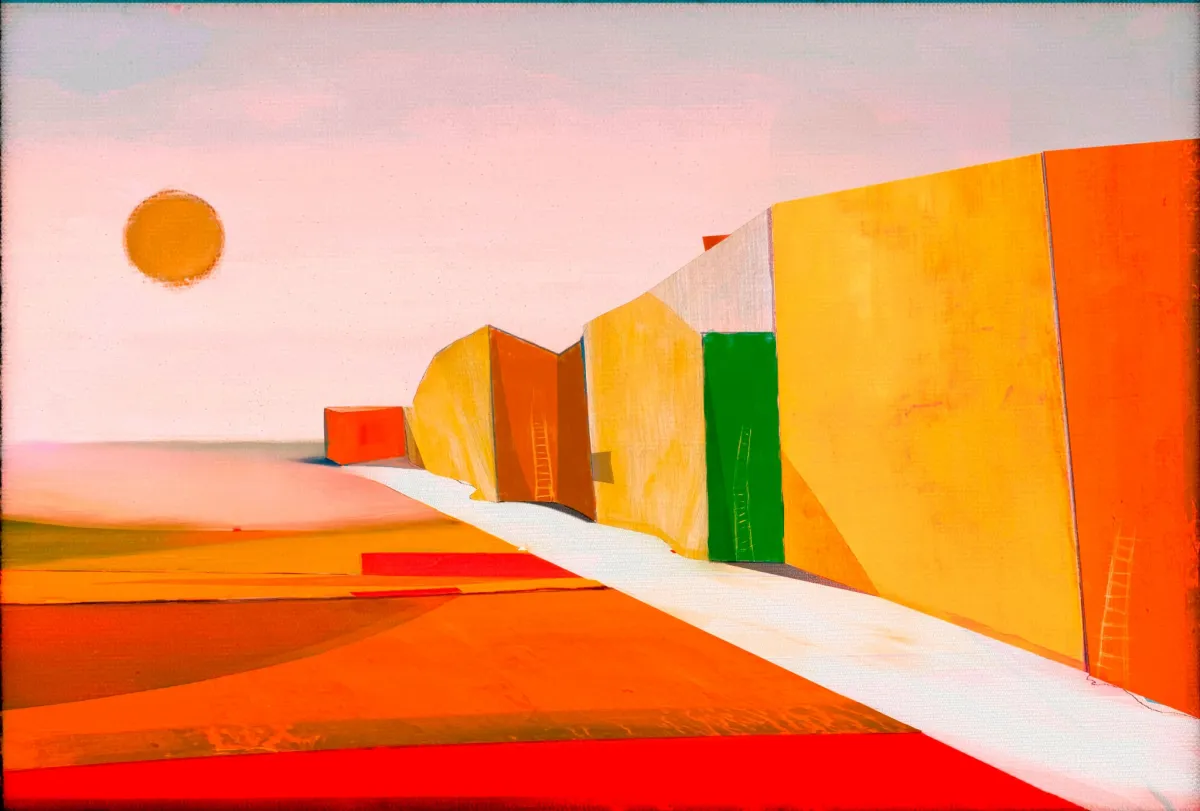
Work from the PRIMORDIUM series by Maurizio Valch.
In this work, perspective guides the gaze between large vertical forms. The structures resemble buildings, walls, or mineral bodies, though no single interpretation fully fixes them. To one side, a sphere introduces a silent presence. Along the composition, small stairways appear, almost absorbed by the architecture.
The PRIMORDIUM series does not represent origin as a pure or pristine moment. The origin already contains divisions, differences in scale, obstacles, and possible directions. The ground is not neutral: it conditions everything that can be built upon it.
From a broader perspective, this idea does not belong solely to the individual. Every person is born within a pre-existing territory: a language, a culture, a history, a social structure, an inherited way of understanding the world. Before choosing, a ground already exists. Before formulating an identity, there are already limits, paths, and constructions that orient one's gaze.
The question is not about escaping this ground, but about recognizing it.
In the EMERSIO series, the relationship with territory changes. It is no longer solely about what sustains, but about what begins to appear. Forms separate from the background, seek a position, and enter into tension with the space that contains them.
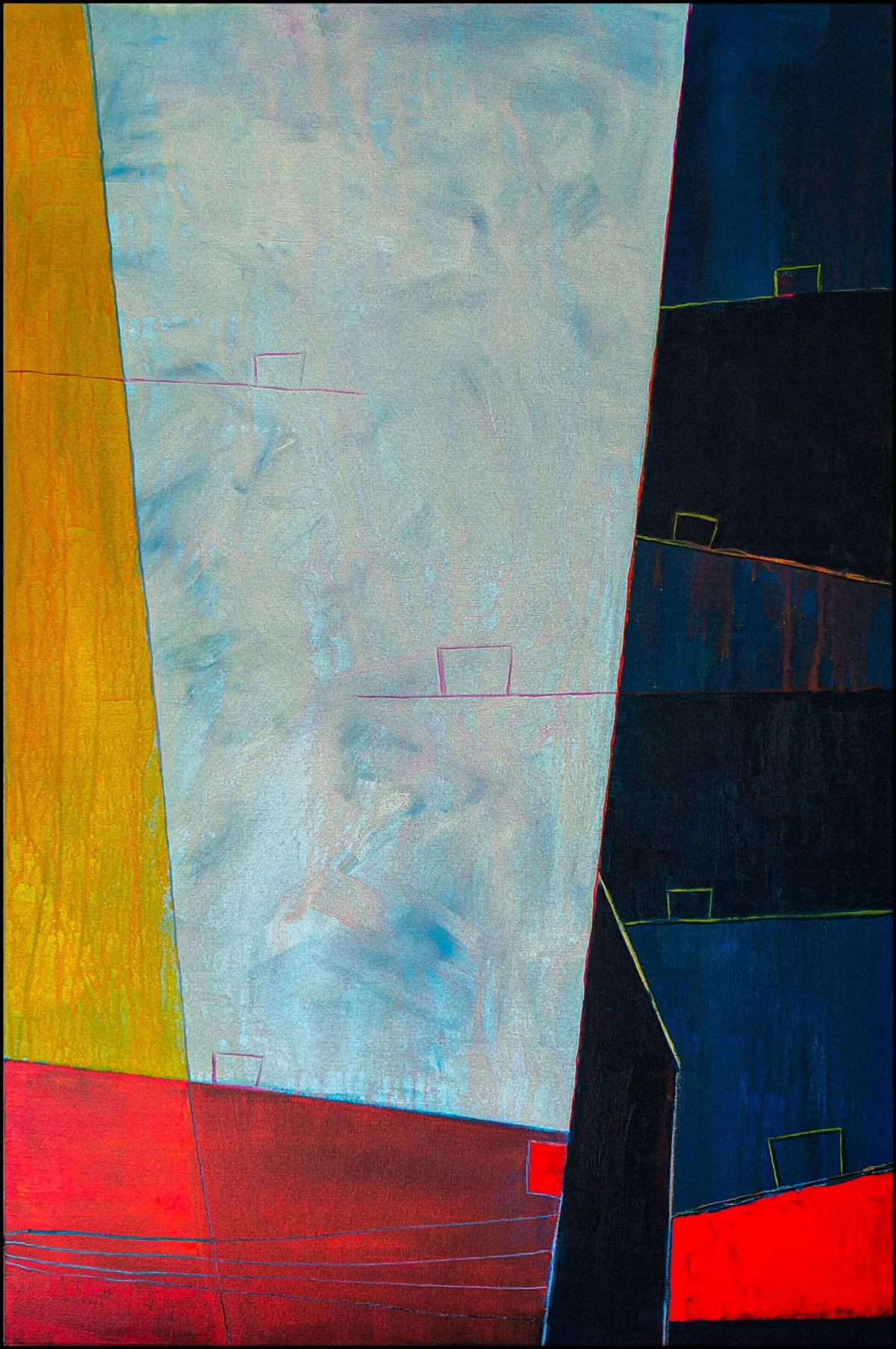
Work from the EMERSIO series by Maurizio Valch.
In this vertical composition, large chromatic zones confront each other and incline. Between them appear small linear forms, resembling doors, frames, or signals. Their scale introduces a human dimension without resorting to figuration.
The EMERSIO series explores the moment when something ceases to remain hidden. This can be a form, a consciousness, a contradiction, or a possibility still fragile. To emerge does not mean having reached a definitive form. It means abandoning a previous condition and becoming exposed.
Therefore, emergence entails risk. That which emerges loses the protection of the undifferentiated. It must occupy a place, establish a relationship with its surroundings, and assume the consequences of becoming visible.
This tension can also be transferred to collective life. A society changes when certain experiences, conflicts, or voices cease to remain beneath the surface. The emergent alters the distribution of space. It compels a re-evaluation of what seemed stable and reveals that every order contains excluded, silenced, or yet-unrecognized zones.
Transformation does not occur solely when something new appears. It also happens when the previous territory can no longer organize itself in the same way.
In the LIMINA series, this tension reaches the threshold. Space becomes more unstable, materiality takes on greater prominence, and divisions lose some of their rigidity. Drips, marks, interruptions, and forms that seem to be entering or exiting the surface appear.
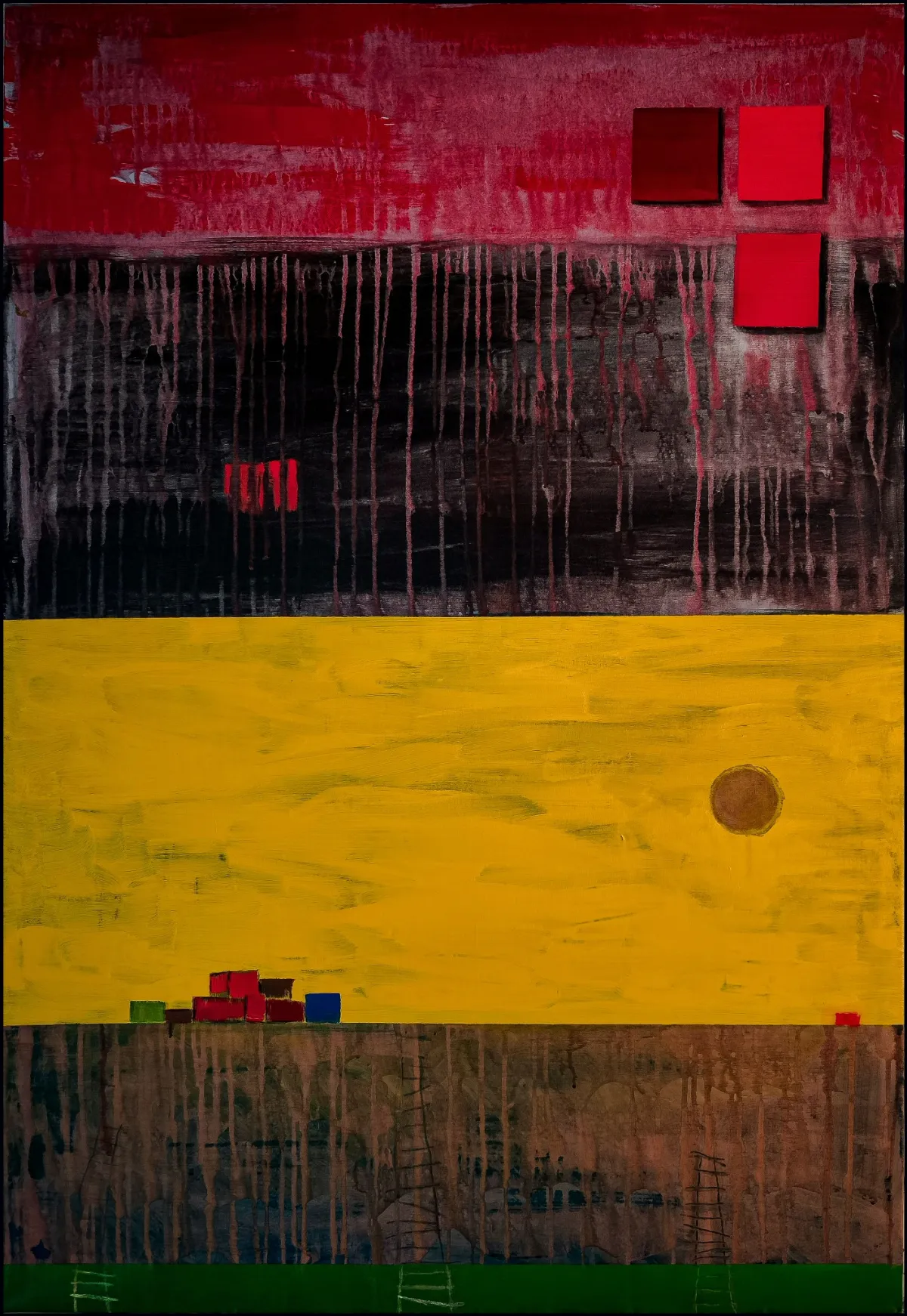
Work from the LIMINA series by Maurizio Valch.
Here, territory can no longer be understood solely as a base. It is traversed by layers, descents, infiltrations, and zones of pressure. The upper blocks, small groupings, and stairways distributed at different levels introduce a sensation of continuous transit.
The word limina refers to the threshold. A threshold is neither a place of arrival nor departure, but the uncertain zone between the two. There, categories cease to be stable. The interior and exterior become contaminated. The past still acts, but the future has not yet taken shape.
The LIMINA series precisely occupies this region. In it, painting begins to show that every structure contains fissures and that all transformation demands passing through a period of indeterminacy. There is no profound change without a loss of orientation.
This principle extends beyond the personal realm. Societies also cross thresholds. There are moments when inherited ideas cease to respond to reality, yet a language capable of replacing them does not yet exist. In these periods, tension, conflict, and the need to choose intensify.
The threshold can generate fear because it forces the abandonment of familiar forms of identity and belonging. But it also opens the possibility of responding in a different way.
Between the PRIMORDIUM, EMERSIO, and LIMINA series, a trajectory is built that moves from ground to emergence, and from emergence to transformation. This is neither a linear evolution nor a closed succession. Each series preserves the questions of the preceding ones.
The origin continues to act in that which emerges. The emergent destabilizes the territory. And the threshold reveals that no structure is definitive.
In this trajectory, consciousness does not appear as an illumination separate from the world. It arises within the material, historical, and social conditions that have shaped it. It becomes possible when the individual recognizes the ground they inhabit, discerns what begins to emerge, and accepts traversing the uncertainty of change.
Territory, then, is not only the place where transformation occurs. It is also that which must be transformed.