Studio Notes
The Skin of Territory
Maurizio Valch's STRATA series explores territory as a living surface, a skin that retains the marks of memory and transformation. Through incisions and blocks, the painting merges individual experience with collective structures, prompting reflection on consciousness and responsibility.
Memory, Incision, and Matter in the STRATA Series
In the STRATA series, territory ceases to be a distant stage and begins to behave as a living surface. The painting becomes skin, an archive, and a field of pressure: it preserves what has passed through it, displays its cuts, and compels us to look at what remains beneath the appearance of stability.
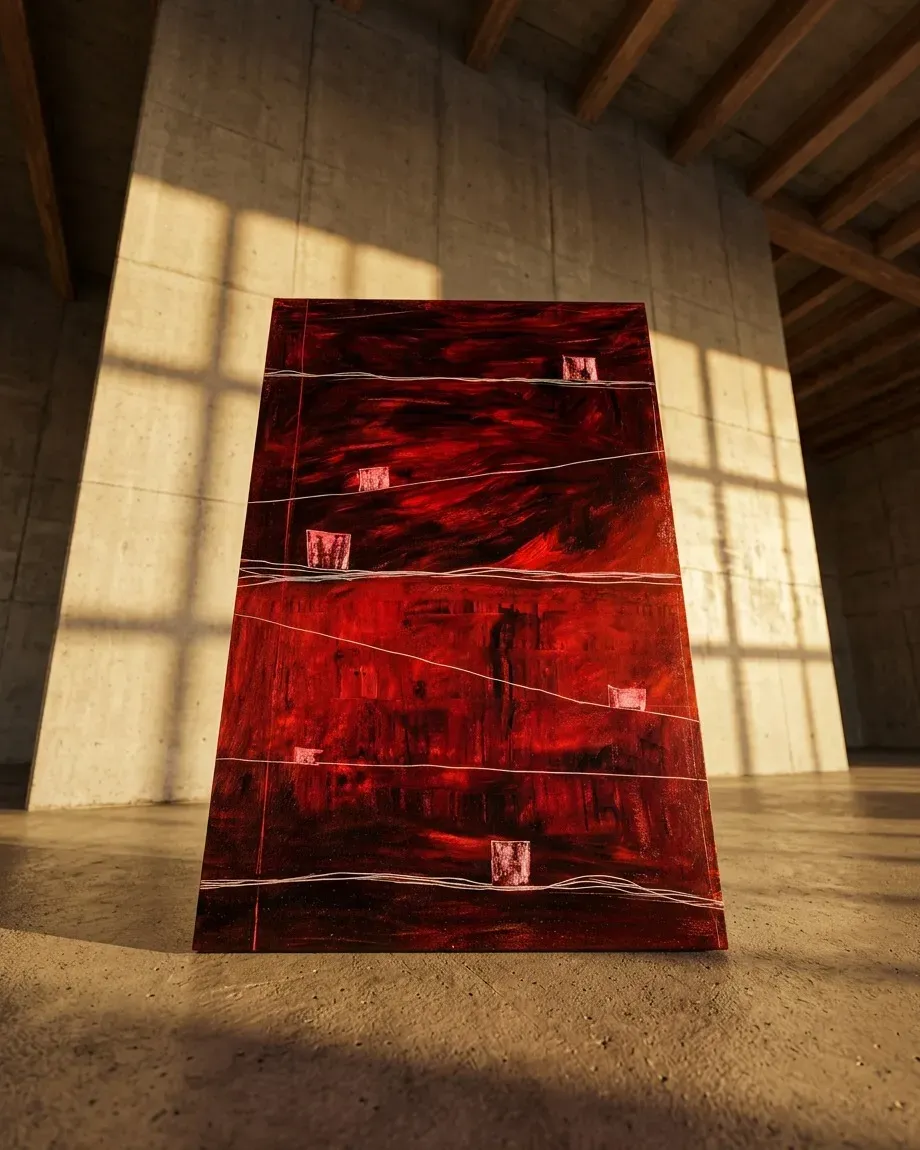
Artwork from the STRATA series. Overall view in an architectural space.
Territory as Surface
In Maurizio Valch’s previous series, territory appeared as dream, origin, horizon, apparition, and threshold. In the STRATA series, this journey becomes concentrated. The landscape is no longer viewed from a distance; it approaches the body and acquires a tactile quality. The chromatic layers may recall compressed earth, eroded walls, or stretched hides. However, none of these associations fully exhaust the work. Territory functions simultaneously as exterior matter, human memory, and social structure.
This dual nature allows the STRATA series to avoid the opposition between inner and outer worlds. What happens within an individual is shaped by shared languages, beliefs, experiences, and conflicts. In turn, every inner transformation modifies how one responds to others. The pictorial surface thus becomes the place where these two dimensions cease to be separate.
The large red, black, and dark fields do not constitute a passive background. They contain movements, remnants of earlier layers, erased areas, and variations in density. Beneath an apparent chromatic unity, the material retains differences. The painting does not conceal its process; it sediments it.
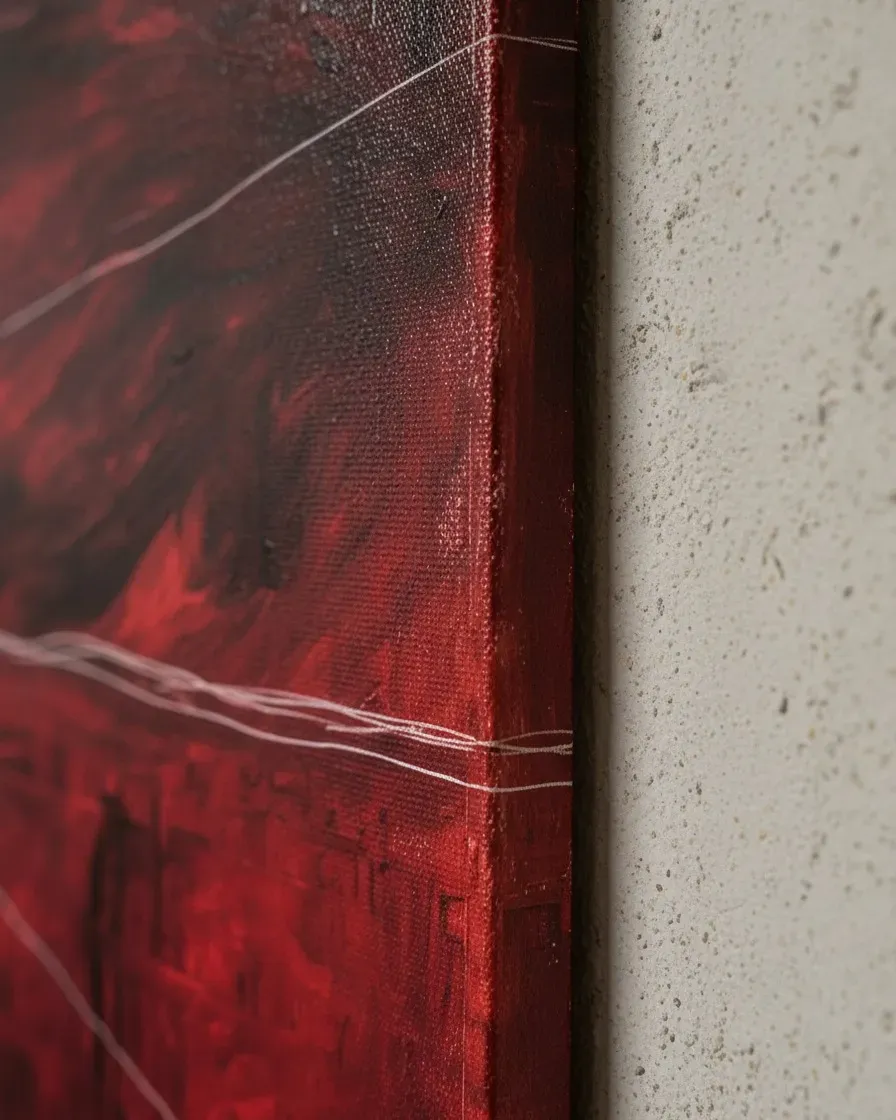
Detail of an edge, lines, and incisions on the red surface.
Incision as Memory
The lines that traverse the artworks of the STRATA series do not behave like traditional contours. They do not describe objects or organize a stable perspective. They cross the surface, change direction, overlap, and at times, continue over the edges. These are marks that physically alter the continuity of the pictorial field.
Incision can be understood as a form of memory. Not because each line corresponds to an identifiable recollection, but because it introduces a mark that can no longer be completely separated from its support. Memory is not added to an intact surface; it modifies it. It can open a path, create a fracture, or leave a minimal sign whose cause is no longer visible.
In this sense, the lines also approximate the idea of a map. But these are not maps intended to guide the viewer to a precise location. They record incomplete journeys, detours, crossings, and boundaries. They are cartographies of an experience that cannot be reconstructed linearly.
Individual memory shares this condition with collective memory. Societies retain marks even when they try to hide them, simplify them, or replace them with a uniform narrative. Historical wounds do not disappear simply by being unnamed. They persist in the structures, habits, and divisions that organize common life.
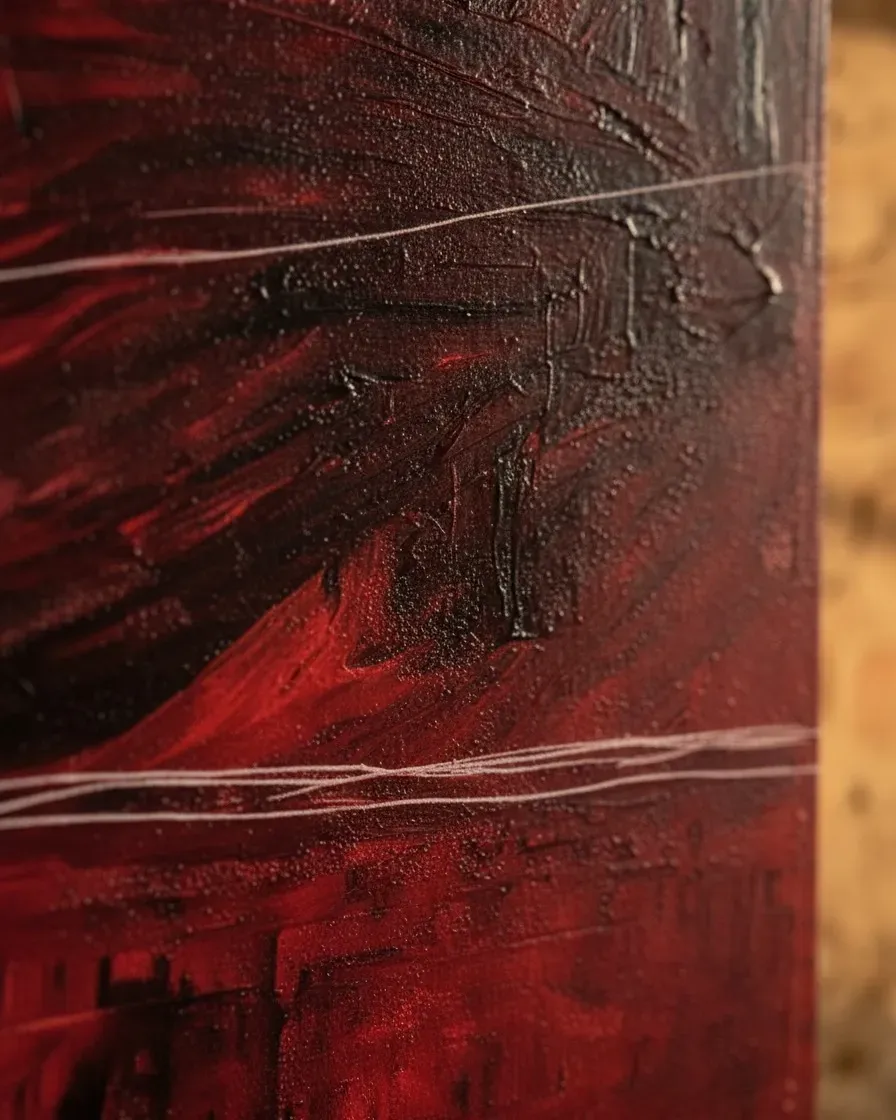
Matter, relief, and superimposed lines in the STRATA series.
Blocks, Beliefs, and Resistance
Alongside the incisions, blocks and rectangular forms appear. Their presence is restrained but alters the distribution of the entire space. They can suggest architectural remnants, monoliths, or hardened bodies. Within the language of the STRATA series, they can also be read as structures of thought: convictions, beliefs, or inherited forms that have acquired weight and resistance.
A belief does not have to be religious or rational to harden. It can be an idea about identity, success, belonging, power, or one's place in the world. When it ceases to be examined, it becomes a structure that organizes the territory from within. The blocks in the series do not illustrate a specific belief; they make visible its material condition, its capacity to occupy space and exert pressure.
The issue is not simply destroying these structures. Some sustain, others protect, and others allow for continuity to be built. Consciousness begins by distinguishing which ones remain necessary and which have become obstacles. This discernment requires a capacity to respond that cannot be delegated to collective thought.
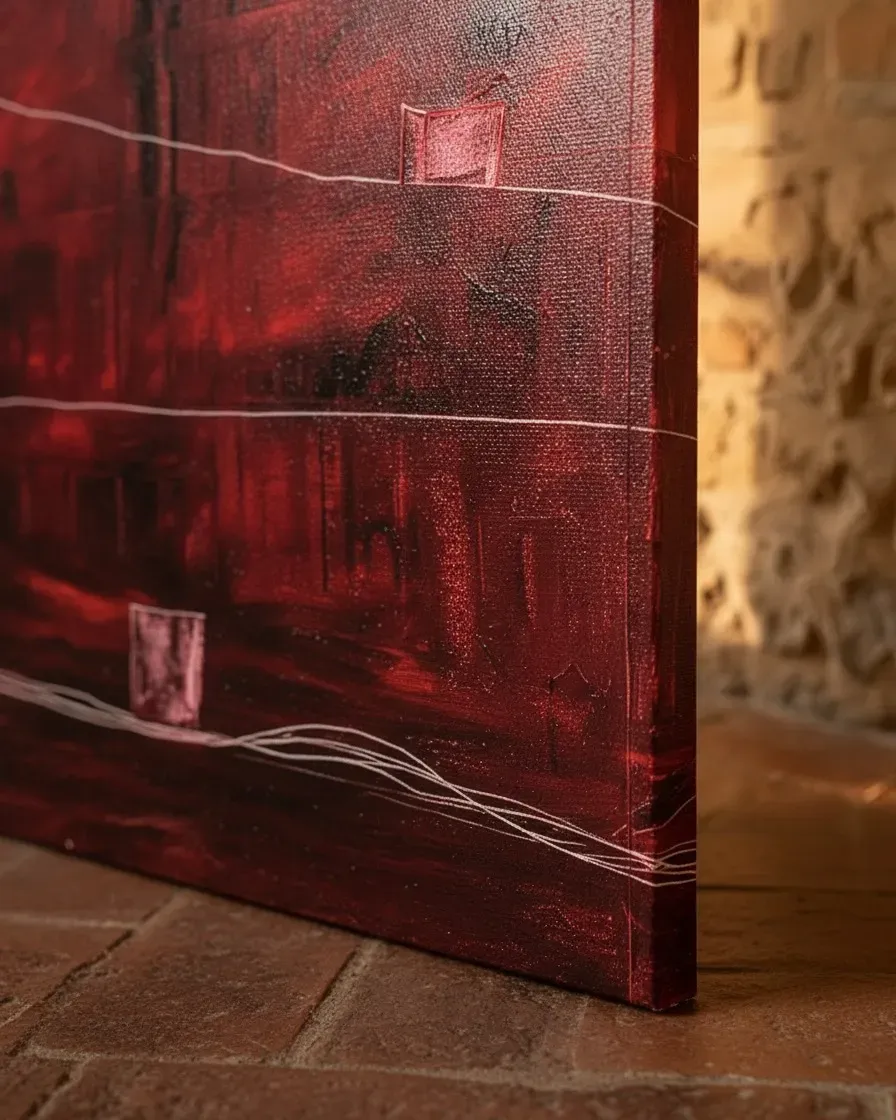
Blocks, horizons, and strata: structures that exert pressure on the territory.
A Skin That Does Not Hide Its Cuts
The comparison between territory and skin is especially significant in the STRATA series. Skin is not merely a boundary. It is a surface of contact: it receives the world, regulates distance, and preserves signs of time. It can protect, but it can also be traversed.
In these works, the painting approaches a tanned and stretched hide. The dark colors, reliefs, drag marks, and tense lines produce a surface that appears to have endured pressure. It does not literally represent a human body, but it introduces a corporeality that is difficult to ignore.
This condition prevents one from viewing territory as something neutral. Every territory has been used, divided, named, and disputed. Every body has also been interpreted by external forces. The STRATA series brings together both realities without turning them into a closed equivalence: the earth can resemble a body, and the body can contain its own geology.
Consciousness and Responsibility
The STRATA series does not present consciousness as a pure elevation or a separation from the world. It situates it within the layers that have formed the individual. Being conscious implies recognizing what has been inherited, what has left its marks, and what continues to act from unexamined zones.
This recognition has an external consequence. Stepping out of a collective current of thought does not mean isolating oneself from society, but relating to it in a less automatic way. Freedom is not solely about choosing, but about understanding from which strata one is choosing and assuming responsibility for that response.
Therefore, the fractures in the STRATA series should not be understood only as damage. They can also open up a possibility. A completely closed surface does not allow its layers to be seen. The incision interrupts continuity, but in doing so, it reveals that the territory could be organized differently.
In the STRATA series, matter does not illustrate an idea; it thinks through its cuts, densities, and resistances. Territory becomes a skin where personal and collective experiences leave their marks. Here, consciousness does not erase previous strata. It learns to recognize, traverse, and respond from them without being entirely determined by their weight.