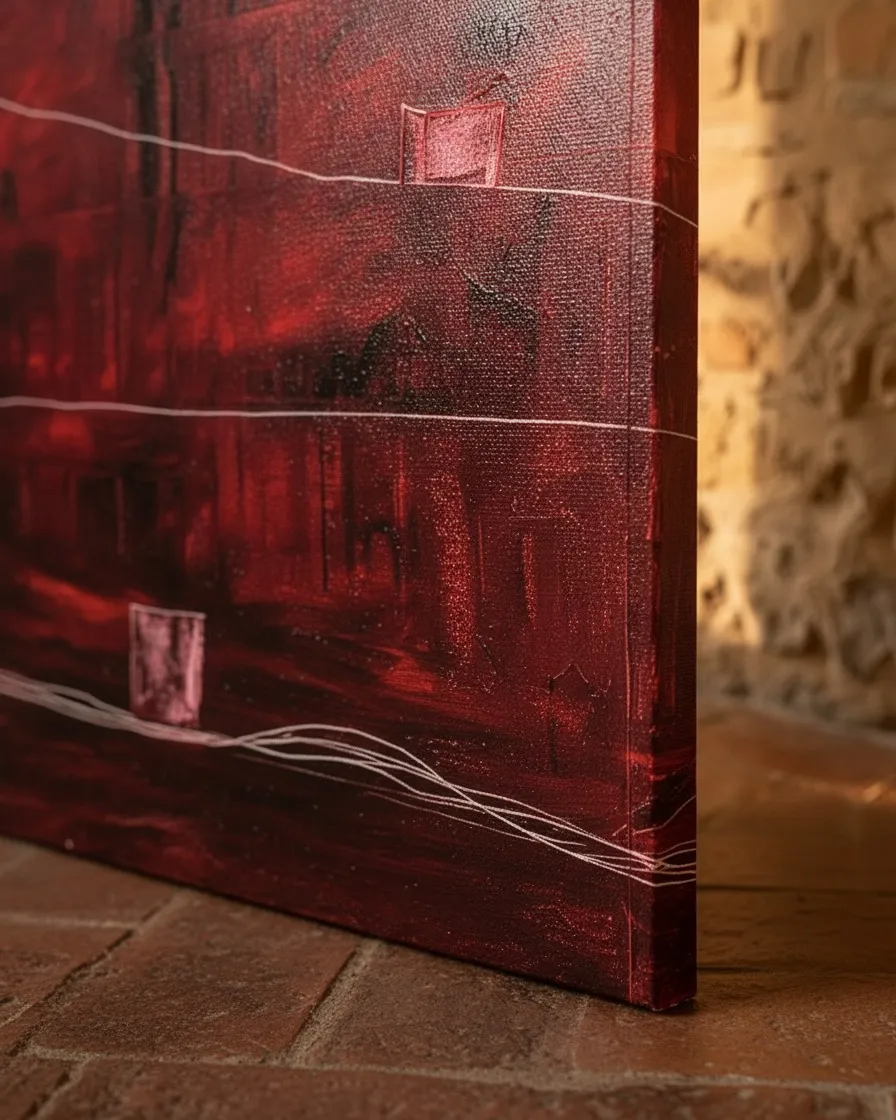
What kind of journey is suggested by a line that, instead of being drawn upon the canvas, carves its way by scraping the surface? In these compositions, the line does not add information; it is a subtractive gesture. Through incisions, Valch scrapes away the dense red layer of oil to reveal the underlying support. Small cubes or geometric niches, carved directly into the thick material, hang from this subtractive stroke. There is no representation of forms here, but rather an excavation: a navigational map discovered by subtraction, allowing the rustic light to interact with the relief.
This shift from addition to subtraction evokes a deeper transition, akin to the dynamics of myth described by mythologist Joseph Campbell in his seminal work The Hero with a Thousand Faces (1949). In the chapter on crossing the first threshold, Campbell explains how adventure demands that the individual leave the safe boundaries of their familiar environment to enter an unexplored territory. In Valch's practice, the orderly studio functions as that safe, controlled world, while the threshold begins where the work assumes its physical autonomy, separating itself from the shelter of the easel and the creator.
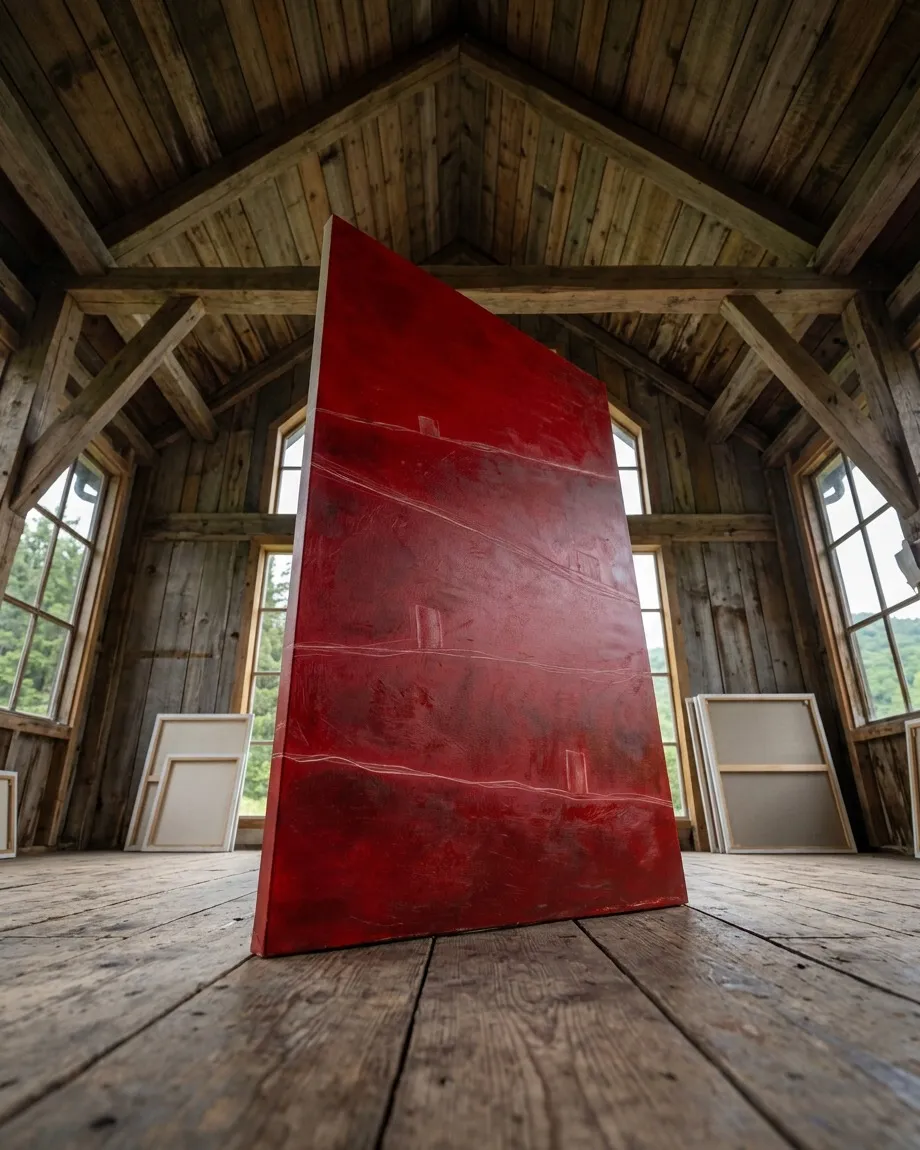
This detachment is fully realized when the canvas stands on its own outside the studio. In the work ATHAR, the vertical format dispenses with walls and easels to stand directly on the plank floor of a barn. Positioned under a timber beam structure and exposed to the natural light streaming through large windows, the painting acts as an autonomous monolith. It no longer functions as an object of passive contemplation in a white gallery, but as a physical threshold that absorbs the irregularities of the open air and the shifting light of day.
A similar tension manifests in DISPERSA. There, the edge of the canvas rests directly on terracotta bricks, in dialogue with the warm sidelight brushing against a rough stone wall. By relinquishing control over the environment, the artist surrenders the work to its own physical and spatial laws. The return to the studio, now stripped of the red density that ordered the day, is experienced not as a loss, but as a return to an open geography—an empty space awaiting its next question.