The Wounded Mark: The Paradox of the Line
Drawing a line is always an act of violence. Before the pencil, the stylus, or the plow touches the surface, there exists an intact continuity, a space that possesses itself in sovereign undifferentiation. Upon introducing the mark, this totality fractures: the inside and outside, ownership and exposure, the measured and chaos emerge. The map is thus born from a wound inflicted upon the territory. Yet, in our contemporary obsession with recording and interpreting every millimeter of our existence, we have committed an error of scale. We have mistaken the line on the map for the ground we walk upon, burying the material fact beneath a dense sediment of theoretical and psychological interpretations. At what point did the path cease to be earth and become a metaphor for the self?
Suspicion of this excess of guides and maps runs deep beneath the surface of modernity. The geographer who longs to reduce the cosmos to a series of legible coordinates and the educator who seeks to police every movement of the child's body share the same temptation: to eliminate uncertainty. But uncertainty is the only space where individual freedom can organize itself. When everything is pointed out, when the path is paved by a prefabricated epic or by a psychological theory that explains the origin of our every stumble in advance, the world narrows. The naked fact—the crunch of gravel underfoot, the texture of a wooden plank, the color of damp ash—becomes buried by mental noise.
To interrogate this tension, we must turn to two figures who operated at the boundaries of this paradox: Alexander von Humboldt, the man who measured the physical immensity of the globe so as not to succumb to its vertigo, and Maria Montessori, the woman who confined the entire universe within the strict limits of a prepared classroom, convinced that only physical boundaries protect the freedom of the spirit. At the intersection of their gazes, and under the material friction of Maurizio Valch's painting, it is revealed that true experience does not consist of accumulating miles or deciphering theoretical labyrinths, but of standing upon the clean fact of one's own step.
I. The Seismograph of the Abyss (In the Voice of Alexander von Humboldt)
At five thousand meters above sea level, the air is not breathed; it is bitten. It is a thin substance, cold as ground glass, that makes gums bleed and eyes burn in their sockets. I remember the ascent of Chimborazo not as a heroic exploit, but as a systematic humiliation of the body before the scale of stone. With every step we took, my companion Bonpland and I felt the mountain expelling us through the wind. The fog was not water vapor; it was a solid mass that erased distances, a grey shroud that reduced the world to the three spans of basalt stretching beneath our boots.
Why did I measure? Why did we carry those heavy mercury barometers, the hygrometers, and the brass compasses that froze our hands upon direct contact? It was not out of academic pride. It was out of fear. The helplessness one experiences before the giantism of the earth is a dissolving force; if you do not interpose an instrument between your eyes and the abyss, the mind crumbles. The number, the atmospheric pressure expressed in inches of mercury, the isothermal line hastily drawn in the notebook wet with drizzle—these were my lifelines. The map was an incision I made upon the void to force it to speak a human language.
Yet, I remember a moment, near the summit, where the thermometer broke. The mercury spilled into a crevice of the volcanic rock, forming tiny silver spheres that trembled in the wind. For a few minutes, I stood motionless, stripped of my numbers. There was no recorded temperature, no calculated altitude. There was only the black rock, the volcanic ash clinging to my wet clothes, and the unspeakable weight of my own body suspended between the sky and the abyss. It was in that moment of absolute exposure, devoid of the guidance of my instruments, that I understood the mountain was not an object of study, but a presence that barely tolerated me. In losing the measure, the world recovered its unsettling and silent immensity.
II. The Liturgy of the Boundary (In the Voice of Maria Montessori)
I observe the young girl's hand. It is small, plump, but her fingers move with the precision of a surgeon. There is no hesitation in her gesture. Between her thumb and index finger, she holds a cylinder of beech wood, polished until the grain resembles a stream of water frozen in time. The exercise is simple in appearance: she must insert each of the ten cylinders into its corresponding hole in the wooden block. There is no rush, no reward for success, no punishment for failure. The silence that has settled in the classroom is not the silence of submission; it is a physical, thick silence that can be felt with the fingertips, like felt or chalk.
The secret lies in the boundary. The wooden block contains its own correction: if the child places a cylinder in a hole that is too large, she will ultimately lack space for the last one. I do not need to intervene. The authoritarian teacher who points out the mistake commits an act of pedagogical violence that atrophies development; they replace the child's experience with their own interpretation of the world. Any unnecessary help is an obstacle to life. The prepared material is the true teacher because it does not judge; it only presents the physical resistance of matter.
When the child finds that the last cylinder does not fit into the remaining space, she does not cry or become frustrated. She looks at the block. She runs the tip of her finger along the edge of the wood. That touch is the birth of intelligence. There is no psychology here, no theory of trauma; there is a physical fact that requires a physical solution. The child removes the cylinders and begins again. In that austere repetition, free from external praise and well-meaning guides, the individual self-organizes. Her freedom does not consist of doing what she wants in a space without boundaries, but of inhabiting the limit with a concentration so pure that time itself seems to stop. The child does not need to be guided; they need to be allowed to collide with the reality of things.
III. Colloquy on the Eroded Plain
The setting is a non-place of horizontal horizons, a plain where the ground is composed of a mixture of dry clay and fine ash. In the background, suspended like a plane of absolute color, rises a wall that vacillates between crimson red and dark grey, crossed by fine golden lines. In this space, two timeless travelers meet.
Alexander von Humboldt: (Leaning on a theodolite tripod, looking at the cracks in the ground). Travel is the only form of knowledge, my dear friend. I do not speak of the mere movement of the body, but of the physical confrontation with the scale of the planet. The map we draw is a peace treaty with nature. Without that network of coordinates, human beings wander helpless, lost in an immensity that does not recognize them.
Maria Montessori: (Sitting on a small wooden stool, observing a handful of ash she holds in the palm of her hand). Helplessness, Alexander, is not cured by the immensity of your maps, but by the intimacy of contact. Your expeditions cross continents, but I fear that by drawing so many lines upon the earth, they end up preventing humanity from looking at what is beneath their feet. An excess of maps destroys the capacity for wonder. If we give the child the map before they have walked the distance, we have stolen their discovery.
Humboldt: (Smiles with some weariness). Discovery is an exploit, an effort of the spirit that imposes itself upon matter. When I ascended Chimborazo, every measurement was a victory of human reason over the hostility of the environment. We did not seek to dominate the mountain, but to integrate it into the grand harmony of the cosmos. How can we organize ourselves if we do not understand the global forces that govern our atmosphere?
Montessori: Harmony is not conquered on the summits, but in the silence of an ordered space. You speak of the hero's exploit, but that is a trap of the ego. The philosopher Jiddu Krishnamurti maintained that "the observer is the observed". When you measure the current or the height of the mountain, you are not measuring nature; you are measuring yourself against it. If the observer is separated from the observed by so many instruments and theories, the pure fact disappears. For me, the true journey occurs within a three-meter radius, where the child manipulates matter with hands clean of theoretical prejudices.
Humboldt: And what do we do with ignorance, then? Is cartography not the tool that frees us from myth and superstition? The map is a beacon.
Montessori: The map can also be a paper prison. Remember the words of Lao Tzu: "To acquire knowledge, add things every day. To attain wisdom, subtract things every day." Your expeditions accumulate data, botanical specimens, barometric readings... an infinite inventory of the world. But sometimes, to see the clean fact, one must strip away the theory. One must subtract. The child who learns to be silent and to concentrate is not accumulating information; they are emptying their mind of unnecessary noise so that the material itself may speak to them. By letting go, all is done. Your endeavor to guide humanity through science can become a subtle form of tyranny if we do not leave room for each individual to discover their own limit without anyone holding their hand.
Humboldt: (Observes the ash slipping through Montessori's fingers). Perhaps you are right. In my eagerness to measure the fire of the volcano, I sometimes forgot the warmth of the cold ash.
IV. Unearthed Matter: Maurizio Valch and the Ash
This imagined dialogue finds its plane of physical consistency in the visual work of Maurizio Valch. His painting is not a representation of ideas, but a material event that rejects easy psychological interpretation. In his STRATA series, the surface of the canvas does not behave like a window to the world, but like a wall that retains the traces of its own geological history. It is a skin that has been wounded, scraped, and incised, revealing that painting, before being an image, is a body.
Let us take the artwork Un solo paso en la ceniza as our starting point.
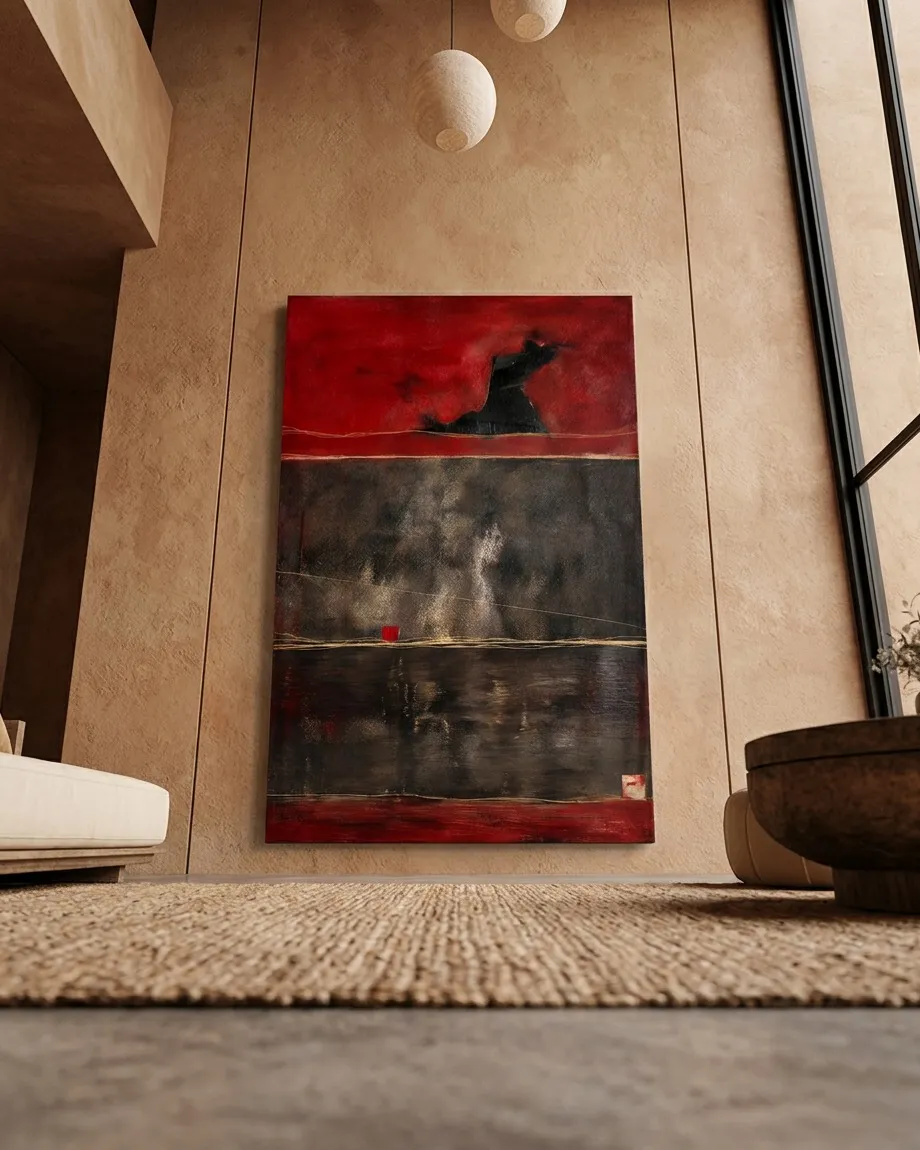
"Un solo paso in la ceniza" (80 x 120 cm) by Maurizio Valch, integrated into a contemporary space of sober lines and warm textures.
The painting is organized in a severe architecture of strata. In the upper third, a band of crimson red, dense and textured, vibrates with the temperature of a latent combustion, crowned by a black, monolithic silhouette that rises like the ruin of a charred structure. Below this crown of fire, the painting sinks into an immense ashen field, a dark grey that evokes the sediment of charcoal and the dust of soot. This surface does not represent emptiness; it is the matter itself that has laid down its violence to settle into the gravity of residue.
The incision here is not a drawn line; it is a physical wound in the paint. Valch scrapes the surface with palette knives and styluses, opening horizontal furrows that reveal underlying layers of old gold and hidden light. These horizontal lines function as geographic boundaries, taut strings that prevent the weight of the dark mass from collapsing. There is an obvious affinity here with Antoni Tàpies, for whom the pictorial surface was a wall loaded with inscriptions and scars, and with Richard Diebenkorn, whose abstract color fields retain the memory of an inhabited territory.
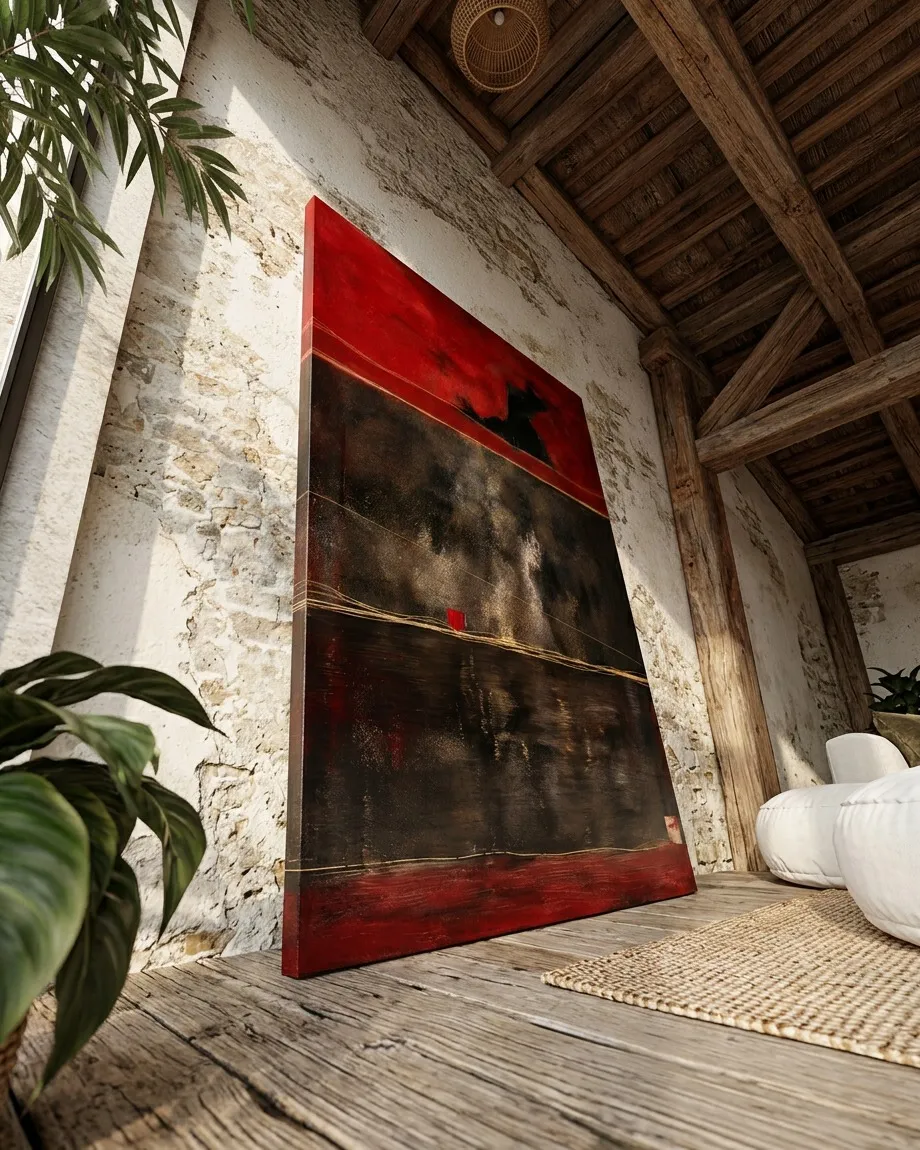
Integration of 'Un solo paso en la ceniza' within a warm environment defined by wood and organic textures.
The artist, having walked the Camino de Santiago five times, seems to have developed a deep suspicion toward the epic of the external path. The hero's journey, so dear to Joseph Campbell's narrative and to Humboldt's own expeditionary spirit, is called into question. Continuous walking does not always lead to enlightenment; often, the excess of miles only serves to feed the mythology of the self. The "clean fact" of the step is buried by the mystical or psychological interpretation of the walk. As Seneca warns in his letters: "We suffer more often in imagination than in reality." The walker's suffering is not in the blister on their foot, but in the theory they build around their own fatigue.
By placing the canvas resting directly on the wooden floor, stripped of the solemnity of the easel or protective frame, the work integrates into the scale of the everyday. It does not ask to be revered; it asks to be inhabited. Its physical roughness demands an exercise in tactile listening that returns us to the experience of the Montessori classroom: matter corrects itself and offers us its own limits.
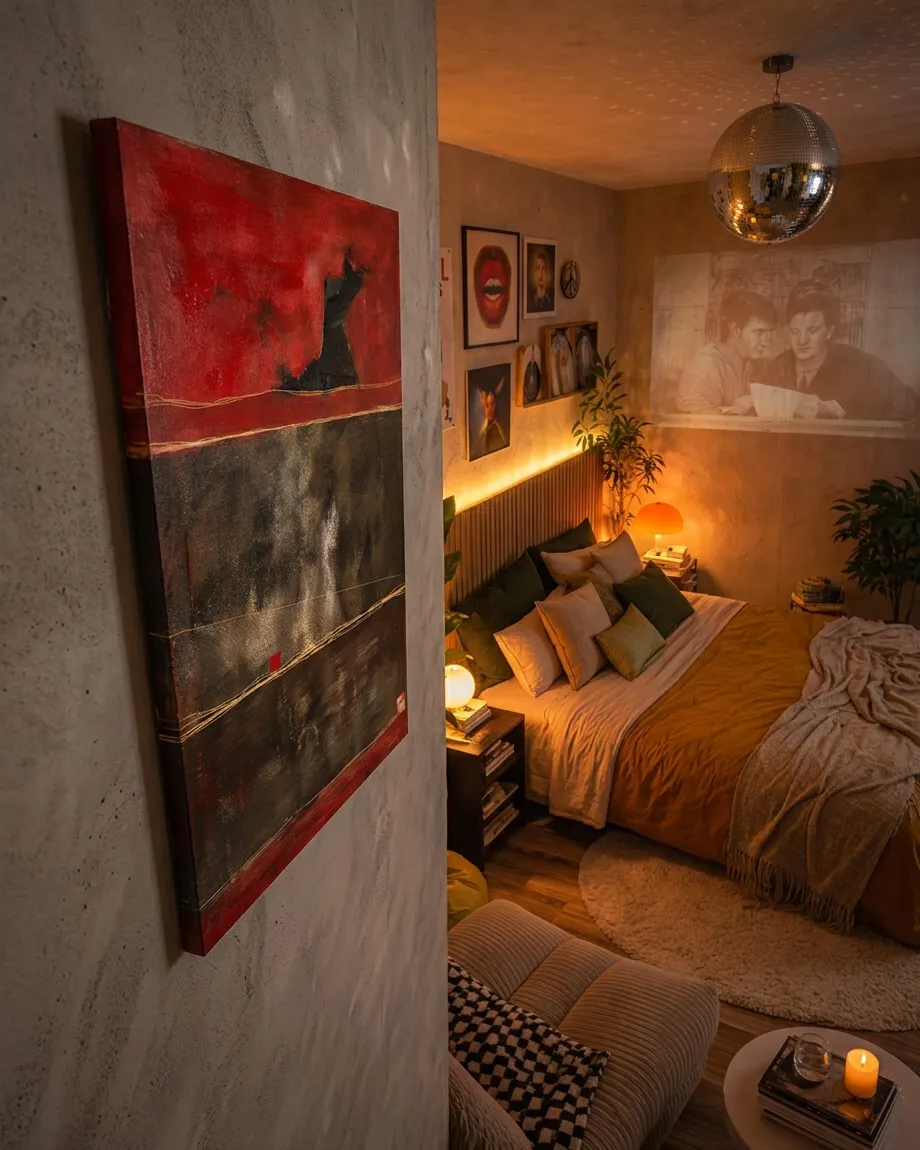
Detail of the soot textures, the upper monolithic silhouette, and the fine incised gold lines structuring the artwork on a 120 x 80 cm support.
In the minimal details at the bottom of the work, this microscale is revealed: a tiny red cube suspended on the fine golden line, and in the opposite corner, a discreet bicolor quadrant that resembles a cadastral mark. These microscopic presences are not ornaments; they are buoys of sanity that hold the balance of the entire ashen mass surrounding them. As Paul Klee noted: "Art does not reproduce the visible; rather, it makes visible." Valch does not show us a burned landscape, but rather makes visible the physical tension between the immense and the minute, between the gravitational force of soot and the resistance of the tiny crimson sign.
V. Triptych of Exposure: Wonder, Helplessness, and Permanence
From the confrontation between the Humboldtian map and the Montessorian boundary emerge three concepts that operate as affective engines of our relationship with the world: wonder, helplessness, and permanence.
Wonder should not be understood as loud astonishment before the extraordinary, but as an attentive openness to the physical mystery of matter. It is the gaze of the child discovering for the first time that wood has a grain, or that of the painter contemplating how dry pigment reacts to the organic binder. This wonder does not seek to immediately categorize or label what is observed; it tolerates the interval, respecting the silence of the object. When Humboldt contemplated Andean vegetation, or when Montessori observed children's concentration, there was a moment of pure wonder free from practical utility. Wonder is the reverse of control: it is the capacity to be affected by the presence of what exists without the rush to translate it into a theory.
Helplessness is the experience of exposure, the awareness that there is no predetermined path or guide coming to rescue us from the void. It is the loss of the map. When we strip away the psychological interpretations that pretend to make sense of our every pain, we are left alone with the naked fact of our fragility. This helplessness, far from being a tragic weakness, is the threshold of true freedom. The traveler facing the storm without the promise of a heroic shelter, the child stumbling against the wooden block without an adult intervening to facilitate the task, experience a fertile helplessness. It is exposure that forces internal forces to self-organize, revealing that the individual possesses a capacity for resistance that prefabricated maps cannot foresee.
Finally, permanence is what remains when we clear the surface of incidental interpretations; the indestructible substrate of the self. In Valch's painting, permanence is the ash: the ultimate mineral residue that survives the fire, which has lost all its flammable eloquence to become pure, silent gravity. It is the same permanence that Borges explored in his fictions when confronting the flow of time with the eternal instant of pure concentration. Faced with the temptation to construct ordered worlds and logical labyrinths to replace chaotic external reality—like the inhabitants of Tlön—matter always returns us to the sobriety of the naked fact.
The freedom of not being guided consists precisely in embracing this triptych: renouncing the authoritarian teacher, the absolute map, and the epic of the constant exploit to recover tactile contact with reality. Only when we allow the incision to tear through our previous interpretations can we look at the territory not as a conquest, but as a space where we walk with a single clean step, suspended over the damp ash of the world.