On the cliffs of Nerja, solid ground surrenders to the Mediterranean Sea. This is not a picturesque viewpoint or a stage set, but a sharp border where the earth breaks away to meet the abyss. This actual threshold serves as the backdrop for Maurizio Valch's painting series, Mare Somniorum. In these compositions, the literal references of the external landscape are emptied out, transforming into a topography of the unconscious. Here, chromatic planes divide sky from earth, suggesting that reality is built from layers of memory, time, and silence.
In an audio poem accompanying the series, Valch's voice recites, against a melancholic background, the chronicle of a peculiar shipwreck: a vessel with no destination and a red keel, sailing through seas of unfinished pigments beneath a vast dome. Far from the classical hero's journey, which demands overcoming storms to reach a distant port, this vessel's voyage is suspended by running aground. The keel, bleeding restlessness, does not signify failure but rather the moment the external journey stops to make way for internal movement. By running aground, the ship is liberated from the tyranny of a destination, discovering its sovereignty in the quiet of the shore.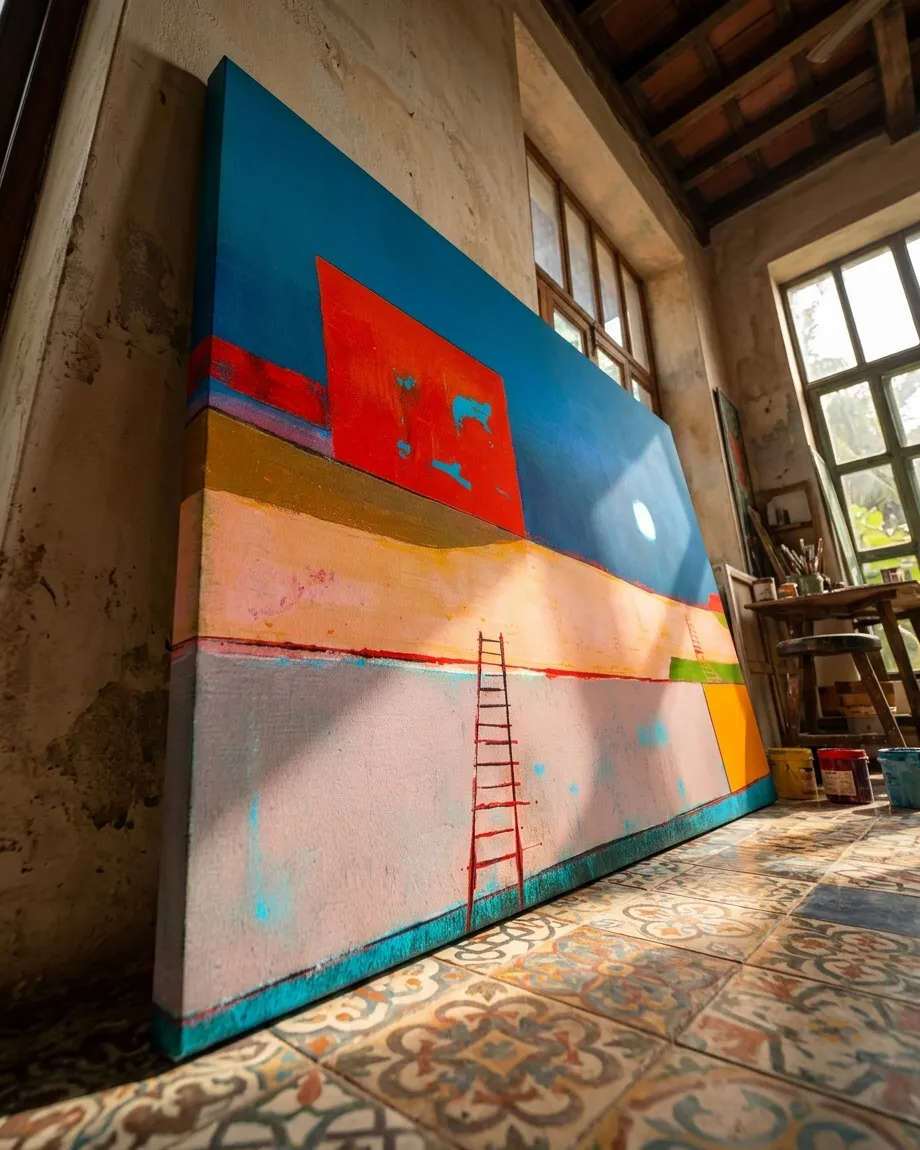
In canvases such as SOL DIVISUS and LUX REMOTA, this immobility takes shape as dense crimson rectangular blocks that disrupt the horizon. These hermetic structures evoke the box drawn by Antoine de Saint-Exupéry in The Little Prince. Faced with the impossibility of drawing a sheep that satisfies the child, the aviator draws a box with three holes, claiming the animal is inside. In the same way, the red monolith in Valch's painting acts as a shelter for the invisible. It is not a monument of power, but a boundary against the analytical urge to translate everything—a box guarding the secret so it may continue to exist, untamed.

If the crimson monolith functions as a closed shelter, the minimal ladders emerging from the lower fields of LUX REMOTA represent the exposure of the journey. They are linear strokes pointing toward a luminous sphere suspended in deep blue. To ascend them requires leaving behind the safety of one's own asteroid—the space where memory preserves fixed identities and comforting explanations. This transition dialogues with the austerity of Estonian composer Arvo Pärt, whose music relies on the interval and silence. In the painting, each rung is a silent interval, a tiny step requiring no complete map to justify itself. The movement does not seek to conquer the remote light, but rather to sustain our gaze before the unfinished.

As these tensions intersect, the canvas ceases to be a surface of representation and becomes a dry dock. A paradox emerges: is the painting the hermetic box protecting the secret from outside eyes, or is it the ladder forcing us to abandon the safe asteroid of memory? Perhaps it is both. Like the stranded ship in the poem, the artwork rests on the border where words fall silent, showing that the true journey does not require a distant port to be real, but only the courage to stand before the open horizon.