The day begins under the siege of an invisible orthopedics. Upon waking, the eye stumbles against the right angle of the walls, the corrected horizontality of the floor, and the grid of the windows. Contemporary space rarely tolerates the sinuosity of the earth; it flattens, divides, and subdues it through the plumb line and the level. This rectification is not merely a structural choice, but a silent pedagogy that trains bodies to move in straight lines and to distrust any descent. In the winter of 1874, in northeastern Brazil, the peasant rebellion known as the Revolt of the Quebra-Quilos rose up against the imposition of the French decimal metric system. By destroying scales and standards in the marketplaces, those communities were not championing chaos, but rather defending the tactile scale of their daily exchanges against the geometric abstraction that sought to appraise their world from a distance.
In his essay Metáforas que nos piensan, the Spanish mathematician and sociologist Emmánuel Lizcano points out that the straight line and the Cartesian plane are not bare truths of nature. They are prostheses created by a specific culture to parcel out, measure, and govern physical reality. In the prologue to that same work, philosopher Santiago Alba Rico coins the term horizóntigo: a vertigo inverse to that of the vertical abyss. It is the physical disorientation that arises before the sinuous, free breadth of the earth, where distances cannot be gridded and the path is forced to wind to respect the geography.
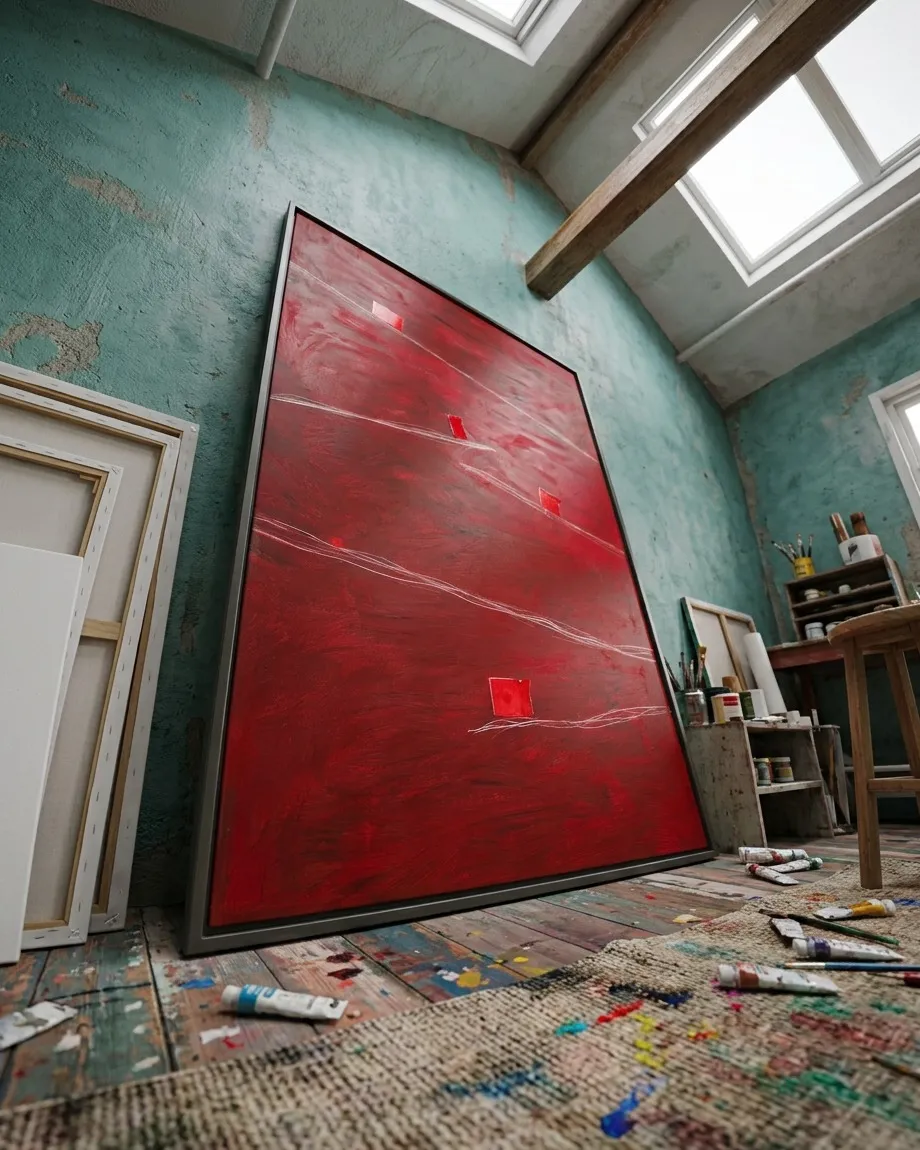
The painting DECLIVIS, by Maurizio Valch, presents a dense, textured crimson color field scored by fine white incisions. On this vertical canvas of great physical density, the lines do not act as coordinate axes or boundaries. They do not divide the space to organize it; on the contrary, they yield, tilt, and fall across the red surface. They are lines that renounce straightness to embody a sliding motion, suspended on a slope that disobeys the law of the level.
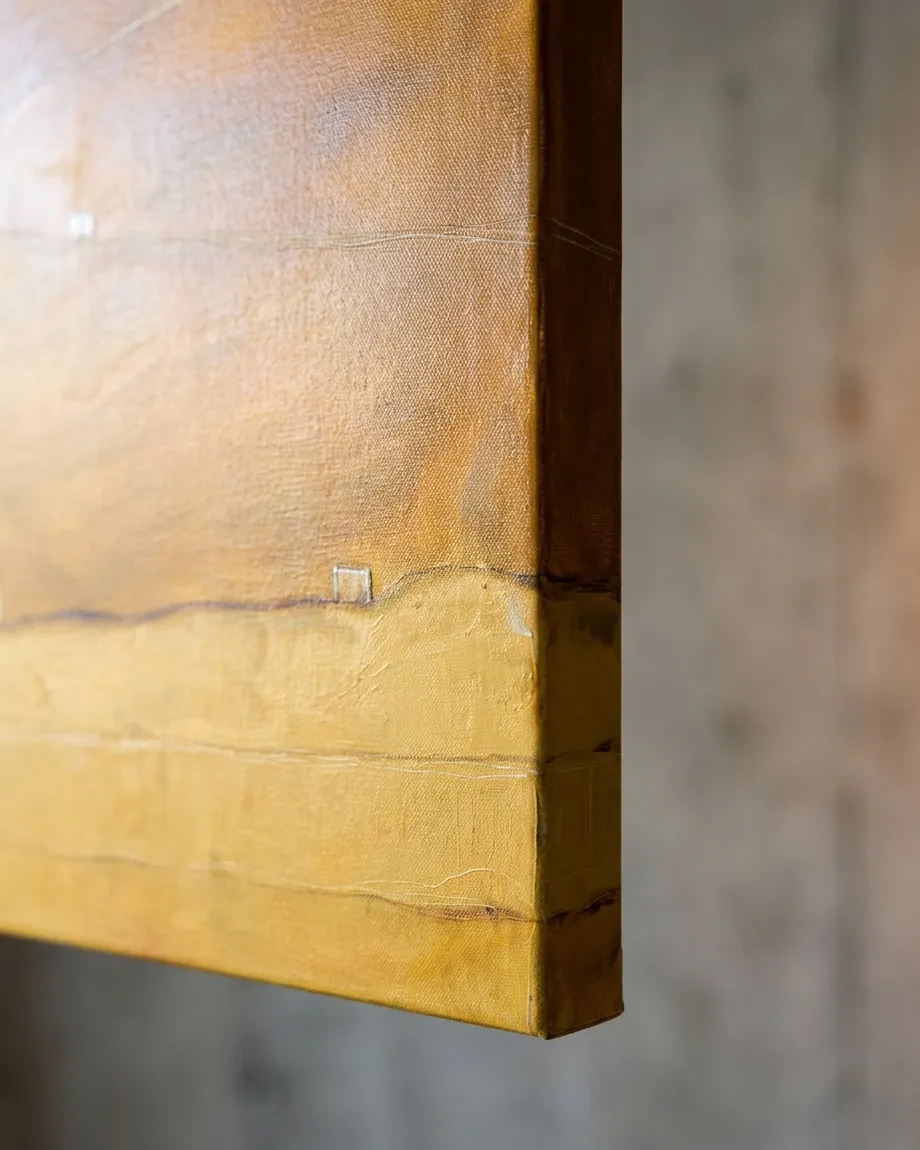
The crimson color and incisions do not stop at the edge of the frontal plane. They continue onto the sides of the canvas, wrapping the stretcher in a tactile continuity that annuls the dividing function of the frame. This persistence of matter brings the painting closer to the condition of a relief—a three-dimensional object inhabiting real space. By spilling over the boundary of pure visuality, the work becomes a “tactile shore”: a membrane where limits touch and the painted surface recovers its status as a body exposed to light and the friction of its environment.
The Oglala Lakota spiritual leader, Black Elk (1863–1950), described in his testimony recorded by John G. Neihardt how his people were forced to live in “square boxes.” In his culture, the power of the world had always operated in circles: from the shape of the round tepees and birds’ nests to the course of the seasons. In this vision, the square represents a static space, a cell that interrupts the flow of life; conversely, the curved line allows the strength of the earth to move and renew itself.
The descent of the line evokes the physics of the clinamen: that minimal swerve of atoms in their straight fall through the void which, in ancient atomist thought, allowed the collision of matter and the birth of things. Walking is not an exercise in rigidity, but a dynamic balance sustained by a succession of controlled falls. The body moves forward because it inclines, momentarily abandoning the vertical axis to surrender to gravity. Within this sliding lies a somatic truth that the grid attempts to suppress: fragility and weight are the indispensable conditions of movement.
Inhabiting the wounded line demands deposing the tyranny of exactness. Facing the control imposed by the planned flatness of offices, classrooms, and laboratories, the decline proposes an aesthetics of deviation. The painting does not pretend to be a window onto an idealized world; instead, it offers a textured surface where the gaze can stumble, slide, and encounter a beauty that depends not on symmetry, but on the honesty of its fall.