The Gravity of the Grimace: Collisions Between the Ass, the Jester, and Spatial Painting
I. The Jester's Shadow and the Line of the Face
In the Renaissance quest for a golden ratio that would unify the cosmos and the human body, Leonardo da Vinci stumbled upon an abyss that his own geometry could not tame: the anatomy of the grotesque. His caricature sketchbooks and physiognomic studies do not represent a detour or a playful whim in his scientific research; on the contrary, they constitute the rigorous map of a frontier. Leonardo pursued the deformed, the mad, and the elderly through the streets of Florence and Milan because he sensed that in the exaggeration of features, the collapse of symmetry, and the sagging of a jaw, a truth of the soul was revealed—one that classical harmony insisted on hiding. For the Tuscan master, sfumato functioned as this imprecise boundary, a mist where light and shadow merged to suggest that human interiority is intrinsically unstable, impossible to lock into a single definitive gesture.
This impossibility of formal reconciliation finds a violent echo in the painting at hand. The depicted face does not dissolve into the atmosphere through the delicacy of sfumato; instead, it is split by an implacable, symmetrical division. One half sinks into a dense darkness, an impasto blackness that devours any relief, while the other is offered in a textured, almost mineral earthy ochre, where the pictorial matter seems to have been dragged across the support with a palette knife. This binary partition of light and shadow does not seek Leonardo's anatomical harmony, but rather its fracture. When confronting this divided physiognomy with the figure of Curro El Palmo, the tragic jester of Joan Manuel Serrat's ballad, the line of the face reveals itself as an insurmountable wound. Curro, the "fake gypsy, former palace jester, noble pimp," drags his own deformity, his condition as a "dwarf vine" who did not serve in the military because he "didn't measure up." Within his contorted body lies the same impossibility of harmony that inhabits the canvas. Merceditas—she of the mouth where "life and death" are embroidered—represents that unattainable ideal, a beauty that on the "dull" flamenco stage coexists with rationing and misery, and who looks at the jester with cruel mockery.
The mouth in the painting, heavily outlined, fleshy and hermetic, seems to concentrate this tension. It is not a mouth that speaks, but one that "consents through silence," or perhaps contains a mute scream that cannot cross the dividing line. The two bulging and expressive eyes, which deliberately evade the direct gaze of the viewer, recall the stillness of Leonardo's drawings, where the lost gaze signals a fundamental disconnect from the environment. The painting does not allow us a sentimental or unified reading of pain; the dark half drags us toward the void of silence, while the ochre half forces us to register the physical roughness of the ground, of brick, of exposed matter.
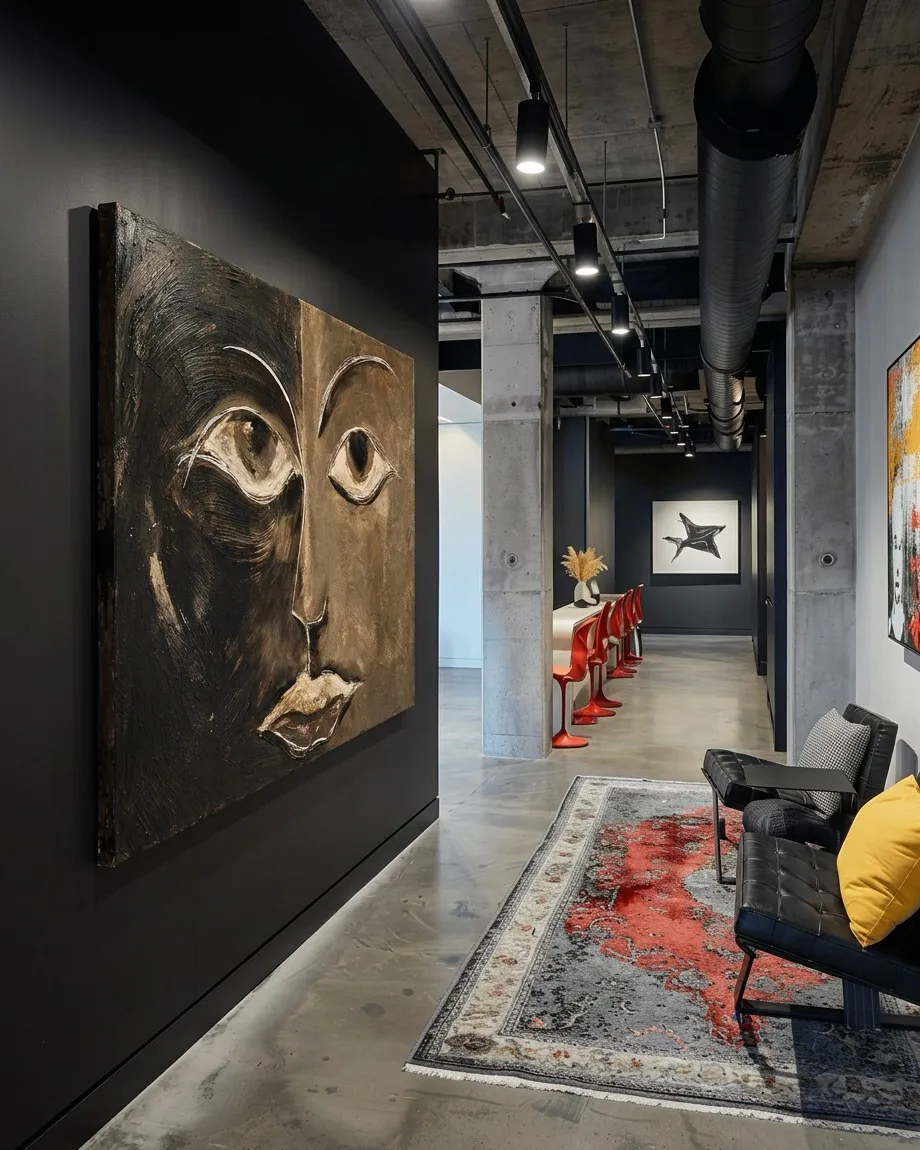
Suspended on a black wall, as seen in this arrangement, the dark half of the face integrates almost completely into the plane of the wall, letting the textured half float like a mask suspended in nothingness. This presentation accentuates the isolation of the physiognomy, stripping pain of any academic decorum or cheap compassion. There is no room for easy tears in this geography of fracture. The pain of the jester Curro, who dies of grief or "lack of iron," is demystified through this dry visuality, where ugliness and deformity are not accidents of fate, but the very structure upon which the experience of the world rests.
II. The Untamed Gaze
As an editor, the temptation to reconcile these materials is almost irresistible. Critical work usually consists of exactly that: taking the roughness of a painting, the bitterness of a neighborhood ballad, and the loftiness of a philosophical treatise, and smoothing their edges until they fit perfectly into a coherent and reassuring discourse. However, my task in addressing the constellation of Isamu Noguchi, Leonardo da Vinci, Friedrich Nietzsche, and Joan Manuel Serrat is precisely the opposite. I must sustain the contradiction, keep the wound open, and resist the urge for a peaceful synthesis.
The ethics of this inquiry lie in not domesticating the gaze of the painting or the weeping of the jester. When I listen to the ballad, I perceive a deep popular tear, a sadness that smells of tobacco, tavern drinks, and the cheap kiosk literature of Marcial Lafuente Estefanía, with which Curro uselessly tries to soothe his obsession. It is a low pain, a melodrama that high culture would quickly dismiss as kitsch or suburban sentimentalism. On the other hand, opening Thus Spoke Zarathustra, I encounter the philosopher's icy, destructive laughter—a laughter that beheads idols with the precision of a surgeon. "Not by wrath, but by laughter do we slay," Zarathustra tells us. How can we make the sovereign laughter of the thinker who dwells in the heights coexist with the choked tear of the flamenco hand-clapper who slowly dies among soleares in a dark corner of the stage?
The painting that accompanies this journey stands between both extremes like an indomitable obstacle. Its eyes, misaligned and bulging, look nowhere; they dodge the viewer, they dodge philosophy, and they also dodge the music. They do not allow themselves to be used as an illustration of misfortune or as a textbook cover. Their presence is purely physical, a scab of pigment and shadow claiming its right to opacity. Contemplating it in its obstinate muteness, I understand that the editor must not be a translator who dissolves differences, but a guardian of friction. The value of this encounter does not lie in finding a common denominator between the sacred parody of the feast of the ass and Curro's melodrama, but in letting them collide, letting sparks fly from that collision, and letting the reader experience the discomfort of a space where the sublime and the low lay claim to each other without ever merging.
III. The Liturgy of the Absurd and the Celestial Stage
In the chapter "The Ass Festival" of Thus Spoke Zarathustra, Friedrich Nietzsche stages one of the most baffling and lucid passages of his work. The "higher men"—those left orphaned by the death of God: the old pope, the magician, the conscientious of spirit, the shadow, and the ugliest man—fall to their knees in Zarathustra's cave to worship an ass. The litany they intone is a parody of Christian liturgy, where the animal's bray, that "I-A" interrupting the prayers, is interpreted as a sign of profound wisdom and divine patience. "God must be eternal... he who has so much time takes his time. In as slow and stupid a way as possible: that is how someone like that can go very far," argues the conscientious of spirit, justifying the divinity of the ass through its own foolishness.
This scene is not a simple mockery of religion, but an exploration of the concept of convalescence following the collapse of grand metaphysical narratives. Faced with the absolute void left by the disappearance of God, the higher men need to invent useless liturgies, minor nonsense, and absurd festivals so as not to succumb to the paralysis of nihilism. The ass, with its physical heaviness and stubborn stupidity, becomes the lifesaver of a group of convalescents who prefer "to worship God in this form rather than in none." It is a survival strategy: the creation of a sacred simulacrum that, through laughter and parody, temporarily restores their ability to celebrate and inhabit the here and now of the earth.
This liturgy of the absurd resonates with striking precision in the tragic geography of Serrat's ballad. Following Merceditas's flight with the "quack doctor" who owns his clinic and drives a smuggled Rolls-Royce, Curro El Palmo surrenders to a parody of secularized penance: "he read Marcial Lafuente from cover to cover, just to avoid following her steps like a penitent." Instead of kneeling before an altar or flagellating himself in a procession, the jester seeks oblivion in Western novels, card games, and soccer pools. It is his own mass of the ass, a low, popular liturgy replacing the old rites of redemption with the consumption of cheap kiosk literature.
The culmination of this sacred parody shifts, after Curro's death, to an improbable celestial stage: "On the right-hand side / On the way to heaven / You will see a stage / Set up by Frascuelo / Where every night / For the good souls / Currito 'el palmo' / Keeps on clapping." Curro's heaven is not the contemplative paradise of scholastic theology, but a flamenco stage run by a mythical bullfighter (Frascuelo) where the jester eternally sings his sorrows "for celestial ears." This elevation of the popular to the divine order constitutes a radical subversion of aesthetic hierarchies. The sublime is not reached through the purification of instincts or elevation toward the abstract; on the contrary, it emerges when clothed in the garments of ugliness, neighborhood melodrama, and farrucas clapped with frost-covered hands.
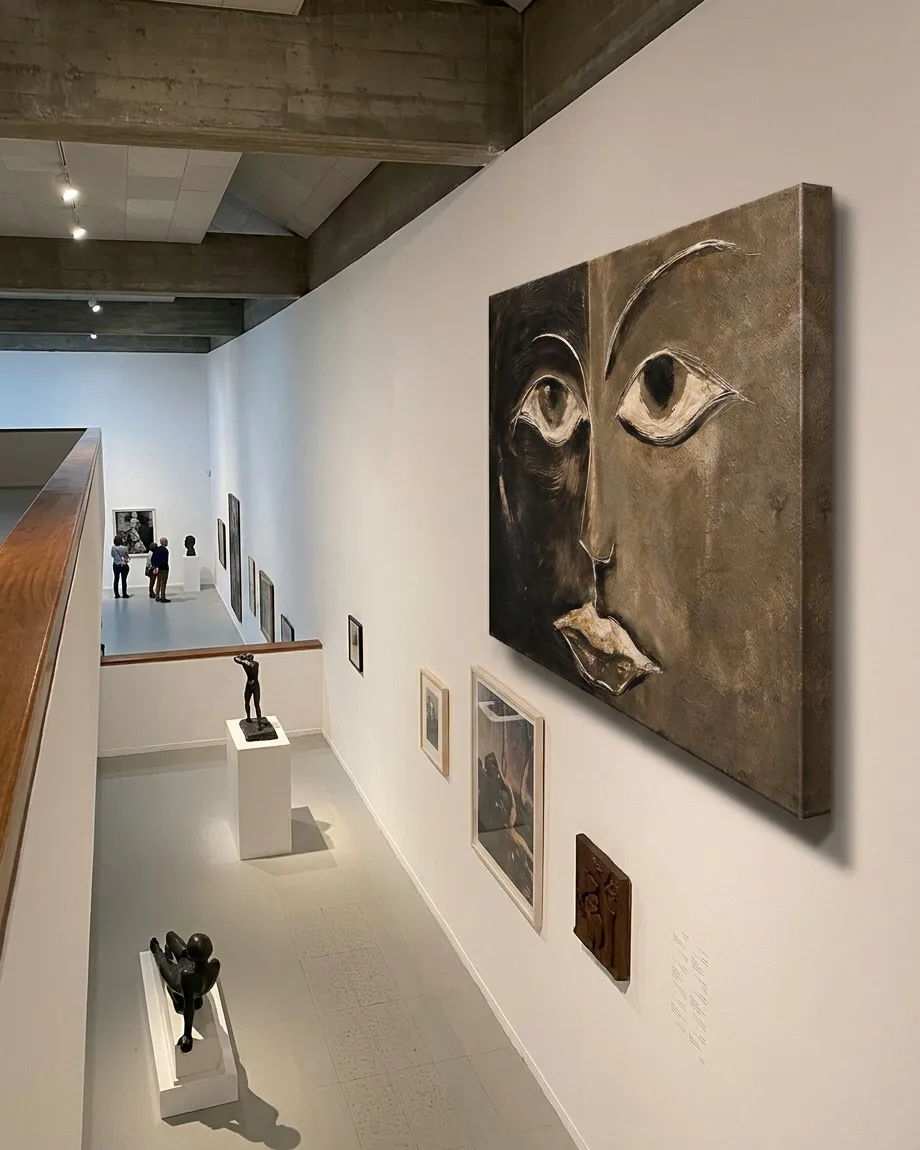
In this setting, where the painting is suspended on an immaculate white wall, dominating the perspective of a lower gallery populated by silent, classical sculptures, the visual work operates as that "celestial stage." From its height, with its rough face and misaligned gaze, it questions the solemnity of the forms resting below. The painting does not dialogue with the canon of statuary unfolded at its feet; it parodies it through its mere textured and asymmetric presence. Like Zarathustra's ass or Frascuelo's stage, the painting demands that we abandon the "nursery room" of refined explanations and accept the coarseness of a material that prefers the vibration of the floor to the purity of the ether.
IV. The Weight of the Mask and Noguchi's Stage
Isamu Noguchi conceived space not as a passive void destined to house decorative objects, but as a field of physical forces and dramatic tensions where bodies and materials engage in a dialogue based on gravity, weight, and balance. In his famous collaborations with choreographer Martha Graham, Noguchi transformed the theatrical stage into a sculptural landscape where dancers did not merely move in front of a backdrop, but had to physically confront the resistance of wooden structures, brass wires, and heavy basalt stones. For Noguchi, sculpture was a way of sculpting space itself, and each piece had to retain the memory of its geological origin, its terrestrial weight, and its inescapable relationship with the floor.
This understanding of matter and gravity is fundamental when analyzing how the painting of the divided face is presented in the exhibition space. Instead of hanging conventionally, aseptically, and lightly on the wall, the work rests directly on the concrete floor, leaning against an exposed brick column.
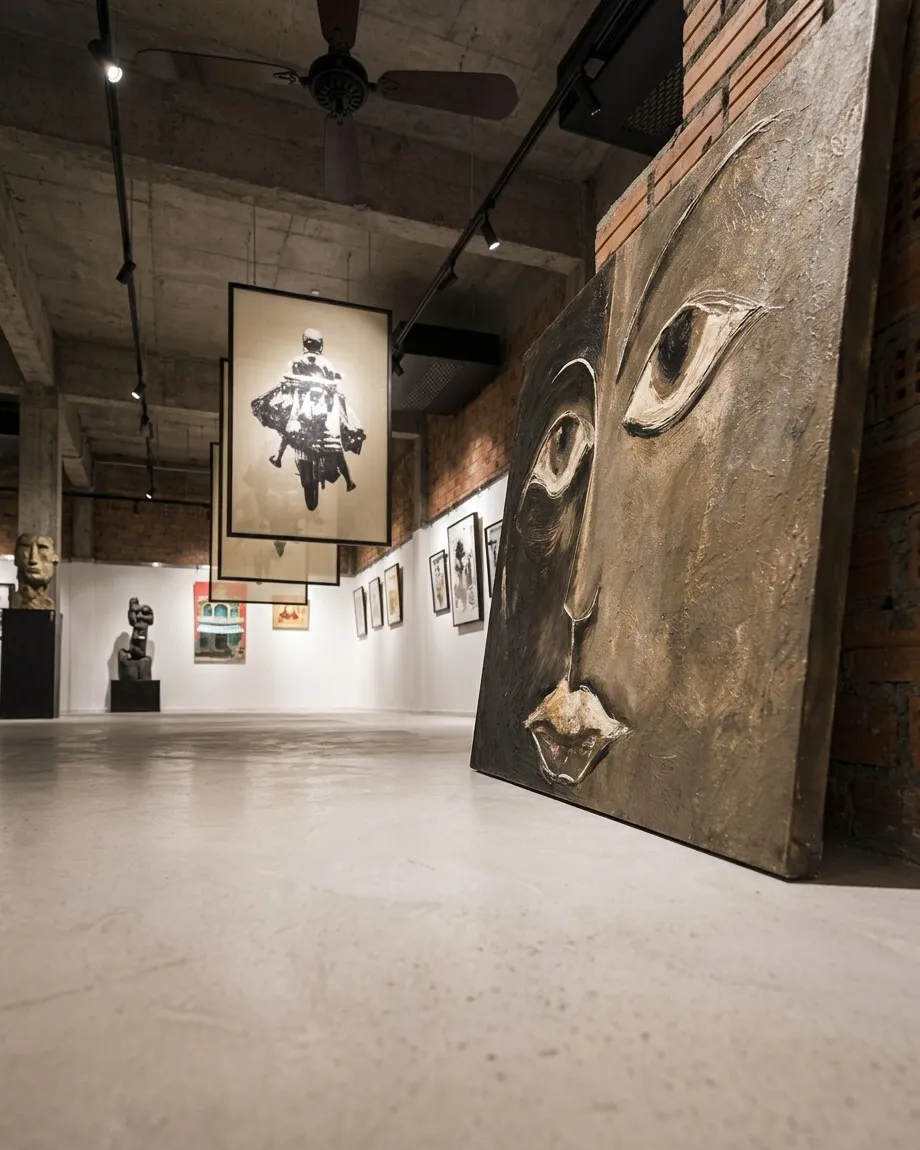
This gesture of leaning the painting, of forcing it to share the same physical plane trodden by the viewer, immediately activates Noguchi's dramatic spatiality. The canvas no longer functions as an illusory window through which we contemplate a face; it becomes a physical body, a material obstacle that interrupts passage in the gallery, a stone stele or a megalith claiming its own weight and volume in the room. By leaning on the floor, the painting renounces celestial lightness and assumes the heaviness of the ass worshipped in Zarathustra's cave. The ass is, par excellence, the animal of gravity, the beast of burden that supports the weight of the world with silent obstinacy. Leaning against the brick, the painting shares that same material stubbornness; it refuses to float, clings to the earth, and demands that the viewer modify their physical path to walk around it, forcing a bodily confrontation identical to the one Zarathustra causes when he leaps into the midst of his kneeling guests.
This physical presence of the painting also functions as a double mask of the one who "consents through silence." In traditional Japanese theater, especially Noh—which Noguchi deeply studied and assimilated—the mask is not used to hide the actor's identity, but to concentrate the archetypal power of the drama. The Noh mask is an object carved with a calculated ambiguity: depending on the angle of the light and the tilt of the actor's head, the carved face can express deep sadness or subtle irony. The divided face of the painting operates under this same principle of the dramatic mask. Its features, suspended between the stubborn silence of the liturgy's ass and the tragic dynamism of the hand-clapper who keeps on clapping on the celestial stage, do not offer a single reading.
The asymmetry of the painted face—one half plunged into the flat void of shadow, the other raised in the rough relief of ochre—prevents the physiognomy from stabilizing into a recognizable psychological portrait. It is a depersonalized face, a cosmic mask reflecting the tension between the void and the sculpted. Like Noguchi's sets, which used the tension of ropes and the mass of stones to suggest the tragic fate of Medea or Oedipus, this painting leaning against the brick uses its own physical weight to embody the gravity of popular melodrama and philosophical laughter. The viewer cannot merely decode the image with their gaze; they must feel the pressure of the canvas against the floor, the roughness of the brick that supports it, and the way the large painted head obstructs and redefines the walkable space of the gallery.
V. The Kingdom of the Earth
I have spent entire days trying to weave this web of words around the painting, the music, Nietzsche's texts, Leonardo's drawings, and Noguchi's spaces. As an editor, I have searched for the subtlest connections, the invisible threads linking the philosopher's laughter to the jester's suffering, and the gravity of stone to the pigment on canvas. In short, I have tried to build a theoretical cathedral that explains and justifies the presence of this divided face in our present. But now, sitting again before the work in the silence of the room, that entire architecture of words begins to crack and reveal its own insufficiency.
The painting remains silent. It possesses an overwhelming muteness, as stubborn and obstinate as Zarathustra's ass before the speculations of the higher men. It does not care about my references to Leonardo's anatomy or my analyses of Noguchi's dramatic space. It does not seek to please art critics or fit into a footnote on the aesthetics of the grotesque. It is just there, simply leaning against the exposed brick, smelling of oil, old canvas, and dust, claiming with its material heaviness a space that no theory can strip away.
Zarathustra shouted to his guests to leave the nursery room and the childishness of their prayers because "we want the kingdom of the earth." This demand to inhabit the present without the promise of redeeming heavens is what the painting fulfills by its mere physical presence on the floor. By refusing to hang with the lightness of a bourgeois decoration, by imposing itself as a coarse body that obstructs our path, the work forces us to descend from the heights of intellectual speculation and touch the roughness of concrete. It reminds us that art, before it is a concept or a discourse, is matter, weight, friction, and presence.
In this silent resistance of the painting lies its true tragic power. The ballad of Curro El Palmo ends with a celestial stage where souls find a parodic consolation; Nietzsche's philosophy pushes us toward the laughter that destroys old idols; but the painting offers neither consolation nor destruction. It stays on the threshold, with its bulging eyes looking sideways, dodging our scrutiny, and its strongly outlined mouth refusing to utter a single explanatory word. It is the reminder that, in the end, when the discourses are exhausted and the songs stop playing, what remains is the obstinate presence of matter, dry color on the surface, and the inescapable weight of the earth beneath our feet.