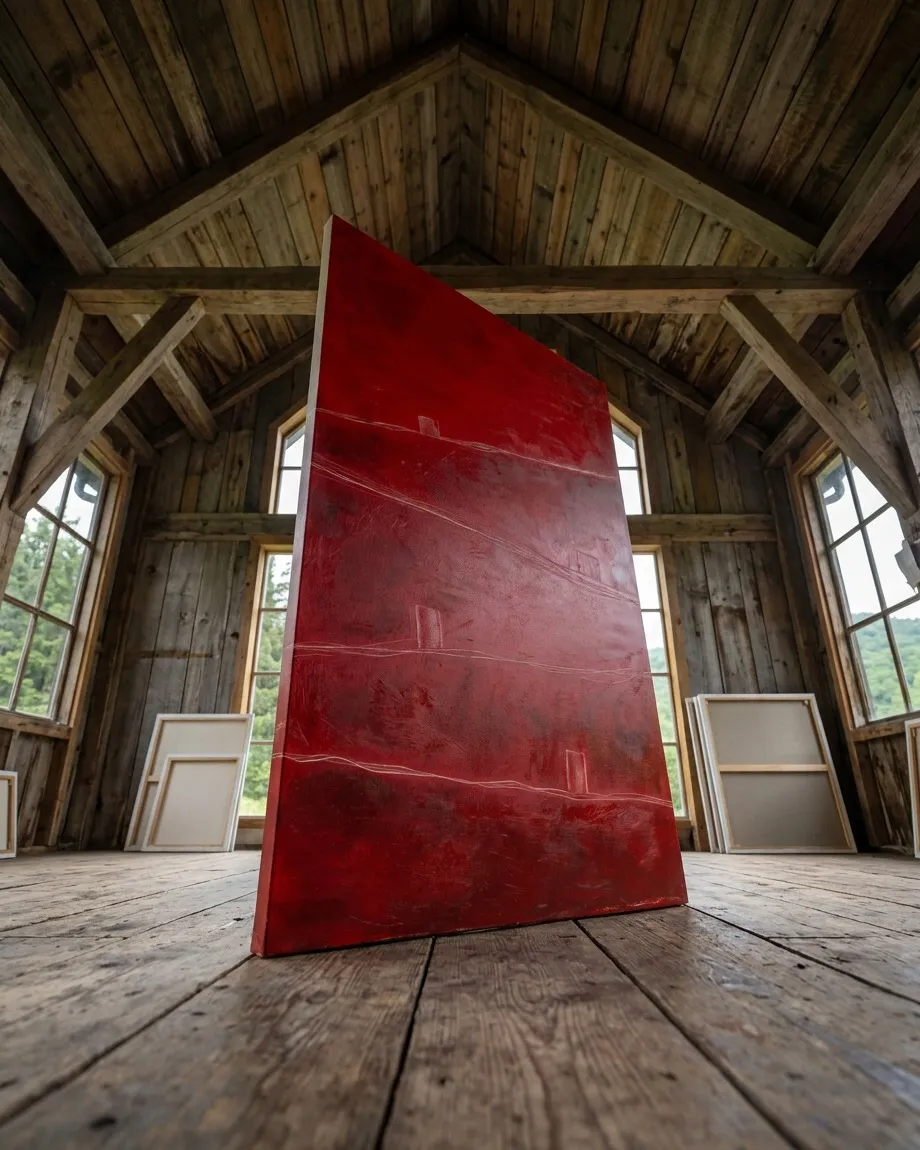
The first impulse when facing a large plane of color is often one of occupation. The human eye, conditioned by an inertia of conquest, seeks to decipher the surface, chart logical paths, and fill the voids with explanations. In ATHAR, an imposing vertical canvas dominated by crimson oil and acrylic seems at first impact to impose this monumental scale. The density of the medium evokes an ancient stratum, an impenetrable wall that triggers a rational urgency to colonize it through the gaze. This tendency toward expansion is not exclusive to viewing art; it is the same mechanism that turns daily existence into a succession of grand gestures, titanic projects, and relentless searches for external validation. The mind tends to believe that to inhabit a territory, whether physical or mental, it must be completely conquered, assimilating every corner under the weight of an absolute theory.
However, upon drawing closer to the materiality of the STRATA series, this claim to wholeness breaks down before the subtlety of accident and subtraction. On the surface of ATHAR, the red plane has been marked by horizontal incisions that do not add information, but rather remove physical matter. They are subtle cuts that reveal the underlying support, opening small geometric compartments distributed in a staggered pattern across the canvas. The space is no longer presented as an limitless plain demanding to be seized, but as a fractured structure where immensity pauses to offer small shelters. This same logic operates in SINGULA, from the SITUS series, where a thin, solitary line is drawn across a dense field of deep blue and black. Upon this minimal horizon sits a single, tiny red block, a mere fragment acting as an isolated sentinel. These discrete interventions radically alter the scale of the composition: the chromatic abyss ceases to be an empty threat and becomes the protective frame for a tiny yet fully sovereign presence.
This need to define a tiny space to shelter what cannot be seen recalls an image from twentieth-century literature. In The Little Prince (1943), the story by Antoine de Saint-Exupéry, the aviator draws a simple box with three holes to address the frustration of a child demanding to see a perfect sheep. By assuring him that the animal is asleep inside that enclosed structure, the drawing defuses the adult eye's craving for exact representation and over-interpretation. The wooden box does not conceal out of malice; it protects the living creature from the wear of external judgment and the insistence on measuring everything by monumental standards. Similarly, the geometric incisions carved into the red medium of ATHAR and the red block defined in SINGULA function like those three holes in the parable. They are boundaries and enclosed shelters where what truly matters occurs safe from external noise, preserving the painting's mystery against the temptation to translate it into rigid explanations.
This retreat toward the small suggests a model of psychological resistance against contemporary demands for productivity and validation. In Saint-Exupéry’s fable, the asteroid B-612 represents a tiny home where existence is measured not by the extent of the territory, but by the quality of care. In that minute space, cleaning three small volcanoes and protecting a single rose under a screen constitute the entirety of a real, unavoidable responsibility. For the artist, this microcosmic scale finds a direct echo in the quiet routine of his rustic studio and his daily commitment to his animals. Attending to an animal's physical needs leaves no room for grandiose discourses or complex theories; it is a concrete, humble act that returns the mind to the immediate present. Against the belief that one has no right to peace as long as something remains unresolved on the horizon of grand ambitions, caring for the small scale acts as a tactile anchor. It is not an escape from the world, but the recovery of an intimate sovereignty against the urge to turn life into a constant heroic struggle.
Ultimately, the pictorial act and lived experience share the same warning: reality ends up buried under its interpretations if its most intimate boundaries are not guarded. When a small action begins to demand a complete theory of who we are, thought has hijacked the fact to turn it into a permanent psychological conflict. Guarding the small scale—the incision in the painting, the silence of the studio, the feeding of the animals—allows us to inhabit the immensity of the territory without the obligation to conquer it. There is no need to possess the entire desert or explain the canvas's abyss; it is enough to sustain the presence of the small red sentinel, ensuring that, amidst the pressure and sediment of time, a minimal dwelling remains where the invisible stays safe.