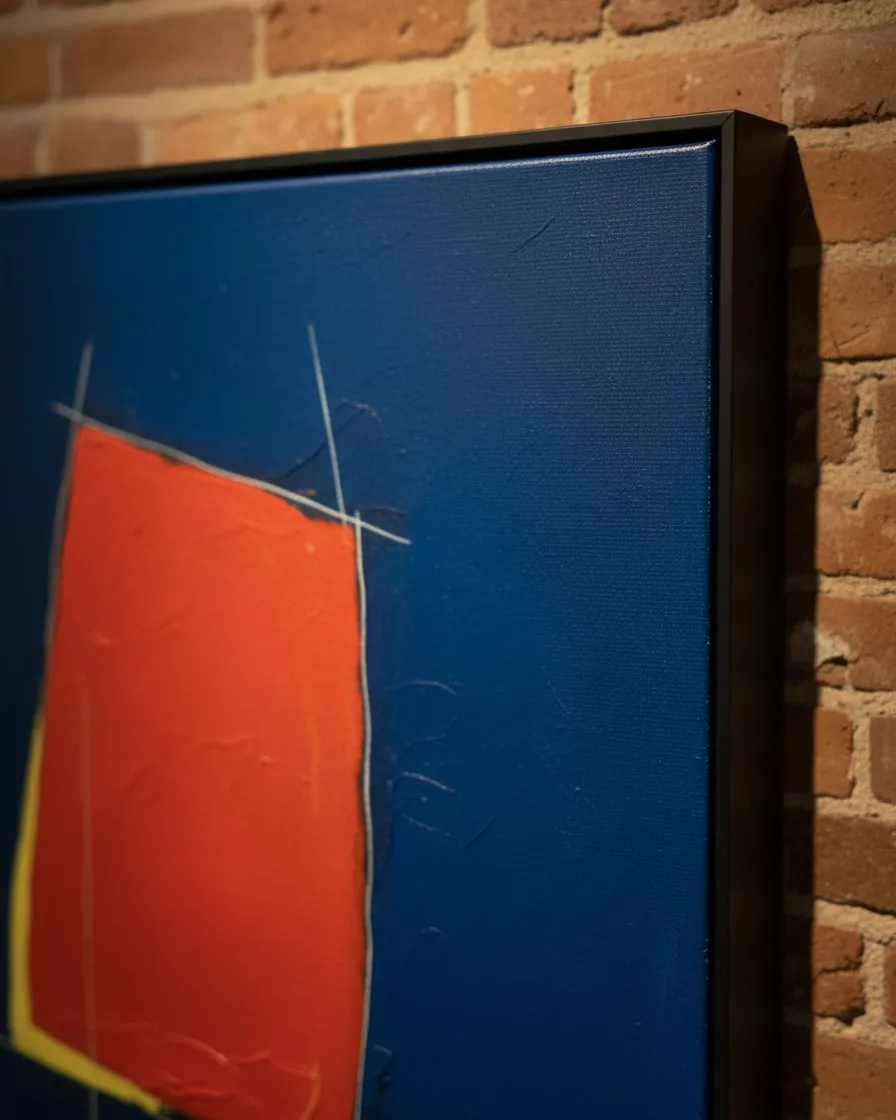
The myth of Sisyphus is often read through the lens of physical exhaustion. A body pushes a boulder up a hill, watches it roll down into the abyss, and descends to begin the journey anew. This condemnation of futile repetition finds a counterpoint in the sobriety of the artwork GRADUS, from the series SITUS. On this canvas, a deep blue field supports subtle white incisions and suspended blocks of color. Without rugged slopes or muscular tension, the geometry establishes a strange stillness: the steps do not lead to any passable summit. Looking at this composition, a suspicion arises: perhaps Sisyphus's punishment lies neither in the weight of the stone nor in the steepness of the incline, but in the belief that peace will only begin once the summit is reached.
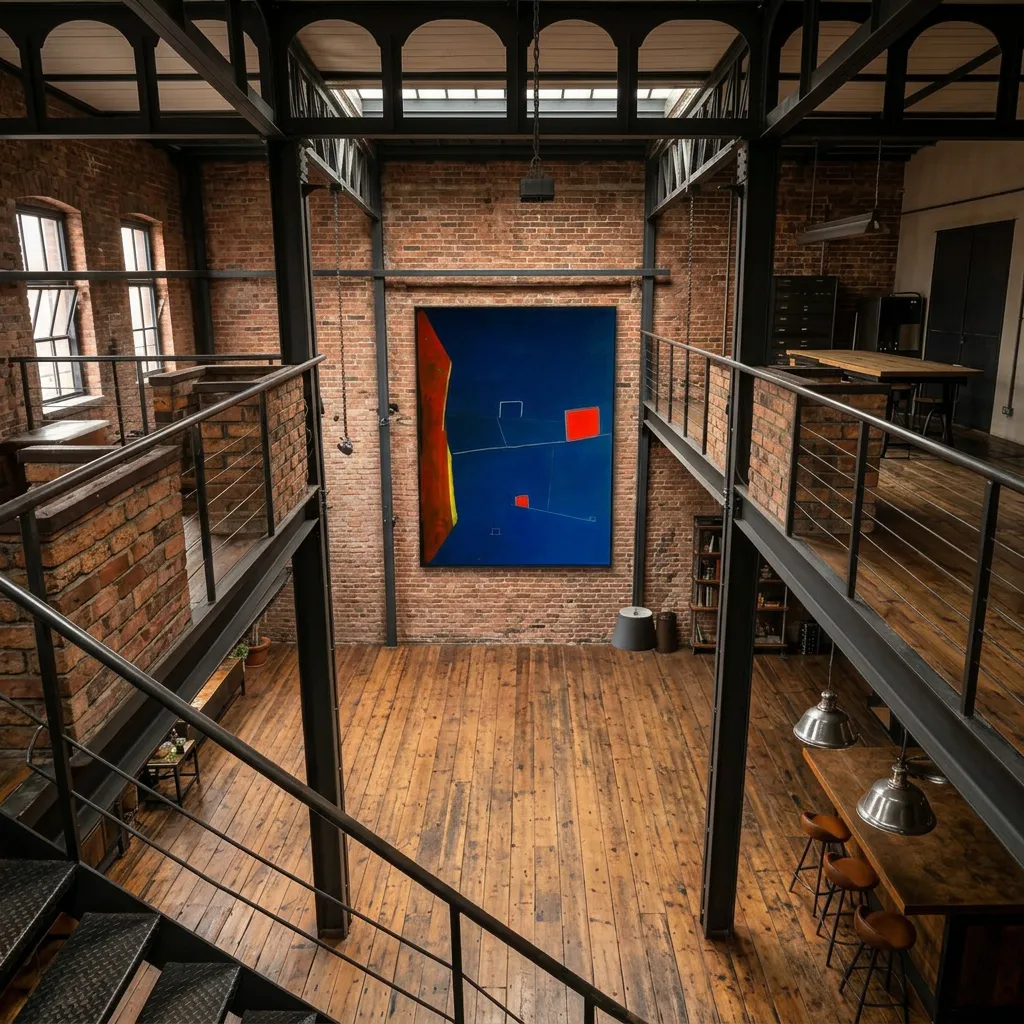
When the mind operates under the premise of postponement, the step—gradus—ceases to be a plane of support or transition and becomes the architecture of self-imposed urgency. Thought transforms the everyday or creative gesture into a doctrine of survival where there is no right to rest as long as something remains unfinished. The hill is no longer a geographical landform but a psychological territory saturated with plans. The boulder being pushed is no longer granite; it is the belief that personal validation awaits at the resolved goal, one meter higher.
This need to construct a linear narrative of effort and reward is linked to the mechanics of a consciousness that fragments the present to invent debts and promises of salvation. A lyrical fragment from Maurizio Valch’s studio recordings describes this mechanism of vigilance:
“This thin layer we call consciousness,
which invents time and latency,
which remembers, praises, or condemns,
which saves or ignites, surrenders and gives in.
This thin layer we call consciousness,
is neither friend nor foe, much less our essence.”
If this layer that classifies and invents time draws the slope, the struggle against the stone becomes insolvable. Thought manufactures emergencies to avoid silence. Yet when the urgency ceases, peace does not always appear; instead, a deep disorientation often arises as the very structure provided by that pressure vanishes.
From this mechanism springs a suspicion toward the "hero’s journey." The archetypal structure popularized by Joseph Campbell, which describes the individual leaving their environment to overcome trials and return transformed, contains a trap for the creator: the glorification of suffering as a mandatory step toward spiritual revelation. When existence is interpreted as an endless quest, tension becomes a badge of honor. The artist forces themselves to suffer under the boulder to justify their right to exist, transforming creation into a stage for sacrifice rather than a space of pure attention.
In his essay The Myth of Sisyphus (1942), Albert Camus proposed a way out of this absurdity: one must imagine Sisyphus happy as he descends to retrieve the boulder. By consciously accepting the meaninglessness of his task, the hero claims ownership of his destiny. However, the visual proposition of GRADUS goes one step beyond this existential rebellion. It does not seek a tragic happiness in the absurd, nor the resignation of pushing the stone forever. It opens a different question: what if we discover that the hill does not exist? What if the slope to be conquered is only the noise of a frightened mind inventing obstacles to flee from silence?
This dismantling of urgency connects with Jiddu Krishnamurti’s perspective on psychological time. His assertion that "the first step is the last" suggests that the quality of the present action is not a means to a future end, but already contains the totality of the movement. If the first step is taken with the desire to reach the summit for validation, that beginning will be conditioned by conflict. If, instead, the step is approached as a simple fact, free from the need to manufacture a theory of survival, the psychological distance vanishes.
By demystifying the summit, the step regains its human scale. It ceases to be the vehicle for a postponed promise and becomes a plane of color on an impenetrable background. In this work from the SITUS series, the lines do not project desperately toward the upper edge; they coexist in a subtle equilibrium that demands no immediate resolution. Peace does not wait at the end of a quest for validation, but in the capacity to observe the stone, the hand, and the ground without the weight of interpretation.