Studio Notes
The Ascent Without a Ladder
This article analyzes the evolution of the concept of 'ascent' in Maurizio Valch's work. Initially visible as a ladder in early series such as MARE SOMNIORUM, the idea of ascent transforms into a structural tension within the pictorial territory in the STRATA series. This shift underscores the effort, consciousness, and decision to question inherited perspectives.
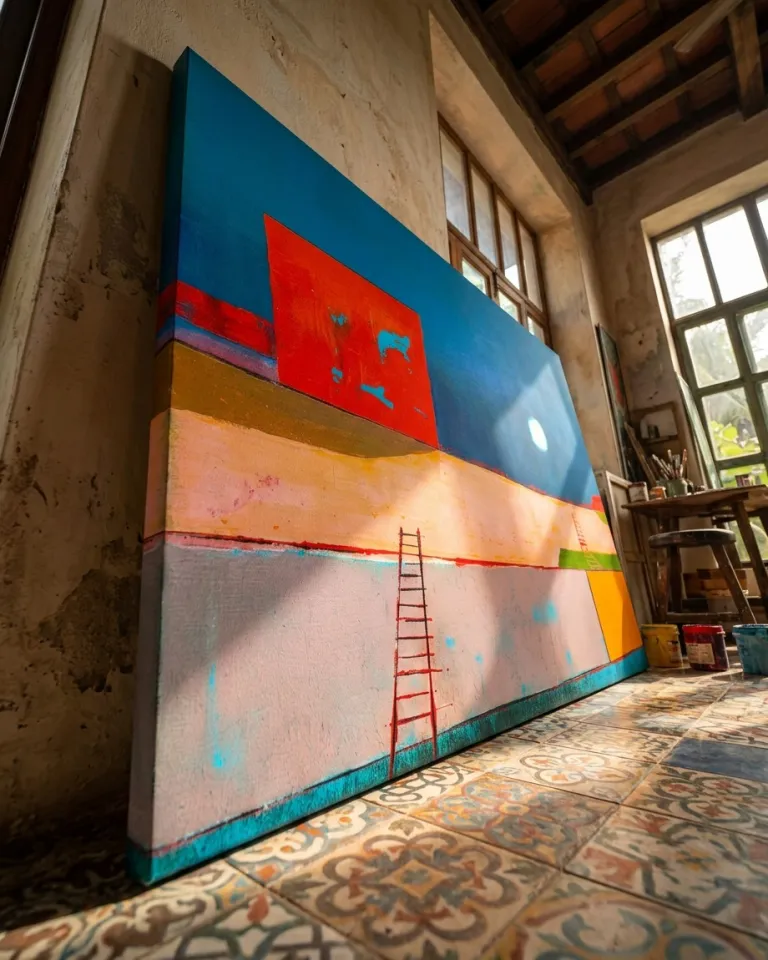
Consciousness, Effort, and Transformation Across the Series
Across Maurizio Valch's series, the act of ascent functions not as a decorative promise or a mere spiritual sign, but as a form of effort. It represents the movement by which consciousness endeavors to detach from inherited perspectives, adopt an individual stance, and respond to the world in a new way. In early series, this movement is visibly present: a ladder traverses the territory, indicating a direction. Later, in the STRATA series, the ladder vanishes. However, the ascent itself does not disappear; it becomes more demanding. It ceases to be a represented symbol and transforms into an internal tension within the territory.
The work LUX REMOTA, part of the MARE SOMNIORUM series, clearly illustrates this initial phase. Here, the ladder is a precise, small, and solitary figure. It does not lead to a scene of fulfillment or an obvious escape; rather, it leads to a transition zone, an intermediate band within the landscape, a region where mystery, distance, and remote light still coexist. The ladder does not resolve the meaning of the work. What it does is introduce a direction: ascending implies leaving a previous level behind.
In this context, ascent should not be understood solely as an internal operation. The ladder appears as an image of consciousness, but also of responsibility. No one can ascend for another. No one can re-evaluate, on behalf of another, the inherited ideas, received frameworks, or unexamined beliefs. The ascent is solitary, even if its consequences are not. What an individual re-examines internally ultimately affects their manner of speaking, acting, relating, and participating in collective life.
This is why the ladder in the early series possesses a broader human dimension. It doesn't solely represent a private quest. It also suggests the capacity to interrupt collective thought when it has become rigid and unquestionable. To ascend is to step out of the automatic flow. It is to gain distance from what is accepted by custom. It is to begin viewing the territory from a different vantage point, even while knowing that no definitive perspective exists.
Figure 1. LUX REMOTA, MARE SOMNIORUM series. Work with visible ladder and territory of ascent.
This idea, with various permutations, runs through the MARE SOMNIORUM, PRIMORDIUM, EMERSIO, and LIMINA series. Sometimes the ladder appears explicitly; at other times, it integrates more subtly into the architecture or the pictorial field. But in all instances, it indicates that transformation requires displacement. It is not enough to inhabit a territory; it is necessary to traverse it. It is not enough to perceive a structure; one must gauge the resistance it offers and decide how to engage with it.
A decisive shift occurs in the STRATA series. The ladder disappears as a visible form, yet the experience of ascent persists. It is no longer articulated by an immediately identifiable element. Now, ascent is integrated into the composition itself: ascending lines, oblique tensions, blocks that seem to support or obstruct passage, chromatic fields subjected to pressure, surfaces that demand a slower reading. The effort is no longer indicated by a sign; it is distributed throughout the material.
This transformation complicates the interpretation. If, in earlier series, the ladder offered an image of passage, in the STRATA series, passage itself becomes a condition of the territory. The viewer no longer finds a tool for climbing; instead, they encounter a field of forces. Ascent ceases to appear as an isolated decision and is presented as a continuous negotiation with layers, boundaries, cuts, and inclines. Consciousness does not advance outside of conflict, but through it.
This is one reason why the STRATA series achieves a broader resonance concerning the human condition. In it, the territory can be understood as memory, as social stratum, as accumulated experience, or as a body marked by various influences. Nothing appears in its pure form. Everything is sedimented. To ascend, in this context, no longer means escaping matter, but rather working within it: discerning the layers that form us, recognizing the pressures that condition us, and sustaining the possibility of an individual response without denying the complexity of what has been inherited.
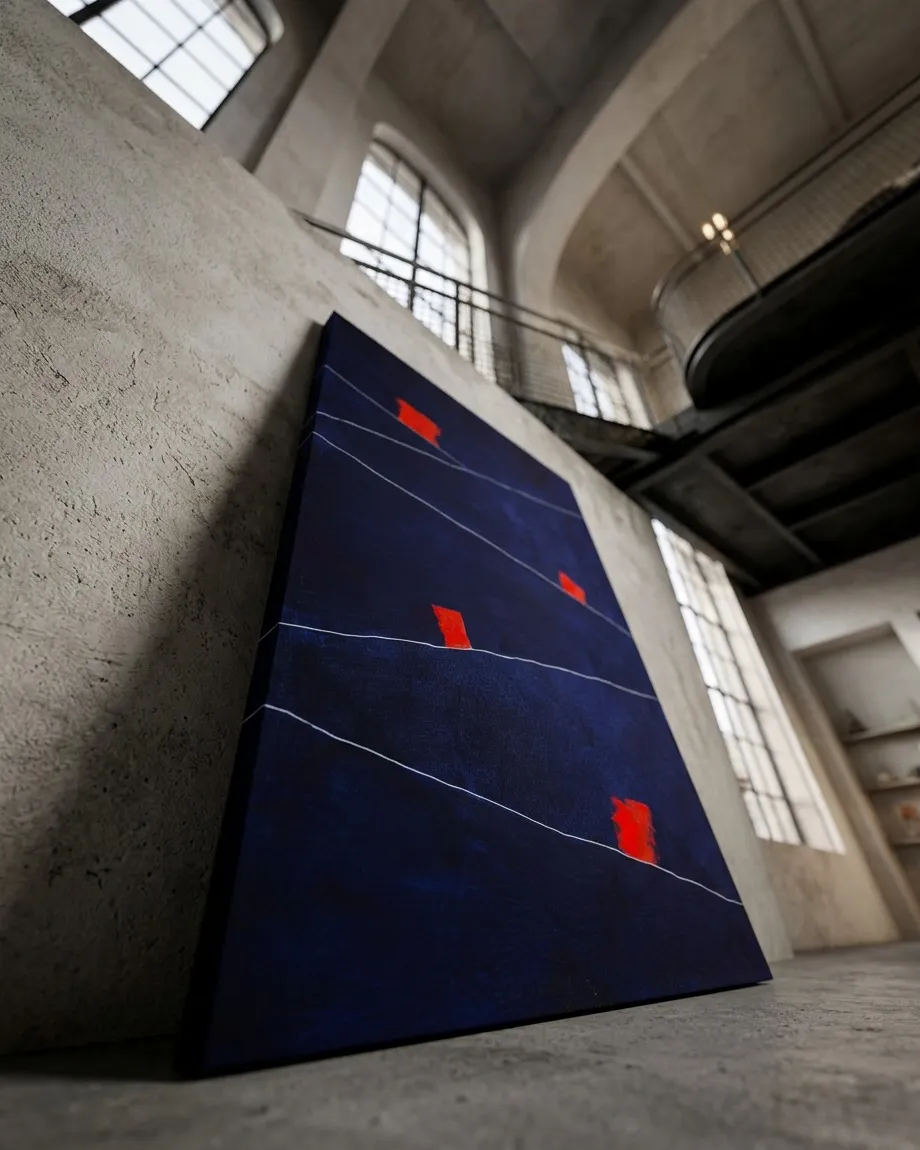
Figure 2. STRATA series. The ladder disappears, and ascent is integrated into the inclination of the territory.
From this perspective, the trajectory across the series describes a significant transformation. Initially, ascent appears as a visible, guiding figure. Subsequently, it becomes a less evident, more intimate, and more structural tension. The external image recedes, but the demand intensifies. The STRATA series does not abandon the idea of elevation; it radicalizes it. The path is no longer drawn. The territory itself becomes the incline.
In this shift lies one of the most profound messages in Maurizio Valch's work. Consciousness is not achieved through mere inspiration, adherence to inherited formulas, or the repetition of collective languages. It demands effort, friction, and a persistent decision not to remain where everything has already been thought out by others. The series illustrate this in various ways, yet they converge on the same intuition: all authentic transformation requires embracing the difficulty of ascent, even when the ladder is no longer visible.
Context & Studies
