Studio Notes
STRATA: The Surface That Remembers
In STRATA, the painted surface becomes a territory where matter, body and memory are subjected to pressure, erosion and transformation.
STRATA: The Surface That Remembers
In STRATA, the surface is not where the painting ends. It is where its physical and conceptual depth begins. Maurizio Valch approaches the canvas as a territory exposed to slow forces: accumulation, pressure, erosion, incision and sedimentation. Each work retains evidence of these processes, not as an illustrated narrative but as material presence. What appears before the viewer does not depict a specific place. It behaves like ground that has absorbed time.
Territory and Body
Although layering gives the series its name, STRATA cannot be reduced to geology. Its layers may also belong to a body, a memory or a structure of thought. Some surfaces recall eroded land, while others suggest stretched, weathered skin. Territory and body are no longer separate subjects. They emerge as different conditions of the same vulnerable matter, capable of recording what passes through it.
This ambiguity allows the painted space to operate as ground, skin, archive and site of emergence at once. The work does not require a choice between an external landscape and an interior territory. Both readings remain active without settling into a fixed explanation.
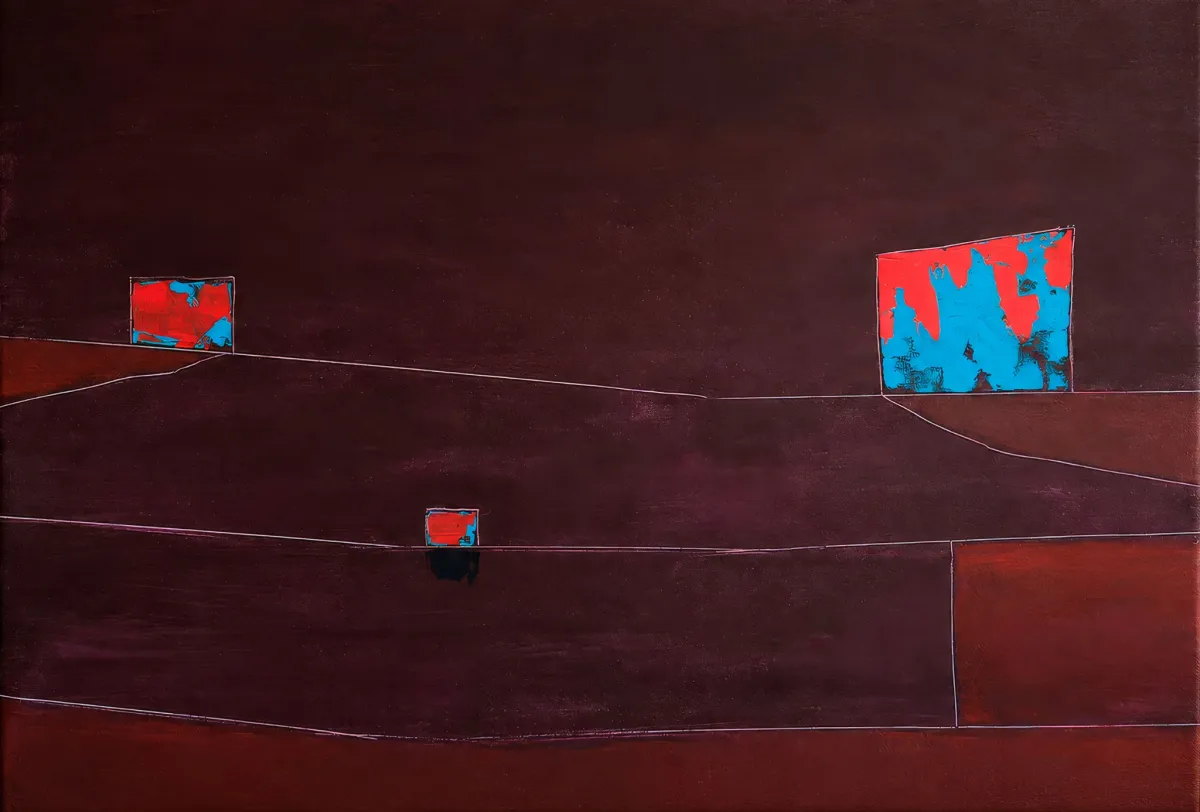
The compositions are organised through broad chromatic fields, strata, horizons, spatial divisions and contained areas of emptiness. Deep earth tones, indigos and crimsons predominate, interrupted by occasional reds, turquoise accents or concentrated areas of light. Colour does not describe a scene. It establishes depth, temperature and pressure.
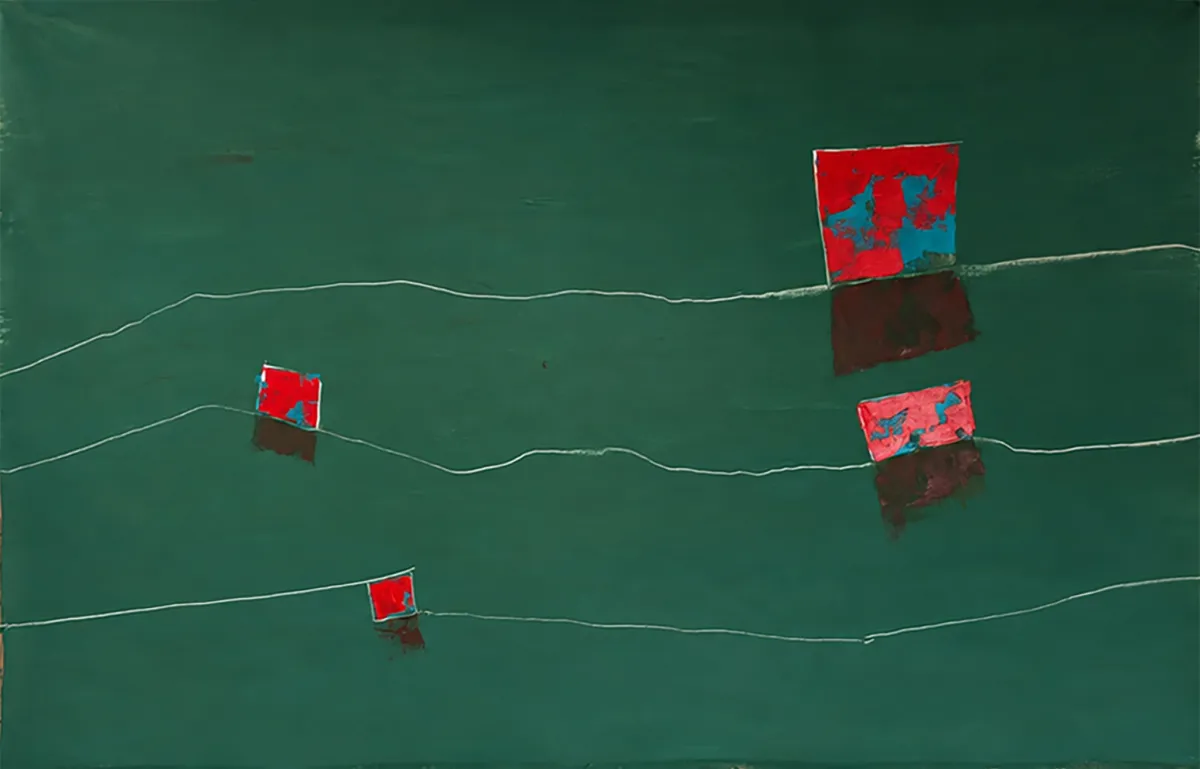
Opposing forces persist beneath the initial stillness. Compression and fracture, permanence and displacement, depth and surface coexist within an austere structure. Every element appears necessary, yet never entirely stable.
Incision, Weight and Memory
The incisions make the record of experience visible. Fine lines, cuts and interrupted paths move across the painted field without fully organising it. They are neither decorative marks nor imposed geometry. They function as traces of memory: they do not reconstruct an event, but they indicate that something has taken place.
In some works, these marks resemble incomplete maps. Elsewhere, they suggest wounds, routes or notations that can no longer be deciphered. Their force lies in this resistance to final interpretation. Memory does not appear as an intact image preserved from the past, but as a change made to the surface itself.
Against the vulnerability of these lines, blocks and monolithic forms introduce concentration, resistance and weight. Their compact presence may evoke beliefs, fixations or inner structures hardened over time. Yet this association never becomes a rigid code. Before becoming a symbol, the block remains matter, volume and tension.
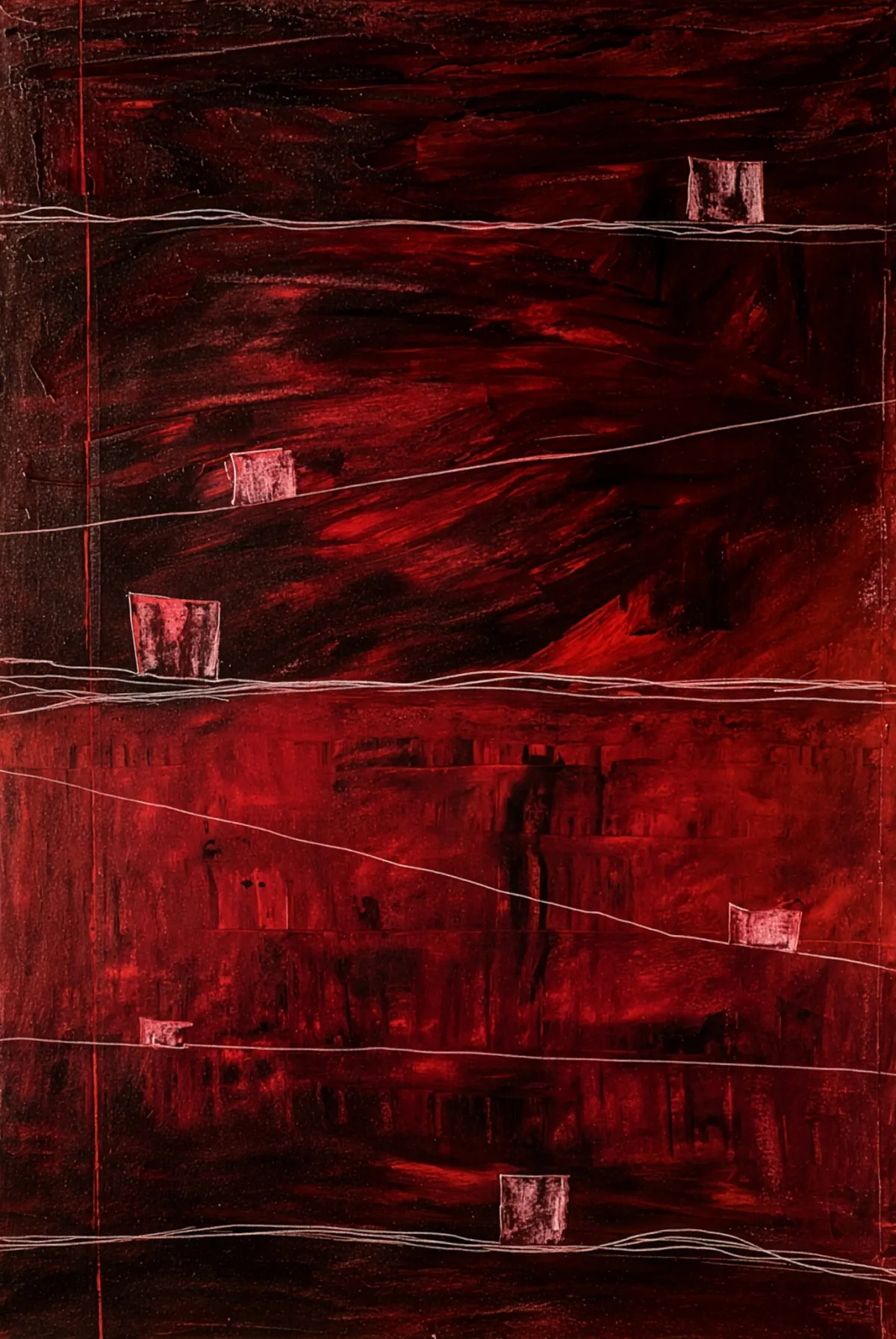
Certain compositions produce a sense of incline, effort or ascent. No staircase appears within STRATA. The upward pressure is generated by the organisation of space, the relationship between chromatic fields and the resistance exerted by particular forms within the painting.
The technique reinforces this conceptual construction. Acrylic foundations establish fields and sedimented layers; oil, glazes and subsequent interventions introduce depth, erosion and shifts in density. Incisions cut across these layers, revealing that the image has not emerged from a single action. The painting retains the history of its making: covered areas, fragments that return, resistant surfaces and cuts that prevent the image from becoming completely sealed.
A Space of Passage
STRATA occupies a distinct position within Maurizio Valch’s recent sequence of painting series. MARE SOMNIORUM opens a field shaped by dream and oneiric space. PRIMORDIUM establishes an originating ground that remains external and elemental. EMERSIO records a moment of emergence and transformation. In STRATA, this territory becomes more individual.
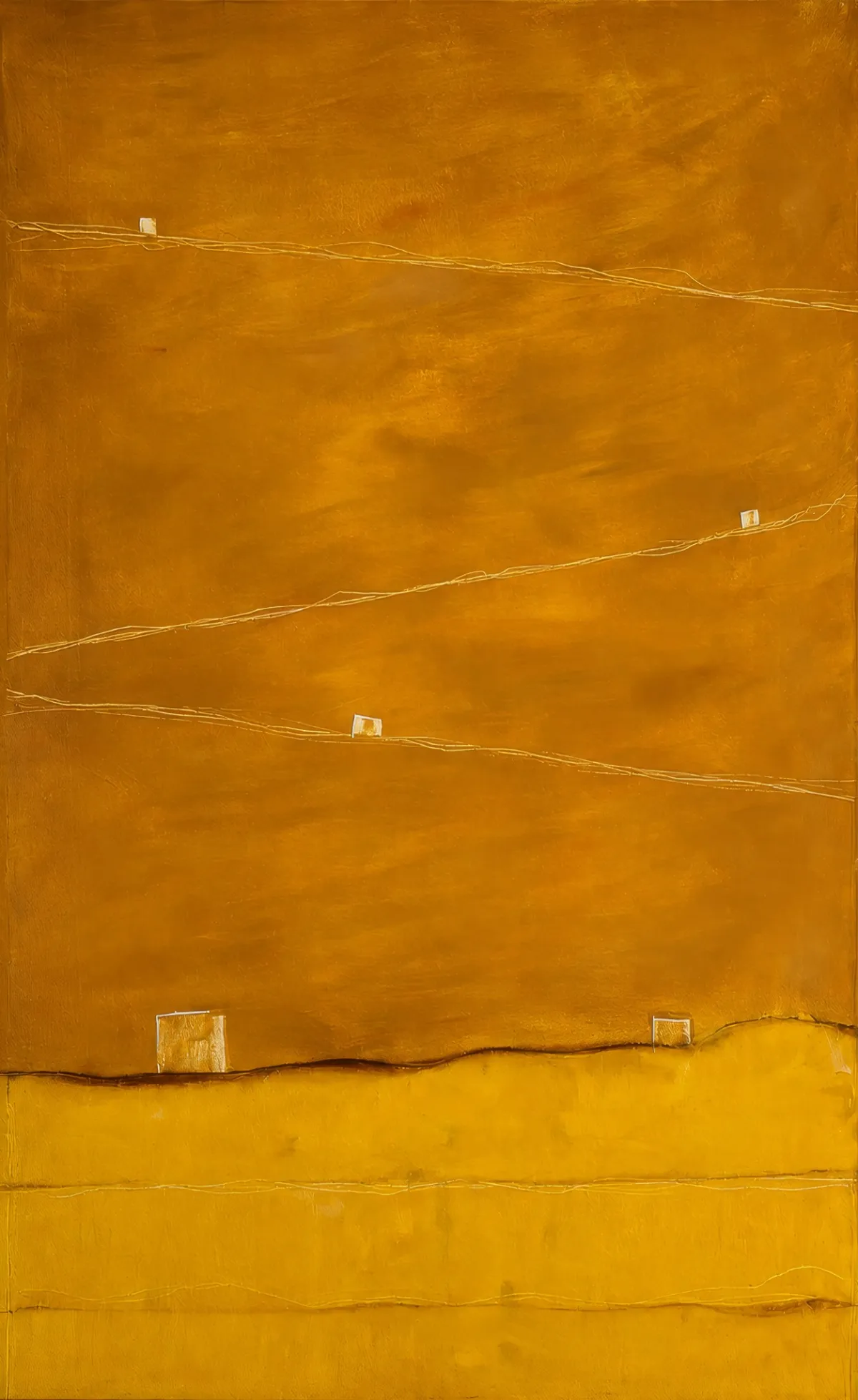
Matter appears to have passed through experience and to carry its consequences. It is no longer only the place where something begins. It is also where something lives, suffers, hardens and continues. The dark, layered surfaces contain this duration without turning it into a linear story.
STRATA presents states of matter and consciousness without separating them. Earth may become skin; an incision may carry memory; a block may embody a hardened structure of thought. None of these correspondences is absolute. Each painting retains its autonomy and remains open as a territory under pressure: a surface marked by time, still capable of transformation.