Studio Notes
From Dream to Territory
Maurizio Valch's work traces an artistic journey from dreamlike perception to structured territory. His series, including MARE SOMNIORUM, PRIMORDIUM, LIMINA, and STRATA, form a continuous inquiry into how we inhabit reality, where external landscapes and internal experiences converge in his pictorial language.
The Trajectory of the Series
Maurizio Valch's oeuvre can be understood as a journey through distinct ways of inhabiting reality. His series are not isolated bodies of work but rather stages within a continuous inquiry: a progression from a space governed by dreams and perception towards a more structured, defined, and conscious territory.
In the series MARE SOMNIORUM, the world remains suspended. The landscape is not depicted as a stable geography but rather as a mental expanse where memory, desire, and distance reshape what is visible. The Mediterranean is more than just a location; it is an imaginary region, a space of passage, and a reservoir of images. The horizon both divides and connects, marking a distance between the known and that which has not yet fully materialized.
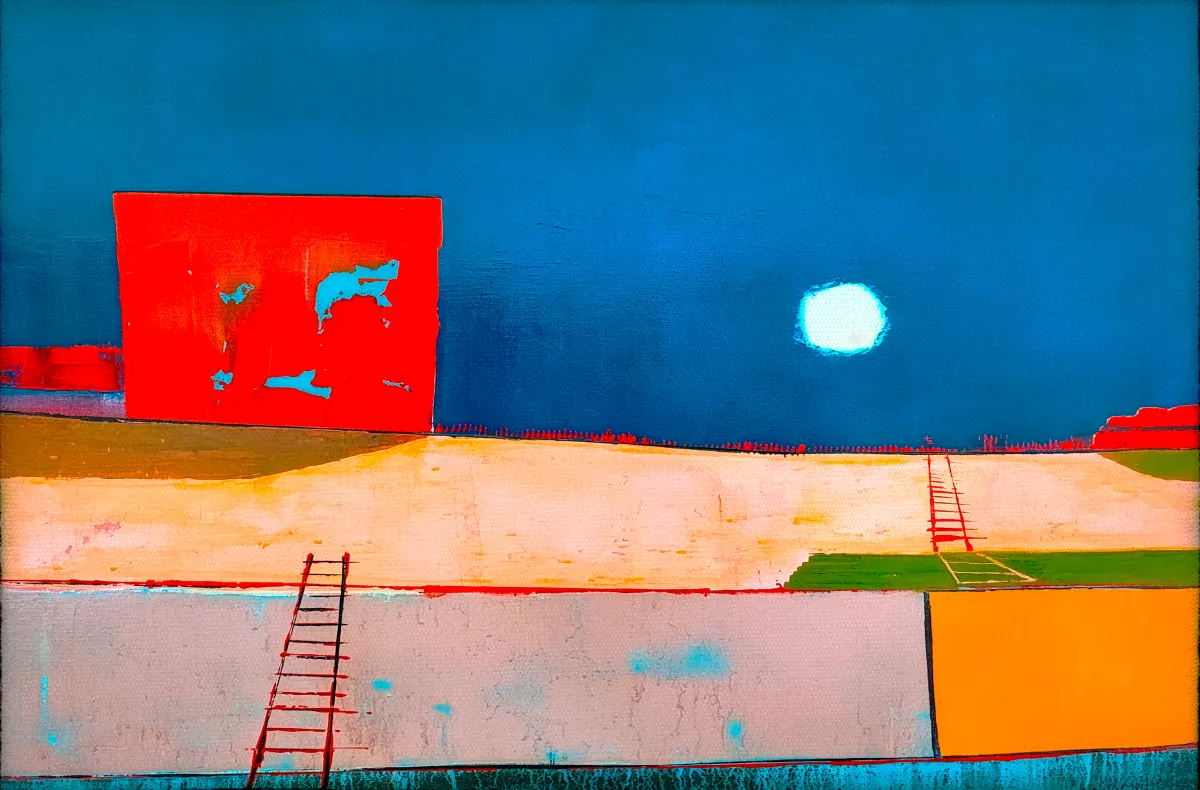
These initial configurations already introduce several elements that will recur throughout subsequent series: stairs, blocks, suspended lights, horizontal divisions, and structures that do not fully integrate into the landscape. These are not rigid symbols; they function as signals, suggesting that the external world encompasses an internal dimension, and that any transformation of consciousness ultimately reconfigures one's relationship with the world.
The staircase symbolizes ascent, yet not as automatic progress or a promise of salvation. To climb implies letting go of a previous stance, re-examining inherited notions, and taking ownership of one's own vision. This journey cannot be undertaken by proxy, which imbues the staircase with a solitary dimension. Nevertheless, this ascent is not confined to individual introspection; it manifests in behavior, in collective life, and in the ability to challenge prevailing currents of thought that society perpetuates unexamined.
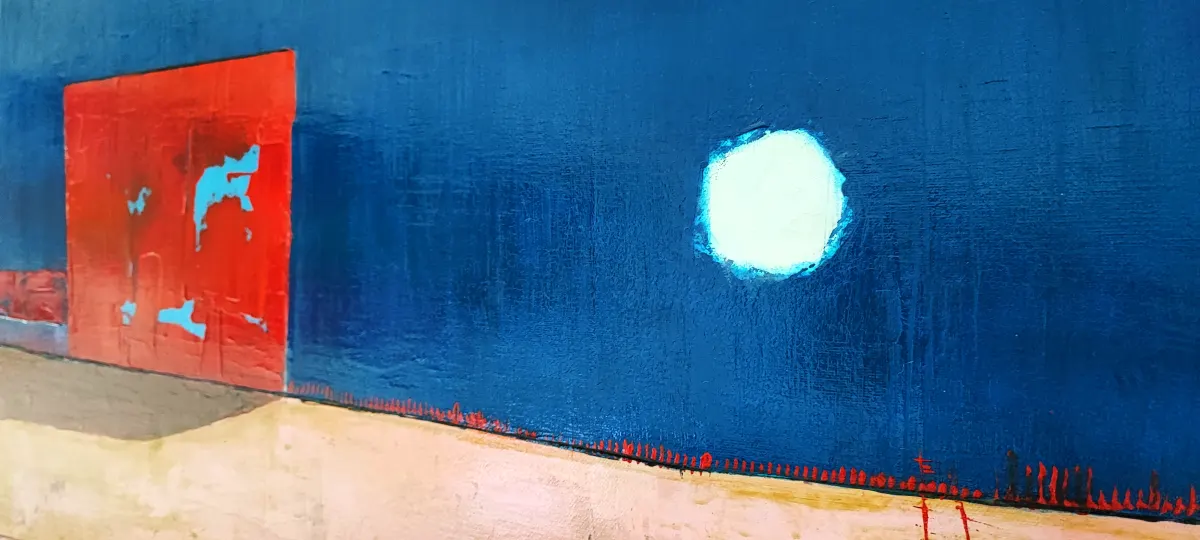
The monolith emerges as a potent presence, retaining a human quality without depicting an actual figure. It might be a structure, a remnant, or a silent form. Its inner nature remains inaccessible. Before it, the moon transcends its role as a mere nocturnal element, casting a soft light that allows the territory to be discerned without fully unveiling its secrets. Light illuminates, yet simultaneously safeguards its mystery.
As the pictorial language evolves, the ground gains increasing significance. In the PRIMORDIUM series, the territory transforms into an origin point. It is no longer merely a dream-infused space but a primal matter from which new forms can emerge. In EMERSIO, shapes begin to lift and detach from the background. The LIMINA series sees space become unstable, with drips, initial incisions, and transitional zones appearing. The painting approaches the liminal space between the formless and that which starts to coalesce.
This progression should not be viewed as a linear evolution where one series simply supersedes the last. Each retains a distinct modality of knowledge. The dream does not vanish when the ground emerges, nor does memory cease its influence as compositions grow more austere. Past explorations remain layered within the new.
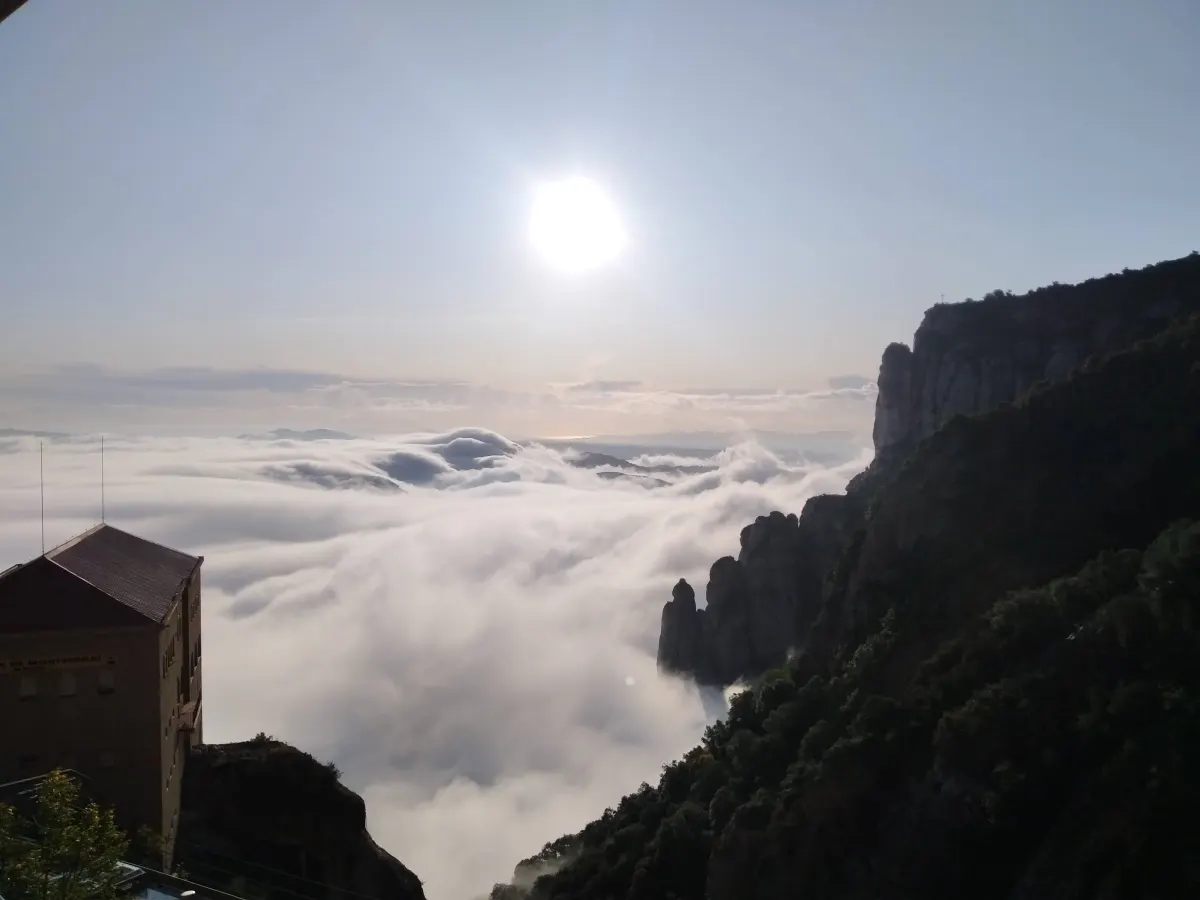
The photograph of Montserrat offers insight into this layering. The mountain, the structure, the light, and the sea of clouds do not directly explicate a particular artwork, yet they inhabit the same perceptual realm. The landscapes encountered by the artist do not reappear as literal documentary illustrations. Instead, they merge, shed their specific temporality, and coalesce into structures. The pictorial territory thus encompasses both external geographies and stratified layers of experience.
This dual condition finds its most intense expression in the STRATA series. Here, the territory transcends its landscape origins to resemble a skin. The surfaces bear cuts, divisions, blocks, and distinct marks. Incisions evoke maps, scars, or mnemonic traces. Monoliths no longer simply occupy space; they exert pressure upon it, interrupt its flow, and compel it to reconfigure itself.
The STRATA series introduces a central question that permeates all the artworks: how much of what an individual considers their own truly originates from personal experience, and how much has been inherited, amassed, or imposed? The layers do not signify a stable identity but rather a construct subjected to the relentless forces of time, pressure, and the potential for rupture.
The trajectory uniting these works does not propose a fixed doctrine or a definitive answer. Instead, it posits a fundamental condition: consciousness does not emerge apart from the territory, but rather from within its strata. It arises through recognizing the imprints, divisions, and constituent elements that have shaped both individual lives and society.
From the realm of dreams to the very skin of the territory, these series depict a transformation that is both individual and collective. Every shift in perspective reconfigures how one relates to others. Every internal fracture inevitably manifests external consequences. And every true ascent commences when an individual ceases to follow inherited paths and embraces the responsibility of charting their own course.