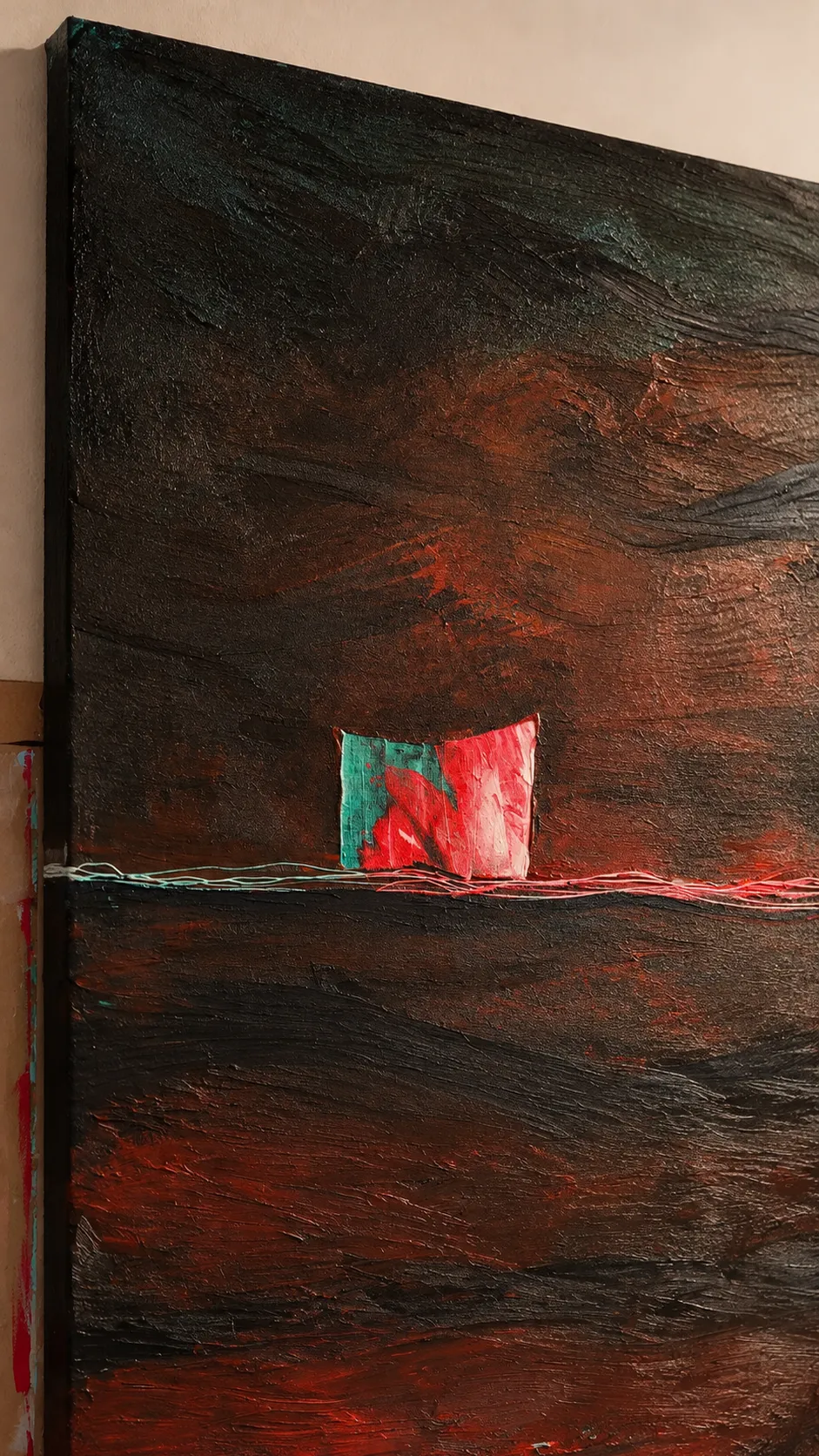
Context study / What the Night Left Burning
What the Night Left Burning (Perspective and Texture) - Maurizio Valch
1. The Lower Sediment (Gravity and the Body)
In front of What the Night Left Burning, the viewer's body first experiences a downward pull. This is not a contemplative invitation; it is a physical imposition of gravity. The lower half of the painting behaves like a dense geological mass, a stratum of dark, ferrous matter that seems to have accumulated the cold of the deepest hours. We do not know if it is compacted mud, wet ash that has ceased to burn, or the dense water of a nocturnal lake that has absorbed all reflections. The heavily loaded and built-up brushstrokes here do not describe a place, but a resistance: matter opposes light, offering a rough, opaque, and tactile surface that demands to be felt with the skin before the eyes.
Before this untamed ground, the voice of Claude Lévi-Strauss resonates—the anthropologist who taught us to see how the human mind draws boundaries and classifies primordial chaos to build a habitable shelter against the elements. For him, this lower mass represents the raw: nature in its densest, most impenetrable state, indifferent to human will. It is the blind substrate upon which we attempt to erect our fragile systems of meaning, a tide of shadow constantly threatening to swallow our small structures of order.
2. The Fracture Line (The Horizon Ignited)
Suddenly, the abyss is cut short. A horizontal, almost electric line tears through the blackness, holding at its center a bichromatic block split between a mint green and an incandescent red. This is where the work’s thermal and visual shock occurs. A child looking at this painting would not get lost in metaphors about existence; they would ask an immediate, physical question: why does that small, glowing box, suspended from such a thin thread, not sink into the immensity of the black mud? There is an extreme fragility to its balance, an almost miraculous resistance against the gravity of the lower sediment.
This floating block acts as the first cultural gesture amid disorder. Following Lévi-Strauss’s tension, the geometry of this core—with its straight edges defying the chaotic fluidity of the background—represents civilization’s effort to impose a mark, a landmark, or a sign within the desert of the night. It is not a house, but the pure idea of structure; a sign of warmth defending itself against the absolute cooling of its surroundings.
I remember standing before the canvas, besieged by the immensity of that dark stain, feeling a deep physical doubt in my hands. As I drew that thin line and placed the bichromatic block of green and red, something shifted in the temperature of the studio. It was not a purely rational decision; it was the wonder of seeing how that minimal strip of light began to vibrate with a silent stridency, holding the entire weight of the black plane like a magnet suspended in the void.
3. The Upper Atmosphere (Opacity and What Remains)
As the gaze ascends, the matter becomes more atmospheric but no less indecipherable. The upper third of the painting is a turbid sky, a space heavy with glazes where black blends with an underground reddish glow, as if the smoke of an invisible fire were tinting the air. Here, light does not illuminate; rather, it reveals the density of the shadow.
This is where Édouard Glissant, the Martinican writer and philosopher who defended the "right to opacity" and conceived of landscape not as territory to be conquered but as a space of complex relations, flows, and submerged memories, intervenes. Glissant would warn us of the danger of wanting to "clarify" this painting, of attempting to project a rationalist light upon it to dissipate its mystery. The work's upper atmosphere reclaims its right not to be fully understood. It is the night folding back in on itself, guarding its secrets, protecting the memories of what burned before we arrived to look.
While Lévi-Strauss’s geometric order seeks to delimit and rescue the floating structure, Glissant’s opacity invites us to accept the uncertainty of the dark background, to understand that the value of painting lies precisely in that which completely refuses to be translated.
In the end, one steps back and realizes that the work has acquired a strange autonomy that no longer belongs to me. I look at this space and accept that the painting knows something about the persistence of fire and the withdrawal of the night that I myself, as a painter, have yet to decipher; it has become a mute witness to a fire occurring beyond my reach.
- Original artwork
- What the Night Left Burning
- Actual dimensions
- 47.2 × 63 in / 120 × 160 cm
- Presentation
- Digital contextual visualization
Context references
oil texture palette knife · abstract painting relief · incised lines on canvas · acrylic paint layers · contemporary art texture · artwork perspective
About this visualization
This visualization places the artwork within an architectural context to help collectors and viewers imagine its presence in a real space. It is an interpretive reference, not an exact reproduction: the original work remains the sole authority for scale, color, surface and material presence.