Context study / What the Night Left Burning
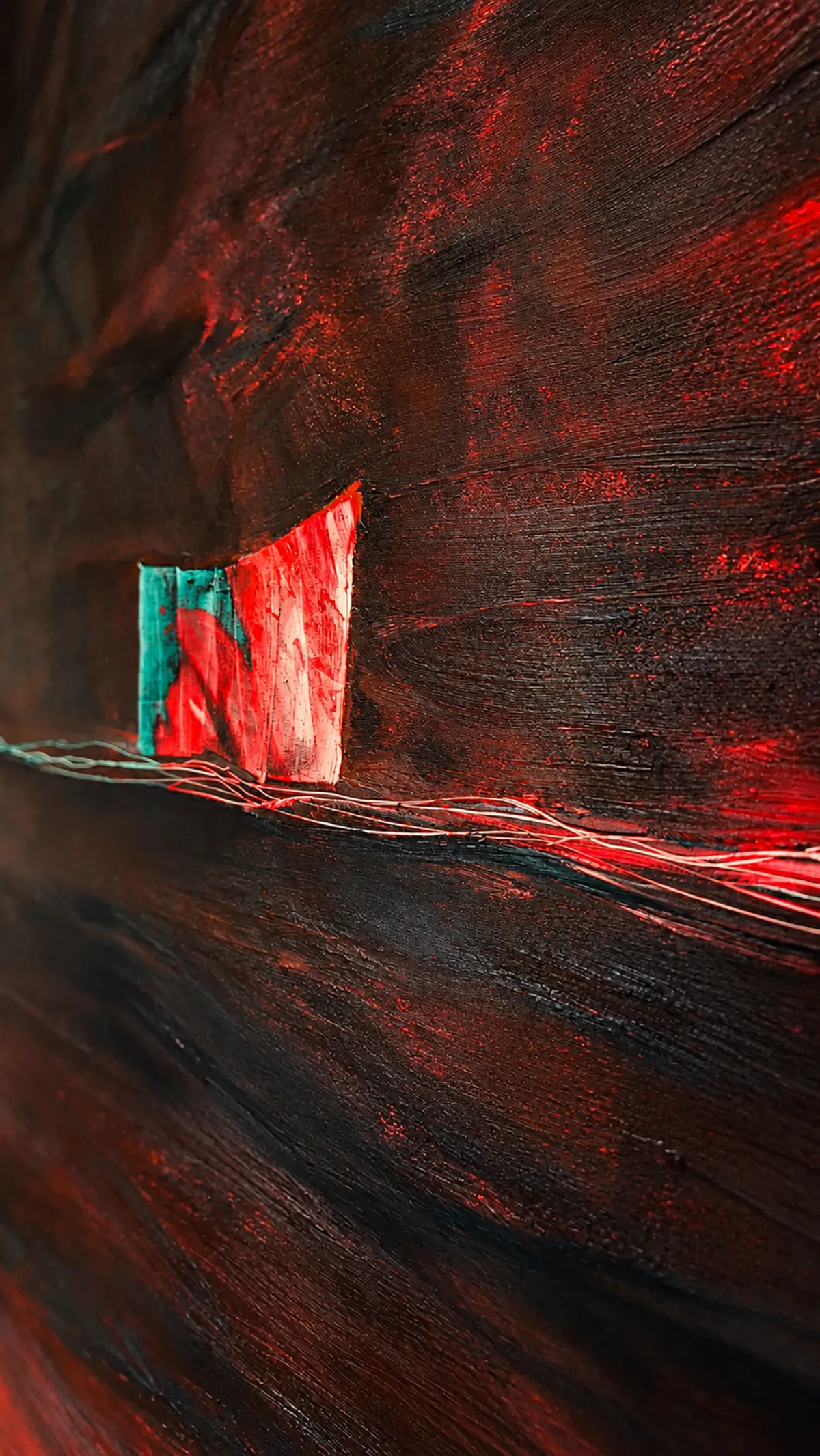
Texture and Matter Detail in What the Night Left Burning | Valch
Movement I: The Complementarity of Shadow
Before the burning surface of What the Night Left Burning, the gaze does not rest; it is drawn into an atmosphere that seems to breathe out of step. In the upper half of the canvas, a dense, almost tactile darkness unfolds in diagonal grooves that reveal, through deep scraping, an incandescent background of reds and ochres. This is not a passive darkness, but a void charged with latent energy.
To Niels Bohr, a thinker who learned to decipher the universe by suspending the need for absolute truths, this surface would not represent a conflict between light and shadow, but a manifestation of their complementarity. The Danish physicist would contemplate this chromatic mass with the suspicion that black does not hide the fire, but is its state of transition. In quantum physics, a particle can also be a wave; on this canvas, the night is also the fire. There is no clear border determining where combustion ends and ash begins: both realities coexist in a superposition of visual frequencies that challenges the logic of exclusion.
When I began dragging the palette knife across the canvas, I was not seeking to paint a landscape, but to witness the birth of a fire beneath the skin of the night. I remember the physical resistance of the material, the friction of the black pigment accumulating in rough crests while the red, dense and viscous, filtered through from below, like lava refusing to cool completely; there came a point where I lost control of the duel between both tones, and simply dedicated myself to recording the vibration of that violent friction on the canvas.
The Interlude of the Body
Right on the scar dividing the painting, a thin line of light and matter—a filament that simulates a copper wire or an exposed vein—cuts across the space from left to right. It is here that intellectual speculation must yield to the vibration of muscle and gravity.
In observing this incised split, Jacques Lecoq intervenes, a pedagogue of space who understood human movement as a direct response to the invisible forces of the environment. Lecoq invites us to feel the painting not with our eyes, but with the weight of our own body: that horizontal line is not a simple brushstroke, but a tightrope requiring an effort of physical balance. Looking at its inclination and subtle oscillations, our physical axis tenses unconsciously. It is an "active silence", a moment of dramatic suspension before the fall, where the horizon itself seems to vibrate under the weight of the upper mass pressing down on it.
Movement II: The Geometry of the Residue
Shifting the balance to the left of this unstable horizon, the anomaly emerges: a geometric, bicolor, three-dimensional volume that seems to float or be aground on the filament. Its left half is a cold, almost mineral turquoise, while its right half ignites in a direct, flat red.
To Bohr, this block is a fundamental discontinuity, the equivalent of a quantum leap within a continuous field. It is an element that introduces a geometric paradox into a universe of organic and turbulent brushstrokes. Where does this ordered structure come from in the midst of the chaos of burned matter?
Lecoq, on the other hand, would see this block as the main actor of the drama. For him, this bicolor volume functions like a neutral mask on a stripped stage. By not revealing its origin, the object assumes the maximum dramatic weight: it sustains the red light on one side and resists the push of the background on the other, becoming the pivot upon which all the tension of the surrounding space turns.
Contemplating that asymmetrical block of turquoise and red floating above the line now, I experience a strange sense of estrangement, as if looking at an archaeological remnant that I did not deliberately trace, but that emerged on its own from the accumulation of oil; it is an orphaned residue that has nevertheless become the absolute center of gravity of the painting, the only solid witness surviving the combustion of this unstable space.
Closure Without Resolution
The painting of Maurizio Valch refuses to give us an explanation of its own ruin. The line of light continues its course toward the margins, losing itself at the edges of the stretcher, reminding us that the visible space is only a fragment of a larger event. As we turn our eyes away from the canvas, the retinal persistence of the red stays with us like an ember suspended in the air of the room. A final question is left hanging in the space: when the lights in the room are completely turned off, what exactly is it that the night of the canvas will continue to burn in the shadows?
- Original artwork
- What the Night Left Burning
- Actual dimensions
- 47.2 × 63 in / 120 × 160 cm
- Presentation
- Digital contextual visualization
Context references
abstract painting texture close up · oil incision detail maurizio valch · bicolor turquoise and red painting block · palette knife texture and paint layers · contemporary art close up
About this visualization
This visualization places the artwork within an architectural context to help collectors and viewers imagine its presence in a real space. It is an interpretive reference, not an exact reproduction: the original work remains the sole authority for scale, color, surface and material presence.