Context study / What the Night Left Burning
What the Night Left Burning by Maurizio Valch in Gallery | STRATA
Movement I: The Scale of the Shipwreck
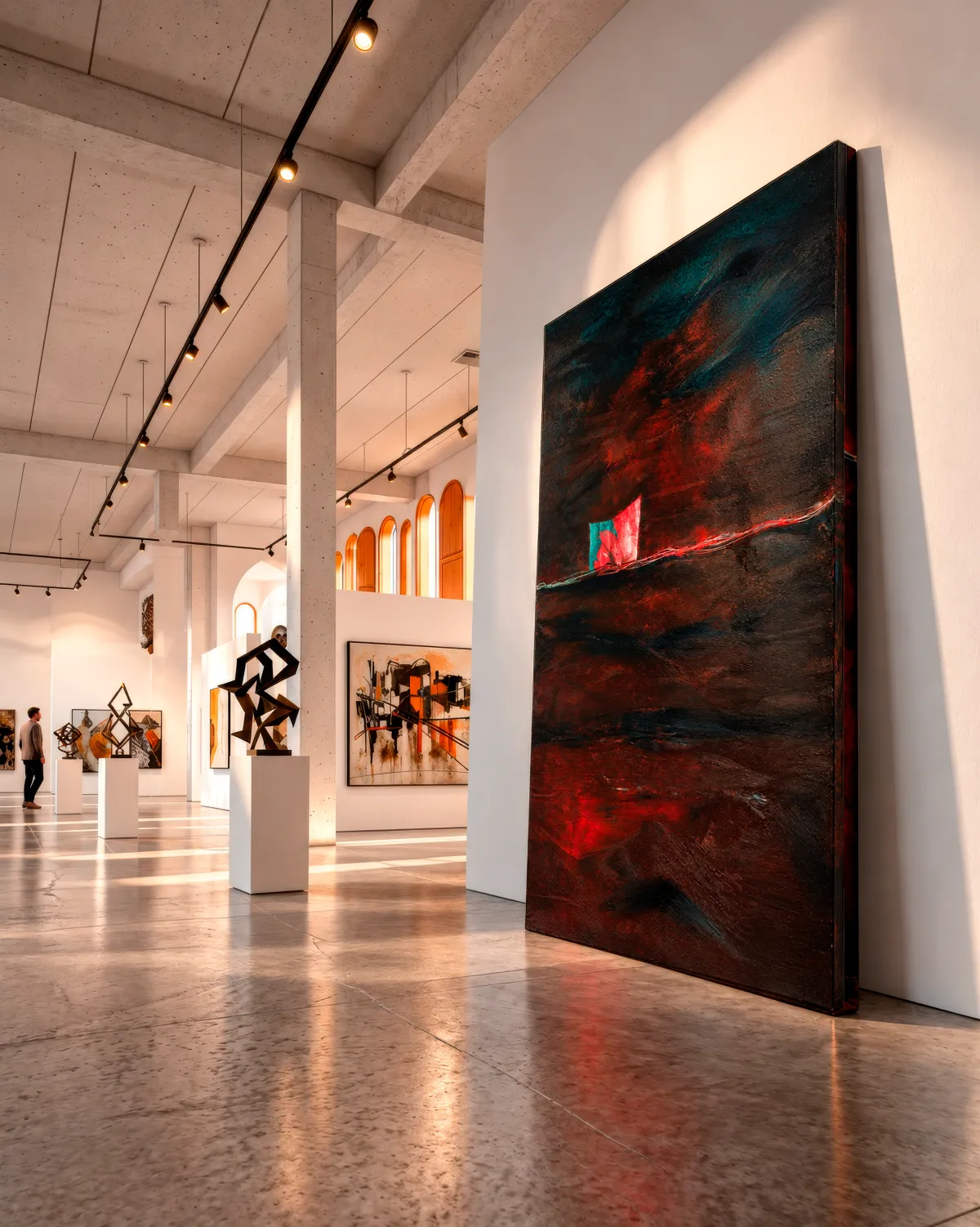
Standing before this artwork is to submit to an unforeseen gravity. The canvas, with its imposing height of 160 centimeters, does not offer itself as a passive window, but as a tectonic wall leaning subtly over the viewer's body. There is a physical density here, almost geological, that is felt in the chest before it is deciphered by the eyes. The surface of the painting is a territory of extreme temperatures and chromatic contradictions: we are not facing an empty night, but a charged, dense, and magmatic darkness that seems to breathe.
Black here is not the absence of light, but accumulated matter, a pictorial soot pressing from the edges of the stretcher. Beneath that gloom, the reds and ochres do not act as mere decorative accents; they vibrate with the latency of an underground fire, as if the canvas were the still-warm crust of a territory that has just burned. Facing this organic immensity, the viewer experiences the vertigo of a shipwrecked soul: the physical sensation that the background is a dense ocean capable of swallowing any presence that dares to float upon its surface.
Movement II: The Geometry That Resists
In the midst of this storm of untamed matter, a thin horizontal line cuts the canvas in two. Floating above it like an improbable anomaly is a small geometric compartment. It is a tiny prism, cleanly divided into two faces: one turquoise and the other a burning red. Its scale is ridiculous against the chaos that surrounds it, yet its formal precision introduces a radical tension into the space.
Before this minuscule structure, Buckminster Fuller—the designer, architect, and visionary who sought in pure geometry the ultimate refuge for human survival in the immensity of the universe—would stop, fascinated and bewildered. For him, this bicolor box is not an aesthetic whim, but a prototype of an autonomous habitat pushed to the limit of its physical possibilities. Fuller interrogates the painting with rational urgency: how does this polyhedron manage to sustain itself on such a fragile line? What gravitational forces allow such an exposed structure not to be crushed by the density of the background? For the architect, the piece is a lesson in thermodynamic resistance: the turquoise of the left face represents the insulation from the external cold; the red, the conservation of internal heat. It is geometry as the last shield of intelligence against chaos.
However, on the same side of the canvas, Maurice Sendak—the illustrator and writer who understood the night, the child's bedroom, and fantasy as sacred spaces where our most fertile monsters and fears dwell—shakes his head with a knowing smile. Sendak does not see an engineering design, but a room suspended at the edge of wakefulness. For him, that glowing prism is a child's bedroom with the light left on late at night, a chest of intimacy surrounded by shapeless creatures lurking in the magmatic shadow of the background. And what is that red blooming from its interior if not the incandescence of child's desire, rage, or dream that refuses to go out in the face of the encroaching shadow? For Sendak, what burns does not terrify us; it shelters us.
> Maurizio Valch: When I confronted this canvas, I dragged the palette knife and the brush almost blindly through that mass of darkness, feeling how the heavy oils resisted my physical movements in the studio. I wanted that blackness to have the weight of wet earth mixed with ash, a wall constantly threatening to bury the thin line of light dividing the composition. I remember the constant doubt of not knowing whether I was painting the aftermath of a great forest fire or simply the residue of a domestic light refusing to die in the immensity of a wasteland; the canvas dictated its own temperature, and I could only follow the trail of the hot pigment before it cooled on the cloth.
The confrontation between both observers destabilizes the painting. Fuller's geometry softens under Sendak's psychological gaze, while Sendak's fantasy is forced to anchor itself to the constructive rigidity that supports the plane. The matter of the painting does not allow their positions to synchronize in a peaceful resolution; the background keeps pushing, threatening both the spatial refuge and the mental sanctuary.
Movement III: What Remains Burning
What time governs this work? The horizon line, lit like an incandescent filament, does not allow us to know if we are witnessing a post-apocalyptic dawn, where light barely manages to break through a charred atmosphere, or if we are contemplating the last ember of a day fading away forever. Time in the painting is circular, suspended in an eternal tension between what is consumed and what resists becoming ash.
> Maurizio Valch: Listening to the ways in which people try to decipher this work, I realize that this small bicolor box already possesses an autonomous life that completely escapes my control and my original intentions. There is an irreconcilable contradiction between the rigor of the design with which I traced its edges and the way it now seems to float like a living organism, pulsing with its own light on the surface of the canvas. I must accept that there is a density in this work that remains an unfathomable mystery even to my own eyes; I painted a refuge, but I still do not know who or what is hiding inside it to protect itself from the cold of the night.
Upon looking away from the painting, the persistence of that small bicolor structure remains on the retina. It is not a victory of order over chaos, nor a surrender to darkness. It is, quite simply, the evidence of a stubborn resistance. Leaving the exhibition room and returning to the light of day, the question follows us in our bodies: in the midst of our own nights and personal disasters, what is that minimal internal geometry that keeps us safe from shipwreck?
- Original artwork
- What the Night Left Burning
- Actual dimensions
- 47.2 × 63 in / 120 × 160 cm
- Presentation
- Digital contextual visualization
Context references
large format abstract painting gallery · contemporary abstract painting maurizio valch · paintings for museums and exhibitions · black and red brutalist abstract art · strata maurizio valch
About this visualization
This visualization places the artwork within an architectural context to help collectors and viewers imagine its presence in a real space. It is an interpretive reference, not an exact reproduction: the original work remains the sole authority for scale, color, surface and material presence.