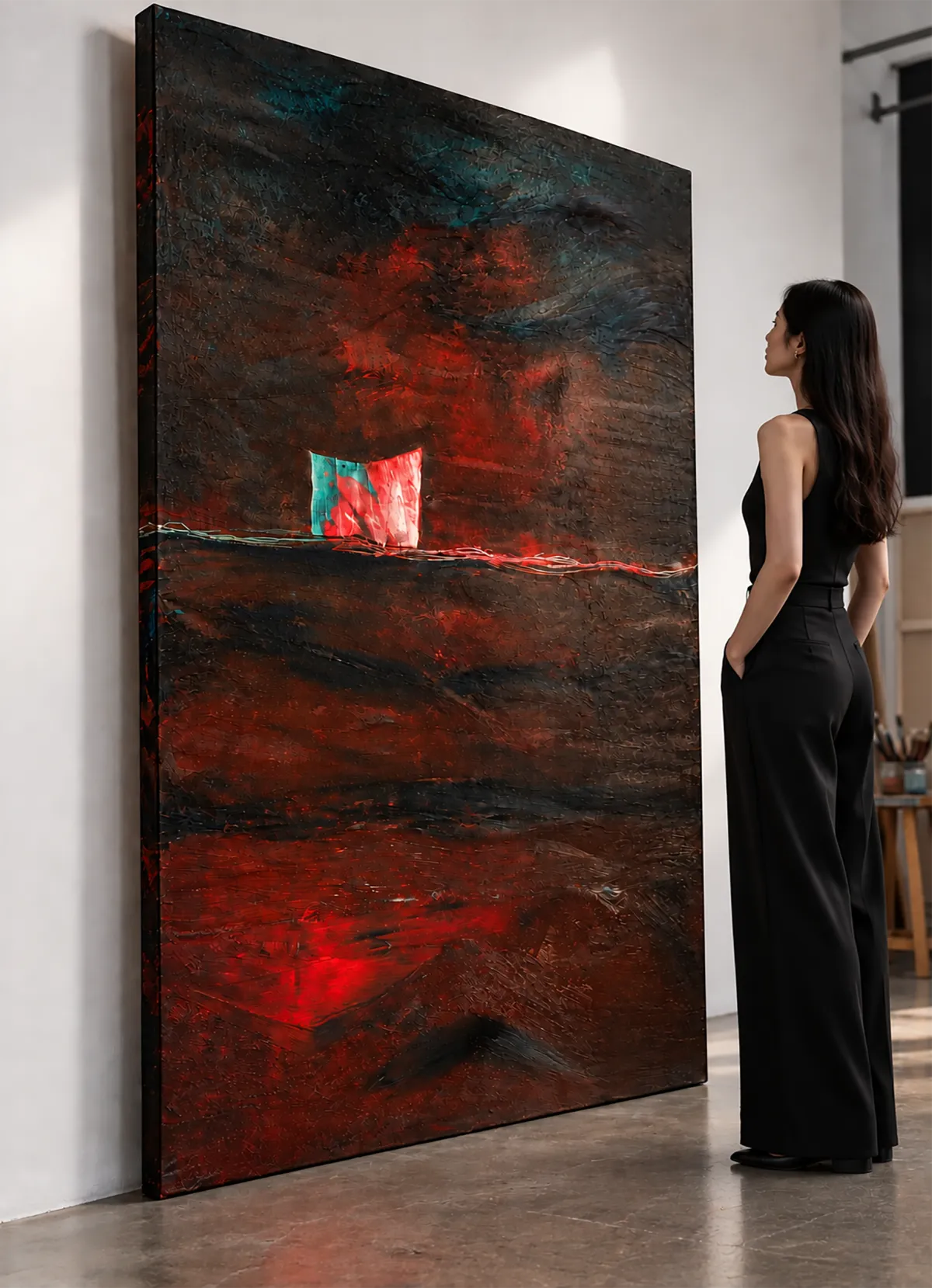
Context study / What the Night Left Burning
What the Night Left Burning - Artwork Details | Maurizio Valch
Part I: The Surface of the Line
Space is not a passive void; it is a dense mass pressing from the edges of the canvas toward the center, a nightly mud threatening to devour every presence. In this upper shadow, the air feels freezing, like the static breeze preceding a storm on the steppe. Amid this suspended emptiness, a formal enigma emerges: a floating quadrilateral, divided into a water-green half and an incandescent red half. Is that bicolor block a burning house in the distance, an open book whose pages secretly burn, or perhaps a lost toy floating in the dark? The child's gaze immediately disarms the gravity of the space, reducing the catastrophe to an intimate miniature.
For Euclid—an observer who seeks the invisible order of the cosmos by reducing chaos to the purity of the line and the point—this scene is a battlefield of spatial tensions. The sage of Alexandria searches with his gaze for the fulcrum, the perfect straight line to support the weight of the floating block. He defines the horizon as an absolute limit, a tense segment trying to contain the pressure of the upper plane. However, his geometry is immediately sabotaged by the atmosphere.
Akira Kurosawa—a director who sculpts the wind and the agitation of the human soul through violent chromatic contrasts and frames charged with destiny—intervenes to displace the rational gaze. For the filmmaker, that dividing line is not an abstract concept, but a high-voltage wire exposed to the wind, a physical barrier barely containing the black smoke of a forest fire. The bicolor block is an actor under a dramatic spotlight; the water-green represents the last stand of calm, while the red is the inevitable intrusion of tragedy staining the frame. Here, geometry is not mathematical: it is pure scenic tension.
> Confronted with the heaviness of this dark matter, I felt an almost physical need to resist its sinking. My hand did not seek to trace a decorative horizon, but to drive a wedge of light, a horizontal needle that would prevent the ashen sky from crushing the base of the canvas. That fine red and white line supporting the block is a tense tendon, a boundary I conquered against the advance of black; a minimal frontier where the painting refuses to be buried under its own weight.
The Horizon Bridge
A scar of wire and light wears down the night;
above, the cold that keeps silent; below, the fire that trembles.
Part II: The Abyss of the Reflection
As the gaze descends below the dividing line, the rigidity of the plane dissolves. We enter the realm of refraction. The temperature shifts abruptly: the biting cold of the upper air becomes here a dense, humid, and subterranean heat. The reflection of the block at the base of the canvas does not respect the laws of Euclidean symmetry. The red stain slips, dilates, and liquefies, transforming into a tide of dark lava pulsing from the depths of the painting.
Euclid is bewildered by this abyss; perpendicularity is broken and the reflection no longer returns the proportions of the original object, but a fluid distortion where parallel lines converge and dissolve in the disorder of wet matter. The point no longer has a position and the plane has become a dense fluid. Kurosawa, on the other hand, smiles at the disaster. He recognizes in this lower zone the climax of the battle: it is the muddy ground of his cinematic battles, stained by the reflection of torches in the rain. The red light is not an optical ornament; it is the projection of the painting's internal turmoil, a current of blood and fire flowing beneath the surface of the wet earth.
The rigidity of the line has completely dissolved in this lower ocean, leaving the viewer floating in a zone of uncertainty where heat is not seen, but breathed.
> There is a point in execution when the painting ceases to belong to you and begins to generate its own climate. I did not plan the density of that red tide at the base; I simply allowed the pigment to seek its gravity. Stepping back, I discovered with a mixture of wonder and strangeness that this lower zone pulsed with a scorching temperature, a heat I did not foresee and which seemed to escape the physical laws of the studio, as if the canvas had stored the heat of a lifetime's fire to let it burn in secret under the paint.
- Original artwork
- What the Night Left Burning
- Actual dimensions
- 47.2 × 63 in / 120 × 160 cm
- Presentation
- Digital contextual visualization
Context references
textured abstract painting details · maurizio valch paintings with incisions · large format contemporary art · abstract canvas with red and black tones
About this visualization
This visualization places the artwork within an architectural context to help collectors and viewers imagine its presence in a real space. It is an interpretive reference, not an exact reproduction: the original work remains the sole authority for scale, color, surface and material presence.