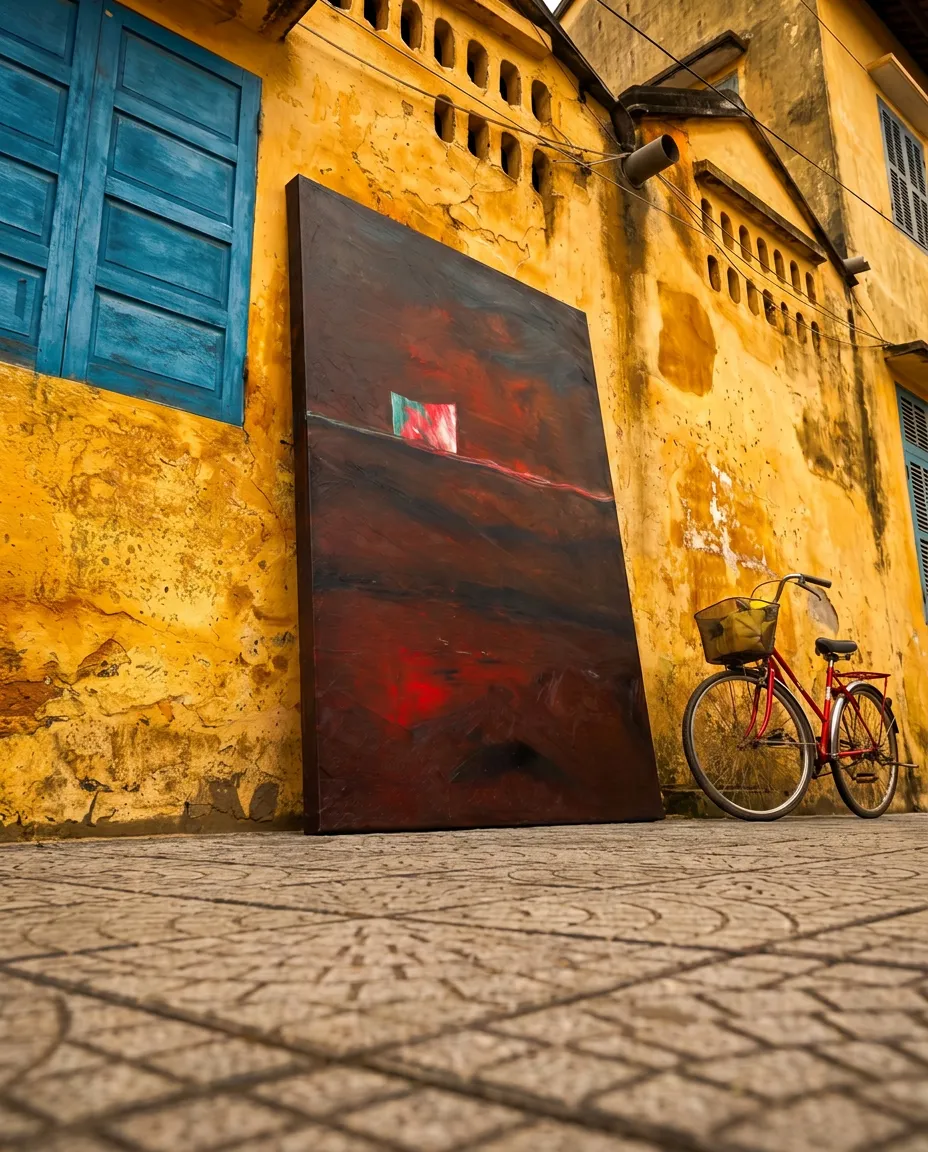
Context study / What the Night Left Burning
What the Night Left Burning in an Urban Context | Maurizio Valch
Movement I: The Three-Dimensional Scar (The Middle Zone)
A horizontal slash divides the 120 x 160 centimeters of canvas, not as a geometric vanishing line, but as a tectonic fault. Above this unstable boundary floats a mysterious bicolor block, green and red, suspended in an impossible gravitation. Here, the two-dimensionality of the canvas is sabotaged. To dialogue with this perturbation, we summon Lucio Fontana, the surgeon of the canvas who was not satisfied with representing the infinite, but preferred to tear the fabric to force physical space to merge with the cosmos.
From Fontana’s perspective, this block is not a mere painted volume: it functions as a conceptual cut, a three-dimensional threshold that sucks the gaze into an active void. It is not a window onto an external landscape; it is a wound through which the pictorial matter exhales its inner light. Fontana would warn that the thin red line supporting the block is a filament of pure energy, a high-voltage wire keeping the canvas surface under unbearable pressure. What is the temperature of the air just three centimeters above that luminous line? Is the green-red block an intruder in the landscape, or is the landscape retreating around it?
> When I isolated that block of color in the middle of the shadow, I felt a strange resistance in the brush, as if the matter itself refused to be purely flat. Sustaining that burning flash against the dark tide required an almost violent physical vibration in the studio; the green and red do not collide to negate each other, but to emit a radiation that seems to look back at whoever observes it. At that middle point, the painting ceased to be something I controlled and became an autonomous object, a silent witness to its own combustion.
Movement II: The Suspended Atmosphere (The Upper Half)
Upon lifting the gaze above the central scar, the painting dematerializes into a turbulent, gaseous mass. The upper half of What the Night Left Burning is not a passive night sky; it is a heavy atmosphere, laden with suspended particles, a shroud of ash and thermal memory retaining the heat of an invisible event. Here, Bruno Latour, the terrestrial philosopher who taught us not to look at nature as an inert stage, but as an ultra-reactive "Critical Zone" where each element metabolizes and responds to the actions of others, intervenes.
Latour would observe this upper half not as an aesthetic background, but as the meteorological record of a wounded planet. For him, this dark mass is not "empty air," but a dense agent loaded with historical soot and chemical exhalations. An insurmountable friction then occurs between our two guests: while Fontana seeks a vertical escape toward the purity of infinite space through the luminous portal of the central block, Latour pulls us back down, reminding us that this dense atmosphere is the feedback loop of our own terrestrial metabolism. Valch's sky does not allow us to escape; it returns our own breath to us, transformed into a cloud of ash.
Movement III: The Reactive Sediment (The Lower Half)
Descending to the base of the canvas, the rhythm of syntax and matter becomes thick, slow, and geological. The brushstrokes here lose the gaseous agitation of the sky to become mud, slag, and sediment. Red is no longer suspended light; it is a subterranean lava flow or the moisture of a ground soaked in the residue of a recent fire.
If this canvas were a heat accumulator, in which direction would the energy flow when we turn off the gallery lights? How does our body weight change when looking at the density of the lower matter compared to the weightlessness of the upper atmosphere? Latour would see in this pictorial ground the very evidence of terrestrial resilience: a substrate that assimilates, processes, and keeps pulsing the heat of what has burned. It is not dead ash; it is a ground breathing latent fire.
> As I pushed the oil toward the base of the canvas, my body immediately felt the force of gravity, the drag of matter demanding its own weight and thickness on the wooden support. There is a deep uncertainty in working this low area: as I spread the dark tones mixed with the burning glazes, I never knew for sure if I was painting the beginning of a subterranean fire that would soon devour the entire surface, or if I was simply caressing the last wet embers of something the night had already finished consuming.
The work, physically resting on the floor of the real world, refuses to offer a verdict. Between the cosmic urgency of Fontana's cut and the terrestrial realism of Latour's Critical Zone, the painting remains a thermal remnant. It does not conclude: it simply continues to burn with a cold light, reminding us that what the night leaves behind is never a void, but an intensely alive territory that resists cooling down.
- Original artwork
- What the Night Left Burning
- Actual dimensions
- 47.2 × 63 in / 120 × 160 cm
- Presentation
- Digital contextual visualization
Context references
large format abstract painting outdoors · work by maurizio valch strata series · abstract paintings with wall textures · contemporary art in urban spaces
About this visualization
This visualization places the artwork within an architectural context to help collectors and viewers imagine its presence in a real space. It is an interpretive reference, not an exact reproduction: the original work remains the sole authority for scale, color, surface and material presence.