Context study / What the Night Left Burning
What the Night Left Burning - Maurizio Valch | Abstract Painting
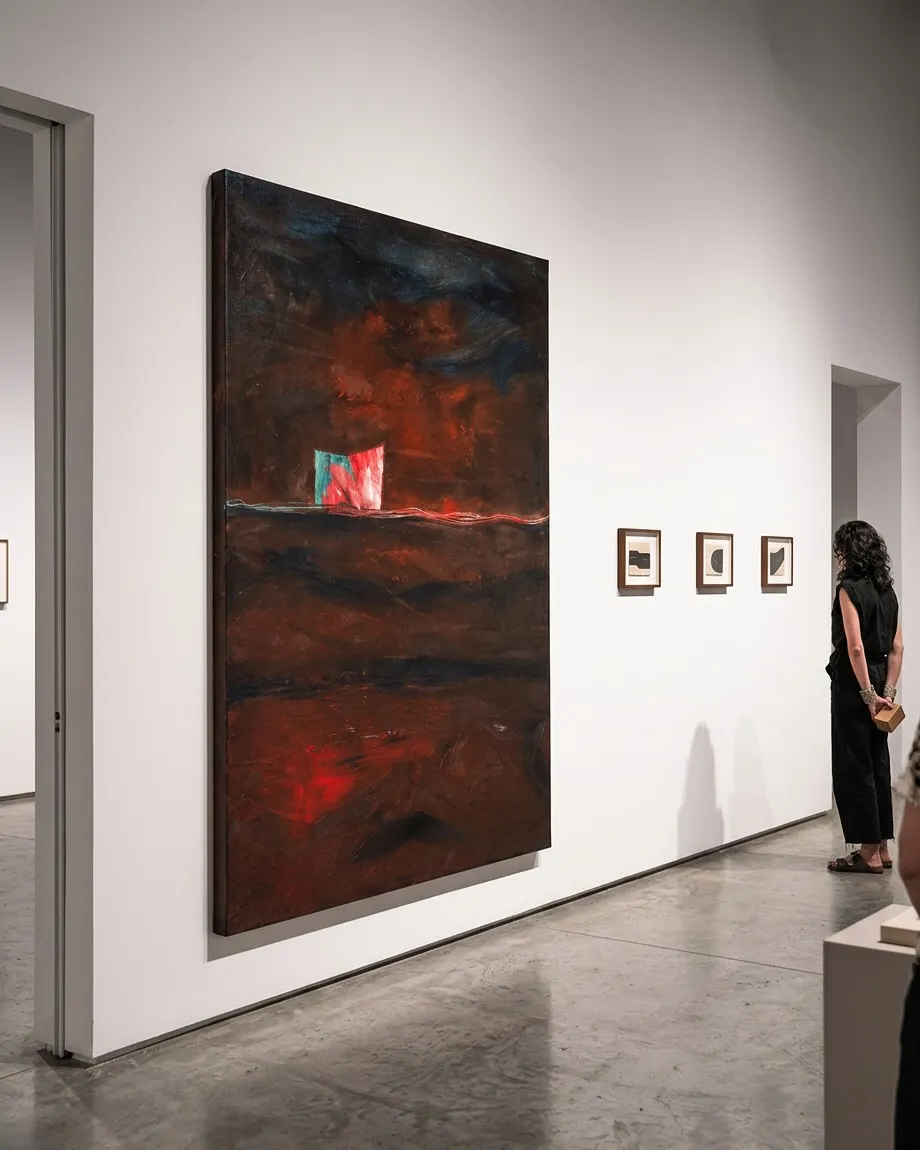
Before What the Night Left Burning (10251), the gaze does not rest: it peers into a fracture. Maurizio Valch's canvas confronts us with an almost biological tension: the immensity of a murky, organic, and oily twilight that seems to breathe, interrupted by the violent precision of a small, two-color geometric structure suspended over an extremely fine horizontal line.
To enter this luminous wound, we are accompanied by Octavio Paz, whose gaze, attentive to the paradoxes of fire, the brevity of the instant, and the silences that bite into the word, teaches us to decipher the light that resists in the ash. Beside him, Gregor Mendel brings the precision of his scientific mind, always seeking the hidden mathematical patterns of heredity, the laws governing hybridization, and the binary division of biological traits in matter. Together, the poet and the scientist interrogate a painting torn between entropy and code.
Movement I: The Divided Cell (The Micro Plane)
In the heart of the twilight floats a small two-color block. It is a clean-edged anomaly in the midst of the gestural storm. Mendel approaches this core and recognizes in it a primal chromosomal diagram: a unit of genetic information split exactly into two chromatic alleles—the cold of the turquoise-green and the heat of the red. For the scientist, this block is a locus where dominance and recessiveness are debated. What is the green color afraid of before the red tide that seems to push it from below? Is this block the originating gene of all the light the painting attempts to conceal?
Paz, conversely, contemplates this geometry as a "bodyless instant." For the poet, there is no biological inheritance, but a word burning in the midst of the stench of silence. That block is the embodiment of human desire: two opposing forces—the ice of the turquoise and the ember of the red—forced to share the same tiny border, united in their contradiction, vibrating in a tense stillness that threatens to burst.
“For weeks, I battled against the inertia of the plane. The canvas devoured every attempt at clarity, as if the dark oil had its own gravity dragging everything to the bottom. In a fit of frustration, seeking to correct an impasto that was too dense and that I believed would ruin the composition, I suddenly made an incised cut of light and placed the two-color block on top of it. That supposed error, that desperate doubt in the face of the stain, was what saved the painting: suddenly, the night had a center to pivot on.”
Movement II: The Horizon Line / The Thread of Inheritance
Beneath the two-color structure runs a very fine incised line of light cutting the canvas in two. What if what we see here is not a night landscape, but the microscopic interior of a cell at the exact moment of mutation?
This line acts as the spindle apparatus guiding cell division in mitosis, the DNA filament where the destiny of matter is inscribed. For Mendel, this thread is the boundary of transmission, the vector separating the traits of the past from future offspring. For Paz, however, this stroke is the scar of the horizon, the thin filament separating what the night has already burned from that which still struggles to be born. It is a line of cold fire, a laser beam sustaining the physical weight of all the upper darkness, preventing the muddy sky from collapsing onto the burning ground.
Movement III: The Mother Shadow (The Macro Plane)
As we move away from the center, we sink into the textured immensity of the Mother Shadow. The painting abandons geometry to become pure thermal vibration. Below, a reddish magma pulses beneath the surface, like a latent fever in the fabric of the canvas; above, a sky of bitumen and smoke suffocates the air. This darkness is not empty: it is pregnant with matter, heavy like damp earth after a forest fire.
It is here that the physics of the painting become tactile. We feel the suffocating heat of the red rising through our pupils, contrasted with the static cold of the green floating above. Valch’s pictorial matter does not depict the night; it behaves like it, swallowing the light to return to us only its thermal remains.
“I listen to Paz speak of poetic silence and Mendel of dominant traits, and I am amazed to see how the work has detached from my hands to begin breathing on its own. I only sought to organize a chromatic accident, but now I see that the canvas guards a biological key, a secret of inheritance and ash that I myself cannot decipher, but which pulses there, inaccessible and alive, every time the gallery light grazes the canvas.”
In the end, before What the Night Left Burning, the question remains suspended in the museum air: what part of this painting continues to burn in silence as we look at it?
- Original artwork
- What the Night Left Burning
- Actual dimensions
- 47.2 × 63 in / 120 × 160 cm
- Presentation
- Digital contextual visualization
Context references
large abstract paintings for living room · contemporary abstract painting maurizio valch · strata series abstract art · dark canvas with red and green two-color block · decorating walls with dark paintings
About this visualization
This visualization places the artwork within an architectural context to help collectors and viewers imagine its presence in a real space. It is an interpretive reference, not an exact reproduction: the original work remains the sole authority for scale, color, surface and material presence.