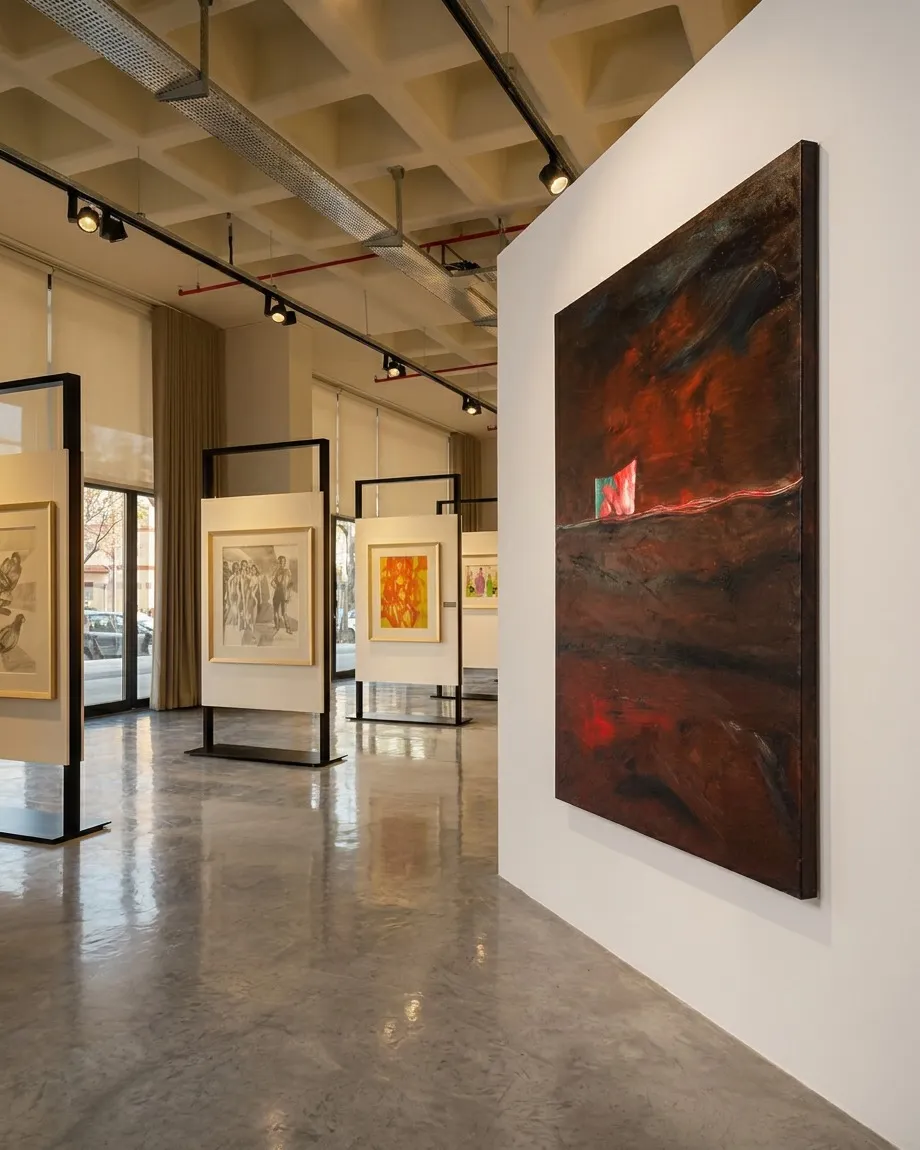
Context study / What the Night Left Burning
What the Night Left Burning by Maurizio Valch in an Art Gallery
Station 1: The Temperature of the Frame (The Time of Wong Kar-wai)
Night on this canvas is not an absence of light, but a thermal accumulator. Standing in front of What the Night Left Burning, the space seems to behave under the direction of Wong Kar-wai, whose camera knows how to freeze the seconds just before the revelation to film the thick air that lovers breathe in the corridor. For him, the twilight is not empty; it is saturated with suspended particles, a latent heat vibrating in magenta tones and burnt earths.
The cinematic gaze immediately stops at that thin horizontal scar cutting across the middle ground. It is not a conventional dividing line, but an incandescent filament, the seismographic record of a horizon that has just fractured. There is a palpable friction between the tectonic density of the lower half—a muddy ground of dense dark tones—and the volatile atmosphere crowning the canvas, where the red behaves like the residue of an explosion suspended in slow motion. Time does not run here; it accumulates in geological layers of dark pigment, waiting for a single draft to reactivate the fire.
Station 2: First Testimony of the Canvas (The Artist's Voice)
> "There is a moment in the studio when paint ceases to be a docile material and begins to demand its own molecular weight. Trying to hold that dark mass on the canvas was like trying to contain an oil spill with bare hands. As I worked, I felt that the density of the background did not respond to my brushstrokes, but to an internal gravity that I had not planned. Each layer of shadow seemed to suck the light out of the physical space of the room, making decisions behind my back, forcing me to step back and accept that the work was no longer seeking to represent a landscape, but to become the physical residue of a fire that I myself could no longer control."
Station 3: The Inventory of the Omitted (Szymborska's Doubt)
Faced with the gravity of the abstract drama, another perspective emerges. Wisława Szymborska, with her relentless curiosity, invites us to distrust large-scale catastrophes and notice the small, impertinent detail floating in the middle of nowhere. Her poetry taught us to question the everyday and suspect solemn silences with almost childlike yet devastating questions.
As we approach the mysterious two-color block floating imperturbably above the seismic line, the poetic gaze interrupts the heaviness of the tragedy: What is this small volume that defies the physical laws of the canvas? Its left half shines in an icy, almost surgical turquoise, while its right half burns in a refractory red. Is it a tiny cabin that has decided to turn on its lights in the midst of the world's collapse? Or is it a matchbox forgotten by a careless giant? By refusing to fall into the common grave of the dark background, this small block acts as a humorous and poetic anomaly. Szymborska reminds us that sometimes mystery lies not in the immensity of the fire that consumes everything, but in the obstinacy of that tiny object that refuses to burn and prefers to float, like a toy abandoned in space.
Station 4: Second Testimony of the Canvas (The Discordance of Color)
> "That two-color block was an absolute capitulation. When the turquoise flash appeared, so alien to the rest of the warm and somber palette, I felt a deep discomfort; it seemed like a mistake, a cold interference in a scene of ashes. I tried to mute it, but that small structure demanded its right not to belong to the painting, to float like a foreign body defying the gravity of the background. In the end, I understood that this area of the painting had to remain free from my own explanation; it is a territory where color functions as pure resistance, an orphan flash that sustains itself and reminds me that painting consists, above all, of knowing when to withdraw in the face of the inexplicable."
Station 5: What Remains Alit
At the physical boundary of the painting, the tension of Wong Kar-wai's atmosphere and the subtle irony of Szymborska ultimately meet. The filmmaker leaves us trapped in the vibration of a night that refuses to fade; the poet rescues us from anguish by pointing out the obstinate persistence of that floating block. In the end, the painting offers no resolution. It returns us to the direct experience of matter: the vibration of the turquoise against the earthy background, the heat emanating from the horizontal scar, and the certainty that something, somewhere in that darkness, still retains enough energy to keep burning. What is truly left burning when we decide to look away?
- Original artwork
- What the Night Left Burning
- Actual dimensions
- 47.2 × 63 in / 120 × 160 cm
- Presentation
- Digital contextual visualization
Context references
maurizio valch exhibition · contemporary gallery paintings · original abstract painting · strata series valch artworks · abstract art in gallery
About this visualization
This visualization places the artwork within an architectural context to help collectors and viewers imagine its presence in a real space. It is an interpretive reference, not an exact reproduction: the original work remains the sole authority for scale, color, surface and material presence.