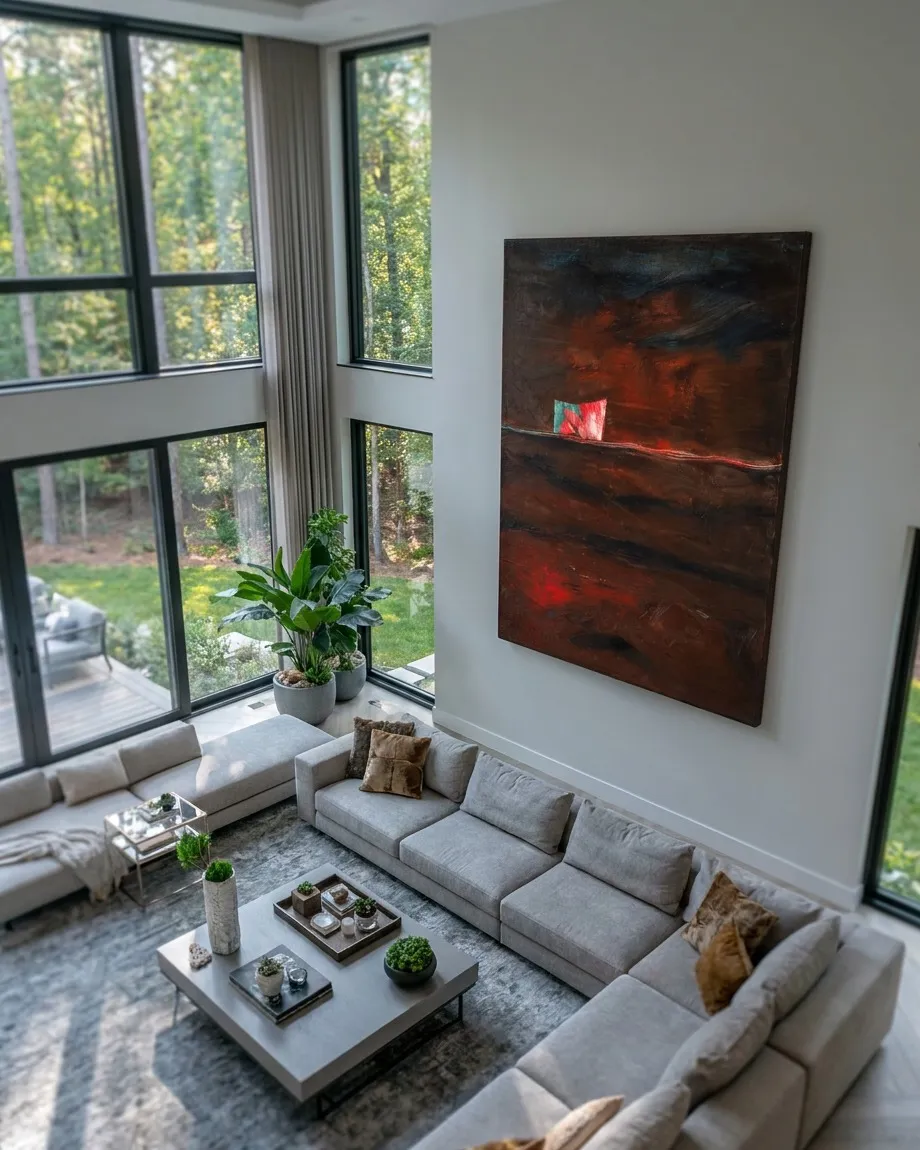
Context study / What the Night Left Burning
What the Night Left Burning Painting in Modern Living Room with Forest Views
First Movement: The Weight of the Scorched Ground (Shiva and Latency)
The lower half of What the Night Left Burning is not an empty space; it is a ground that accumulates gravity. Here, a dense materiality of earthy browns and accumulated soot unfolds, where the canvas seems to have absorbed the residue of slow combustion. To interrogate this wounded blackness, we summon Vandana Shiva, an Indian philosopher and activist who understands the earth not as an inert resource, but as a living organism that keeps memory beneath its scars. From her perspective, this dark stratum does not represent the definitive death of the landscape, but a state of extreme latency.
Shiva does not see sterile ash; she detects the power of a ground that retains the heat of what was devastated. Beneath the crust of charcoal and shadows, a reddish twilight pulses, refusing to fade completely. It is the resistance of the earth refusing to be sterilized. Instead of passive devastation, this wounded ground functions as a womb of ash: a substrate where the nutrients of the fire reorganize in secret, waiting for the moment when the pressure yields. The darkness here has weight, moisture, and memory; it is a physical force that sustains the entire upper plane.
Second Movement: The First Crack (The Voice of Maurizio)
When I first began to confront this surface, I was not seeking to paint a landscape, but to interrogate the silence that remains after everything has been consumed. By accumulating these layers of dark pigment, I realized that the night is never truly black; it is a thick sediment, an accumulation of ancient fires that have cooled on the surface but continue to pulse below like a reddish secret. It reached a point where my own hand stopped guiding the brushstroke: the canvas began to demand its own density, dictating where the matter should weigh and where that first vibration should break through, disrupting the inertia of the plane.
Third Movement: The Contraction of the Horizon (Graham and the Line of Tension)
Just at the boundary where the scorched ground touches the upper atmosphere, the canvas is pierced by a very fine seam of light. To understand the balance of this horizontal scar, we call upon Martha Graham, an American dancer and choreographer who revolutionized modern dance by turning breath, pain, and muscular contraction into the raw material of movement. Graham does not see a static horizon line; she sees muscular tension at its absolute limit.
This vibrating seam, tinged with an incandescent red and a faint whisper of turquoise, is the pictorial equivalent of a contraction: the moment of maximum resistance before the body breaks or is released. It is not a decorative element dividing the painting in two; it is a tense tendon sustaining the tremendous pressure of the dark sky against the heavy ground. The balance of the work is precarious and dramatic; if that line were to break, the two masses of shadow would collapse into one another. It is the gesture of a body suspended in mid-air, holding its breath in the midst of the twilight.
Fourth Movement: The Two-Color Refuge / The Unconquered Zone
And then there is that indomitable core, that small two-color refuge that refuses to dissolve into the atmosphere of ash. By juxtaposing electric turquoise and carmine in that small floating geometry, I wanted to introduce a discordance, an almost icy flash within the latent fire of the night. I admit that, even now, when I contemplate that form, there is something in it that eludes me, a portion of mystery that does not belong to me and resists being domesticated by my brush or my intention.
Faced with this mysterious two-color core, a question arises from a clean, naive gaze: What would happen if we touched that bright block? Is it cold as ice, or does it burn with the intensity of an sleepless ember? Does the night weigh more above or below?
For Vandana Shiva, that small two-color structure is an indomitable seed, a stronghold of luminous biodiversity that has survived the fire and refuses to assimilate into the homogeneity of charcoal. For Martha Graham, on the other hand, it is a concentrated spasm, a core of pure energy where color folds back upon itself like a closed fist before delivering a blow. The two women observe the painting in silence. There is no consensus: is it a house burning in the distance, a profane altar consecrated to what we could not save, or an open wound that refuses to close? The painting does not answer; it only emits the residual warmth of what the night left burning.
- Original artwork
- What the Night Left Burning
- Actual dimensions
- 47.2 × 63 in / 120 × 160 cm
- Presentation
- Digital contextual visualization
Context references
living room painting with forest views · modern nordic living room decor · double height living room contemporary art · red and black abstract painting · large format original art
About this visualization
This visualization places the artwork within an architectural context to help collectors and viewers imagine its presence in a real space. It is an interpretive reference, not an exact reproduction: the original work remains the sole authority for scale, color, surface and material presence.