Context study / What the Night Left Burning
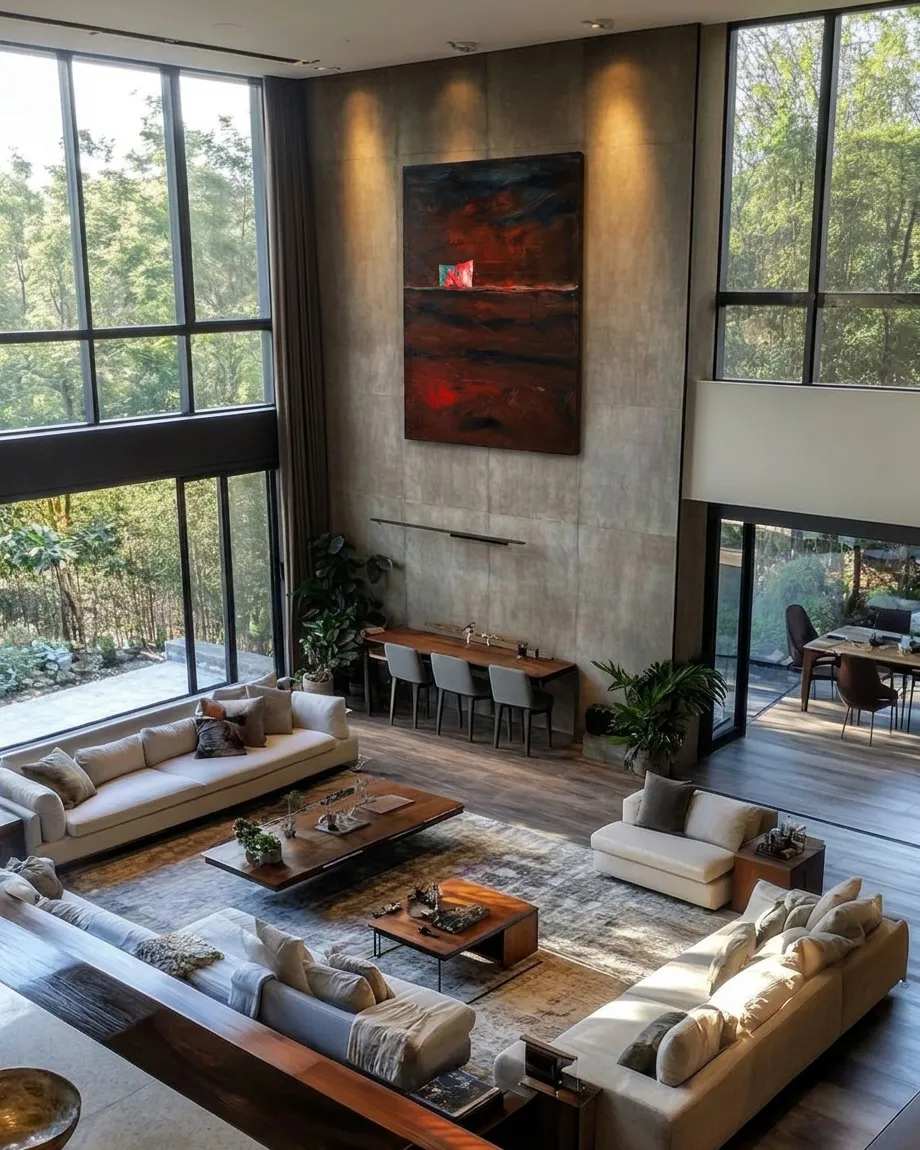
What the Night Left Burning Abstract Painting in Concrete Living Room
The Refraction of the Wound (Above the Horizon)
Isaac Newton, the physicist and mathematician who pursued the elusive nature of light and decomposed the rainbow in the privacy of his darkroom, stands before the upper half of the canvas with the suspicion that darkness is not an absence, but a physical density exerting its own gravity. His gaze ignores any mystical reading; for him, that mysterious bicolor block floating just above the dividing line is a phenomenon of chromatic resistance. How is it possible that in the middle of a sky struggling between Prussian blue and jet black, the color divides so sharply into a spectrum of turquoise green and burning red?
Newton observes the painting not as a space of representation, but as a rough prism where light has been trapped and forcibly refracted. The floating block is not a symbol: it is a body of high luminous pressure. The turquoise and the red do not mix; they collide at a millimetric vertical border, mutually sustaining each other against the pressure of the surrounding gloom. For the physicist, that vibration is pure thermodynamics: light struggling not to be absorbed by the dark mass of the firmament, a sky that seems to weigh tons and presses the edges of the brilliant matter as if to extinguish it.
The Maker's Voice (First Interlude by Maurizio Valch)
> When drawing that dividing line, my hand did not seek to split the space, but to contain the vertigo. I remember the tense pulse, the weight of the oil accumulating in the center of the painting as if the matter itself knew where the rift had to incarnate. That small block of color was not planned; it appeared as a physical necessity of escape, a vent to keep the canvas from collapsing under its own weight. Sliding the turquoise pigment next to the burning red, I felt the vibration of two opposing temperatures touching without merging, an absolute limit where the painting ceased to be a gesture of mine to become a tectonic border.
The Sediment of the Disaster (Below the Horizon)
W. G. Sebald, the writer and tireless walker who mapped the ruins of the twentieth century seeking the traces of the destroyed in silent landscapes, prefers to ignore the celestial vibration to fix his gaze on the lower half of the painting. For him, this zone is neither inert pigment nor pure abstraction: it is scorched earth, a geological stratum of deposited ash and memory. Sebald walks in thought through that dark and muddy mass of brown brushstrokes, where the remnants of an ancient fire seem to have been washed away by rain and compacted by the passage of time.
Here, Sebald's archaeological gaze confronts Newton's optics. While the physicist seeks the speed and decomposition of light in the heights, the writer seeks the weight of the residue on the ground. In the lower area of the canvas, a muffled red pulse emerges from the depths, like embers covered by a thin layer of damp earth. For Sebald, that subterranean glow is the witness of a disaster that occurred before we arrived to look; it is not a light that illuminates, but the remaining heat of what is no longer there, the melancholy of a landscape retaining the fever of its own destruction.
The Incombustible Remnant (Second Interlude by Maurizio Valch and Closing)
> There is a moment when the oil cools and the work withdraws from me, claiming its own right to opacity. Looking now at that pocket of fire at the bottom, I realize that the painting knows things I still do not. I believed I was governing the matter, but it was the canvas that decided which part of the night should continue to burn and which part should become irreversible ash. That small glow resisting in the dark does not belong to me; it is what remained safe from the fire, the incombustible remnant that the night could not extinguish and that now observes me from its own silence.
In the end, before the imposing scale of this suspended horizon, a question remains that neither the physics of light nor the memory of the ground manages to answer fully: is that bicolor flash floating in the heights the sign of something beginning to ignite, or the last fragment of a world that has finished burning?
- Original artwork
- What the Night Left Burning
- Actual dimensions
- 47.2 × 63 in / 120 × 160 cm
- Presentation
- Digital contextual visualization
Context references
painting for concrete wall · double height living room decor · contemporary brutalist painting · dark paintings living room decor · large format abstract art
About this visualization
This visualization places the artwork within an architectural context to help collectors and viewers imagine its presence in a real space. It is an interpretive reference, not an exact reproduction: the original work remains the sole authority for scale, color, surface and material presence.