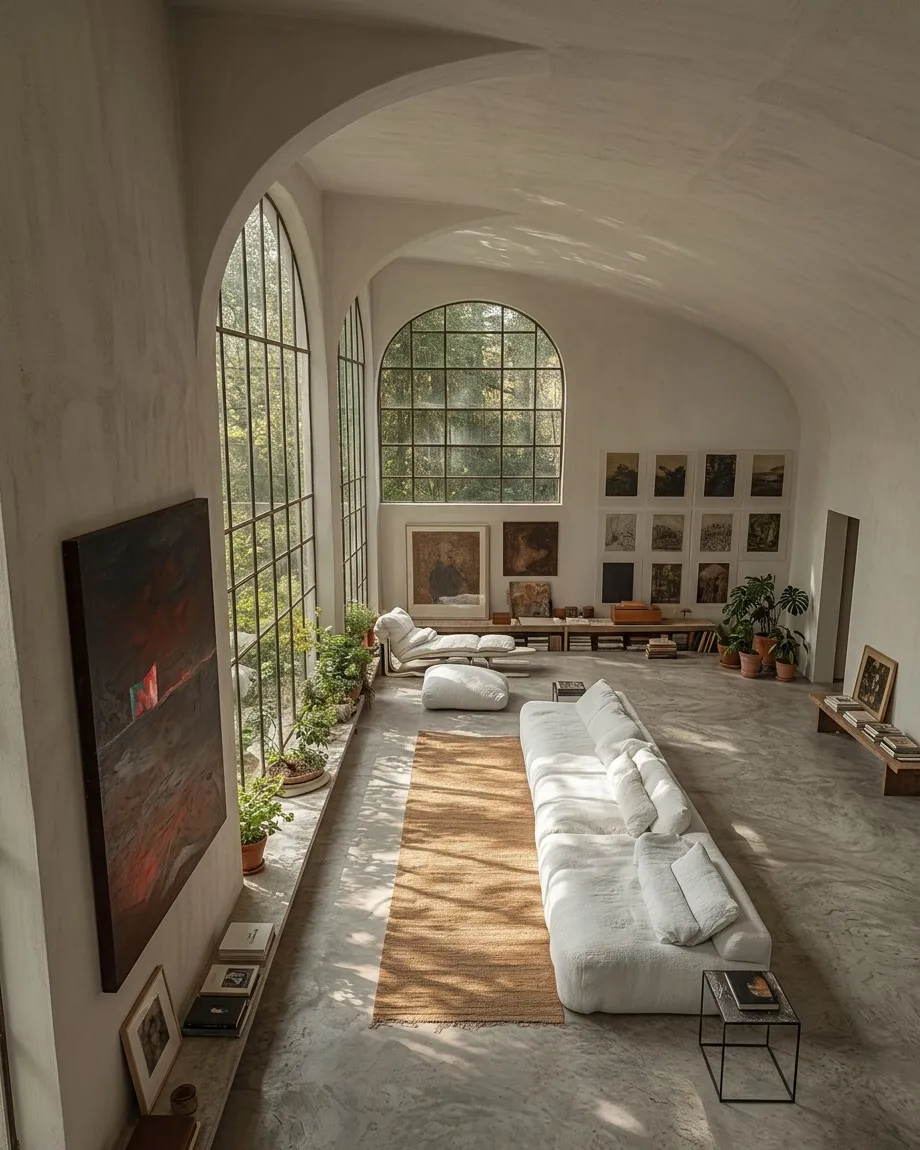
Context study / What the Night Left Burning
What the Night Left Burning Painting by Maurizio Valch in Vaulted Room
Movement I: The Horizon of Rotation
There is an instant in the contemplation of What the Night Left Burning when the eye is suspended on an electric border, a thread of light crossing the canvas from end to end. Above this horizontal seam, the painting unfolds into a turbulent and charged atmosphere, a celestial gloom that seems to breathe with the density of the air before a storm. In this suspended void floats an enigmatic three-dimensional prism, a small geometric jewel faceted with green and red flashes that defies the gravity of its surroundings. Vera Rubin, the astronomer who stared at the outskirts of galaxies to reveal that the invisible is precisely what holds our universe together, invites us to look here for that hidden mass supporting this subtle celestial balance. Under her gaze, the prism is not a random anomaly, but a detector of the invisible, a beacon of matter floating weightless thanks to forces the eye cannot record, but which the painting senses.
If that thin line of light upon which the prism gravitates were a high-voltage wire, we would feel the current traveling from one end to the other, connecting the greenish cold of the left flank with the reddish vibration of the right. It is a temporary short circuit, a vector stabilizing the upper tempest and preventing the geometric structure from collapsing into the abyss below.
"As I drew that dividing line, I felt the urgency to drive an absolute point of resistance into the instability of the atmosphere. Painting that geometric prism was an almost violent act: placing a rigid, faceted block, with green and red flashes, in the middle of an aerial matter that seemed to disintegrate by the moment. While doing so, a strange material doubt assailed me that I still do not know how to decipher today, as if geometry came not to order chaos, but to measure the depth of its collapse."
Movement II: The Core of Lost Gravity
Descending the gaze below the horizon, the weight of the painting changes drastically. We enter the mire of matter, a tectonic trench where earthy browns and blacks overlap in heavy, almost geological brushstrokes. In this lower zone, the paint becomes body, accumulation, and thermal residue. Charles Lyell, the geologist who understood that the Earth's physiognomy is not the result of sudden catastrophes but of the slow, constant whisper of subterranean forces accumulated over eons, would see in these lower layers not a static background, but a living record of latent heat. For Lyell, each vein of dark pigment is a stratum of sedimented time, a slow cooling that nevertheless preserves a still-active magma at its core.
This internal fire manifests in a burning spot trembling in the lower area of the canvas: a red, liquid flash smoldering from the depths as if it were the reflection of a fire buried under tons of ash. If we could slide our fingers across the surface of the painting, the transition would be physical: the upper half would return the damp cold of a night mist, while touching the lower third we would notice a dense temperature, a dry heat pulsing under the crust of oil.
"While working on the density of that background, the matter itself seemed to rebel against the brush, accumulating a physical weight that spread to my hands and chest. In applying the lower red reflection, I was not seeking to paint fire, but to record an irradiation that my own body demanded; the finished painting has ended up storing a dense, alien heat, a latent combustion that I did not consciously plan and that now observes me as a completely foreign territory."
Movement III: The Sediment of Deep Time
In the space where the canvas and the viewer coexist, the gazes of Rubin and Lyell enter a magnetic friction. The astronomer's cosmological time, with its impossible balances and invisible masses, weaves together with the deep geological time of the scientist, where matter wears away and accumulates under the influence of the Earth's internal fire. What the Night Left Burning thus becomes a meeting point between the immensely distant and the intimately terrestrial.
What the night "left burning" on this canvas is not a visible bonfire or a closed explanation; it is the vestige of something that has collapsed but refuses to cool entirely. It could be the last fragment of an extinct star fallen into an ocean of pitch, the residual memory of a home consumed by time, or simply the physical temperature of memory when it resists the dark. In the end, the work refuses to reveal itself completely, leaving us on the threshold of its atmosphere, suspended between the cold air surrounding the prism and the internal combustion that continues to warm the base of the canvas.
- Original artwork
- What the Night Left Burning
- Actual dimensions
- 47.2 × 63 in / 120 × 160 cm
- Presentation
- Digital contextual visualization
Context references
minimalist living room abstract painting · maurizio valch strata · large format abstract painting · high ceiling living room decor · dark and red tones painting
About this visualization
This visualization places the artwork within an architectural context to help collectors and viewers imagine its presence in a real space. It is an interpretive reference, not an exact reproduction: the original work remains the sole authority for scale, color, surface and material presence.