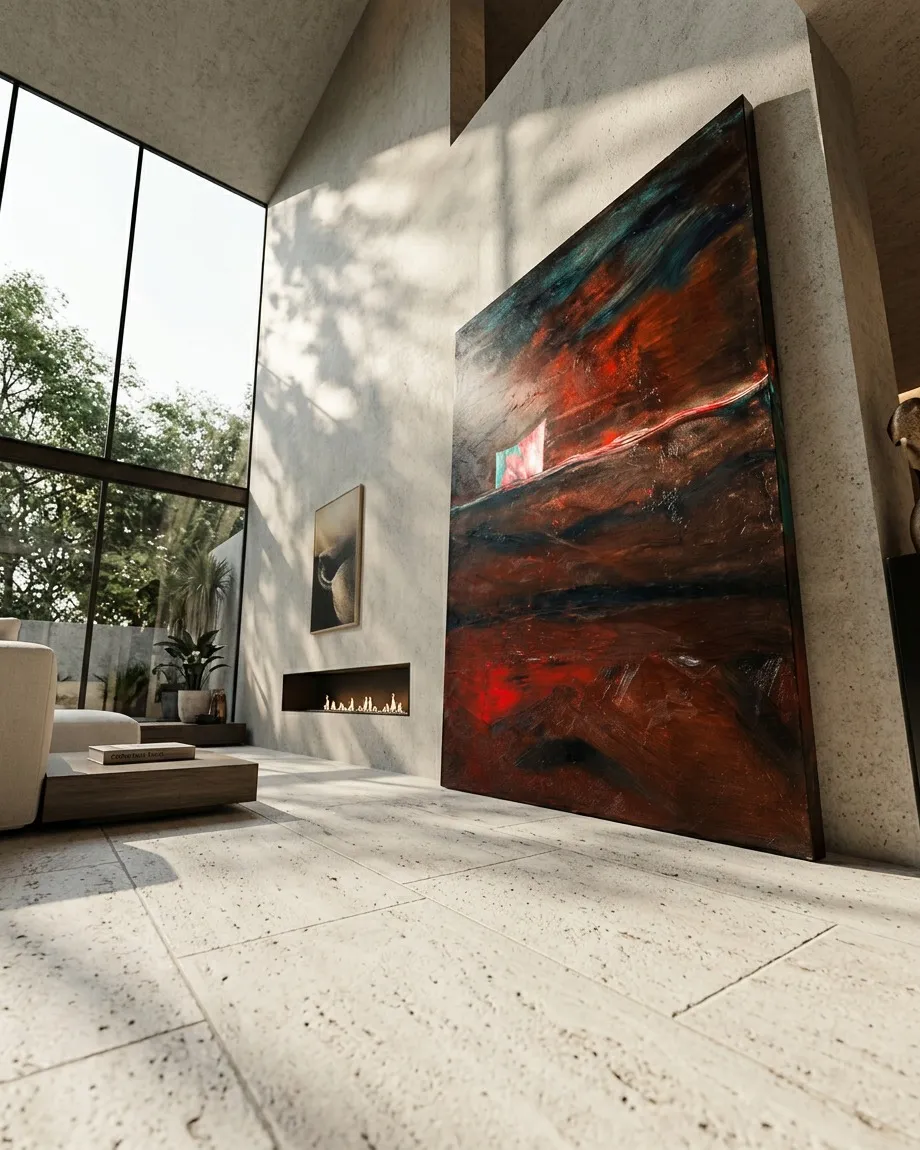
Context study / What the Night Left Burning
What the Night Left Burning by Maurizio Valch | Design Space
Movement I: The Law of the Limit (The Upper Weight)
The upper half of What the Night Left Burning is not a sky; it is a suspended collapse. A mass of shadows, loaded with mineral greens and organic blacks, presses down with the physical weight of an atmosphere that has lost its elasticity. The air up there feels dense, almost solid, as if the night had cooled too quickly, trapping smoke and the last vestiges of light in a chromatic crust that demands a pulmonary effort from the viewer. Amid this oppression, the horizon line does not act as a vanishing point, but as a sharp boundary, an incandescent high-voltage wire cutting the surface of the canvas and dividing the space into a before and after of the fire.
It is impossible to contemplate this horizontal fracture without invoking Thelonious Monk, an architect of silence who knew that the most beautiful tension is always born from the space left between two broken notes. Through Monk's gaze, the composition is not read from left to right, but as a dissonant and physical chord. The dark brushstrokes of the background are those heavy, prolonged silences that the pianist let fall onto the keyboard; suddenly, the burning line breaks in like a sharp blow, a note accented off-beat that disrupts symmetry and forces us to recalibrate our hearing—or our sight. There is no smoothness in this transition: it is an impact of light vibrating harshly against the surrounding gloom, a syncopated visual rhythm where empty space weighs as much as the stroke that wounds it.
> "When I drew that horizontal line, I remember feeling an almost physical hesitation in my arm, a doubt running through the palette knife before touching the canvas. There was an urgency to divide the canvas, to create a border of fire, but upon placing that green-blue block right next to the bright red, something changed in the studio. An unforeseen vibration occurred, an optical hum that was not in my primary plans. In that precise instant, I understood that the painting had ceased to be a territory I governed; it began to make its own decisions, to demand its own air, and to impose its temperature."
Movement II: The Dissonant Interval (The Bichrome Monolith)
Floating above that line of tension, like a buoy in a sea of burning asphalt or an inexplicably suspended structure, stands the bichrome monolith. It is an imprecise geometric shape, a volume with two faces—one of a burning red, the other of a gélid, bluish green—shining with its own light in the middle of nowhere.
If a child were to stand in front of this canvas, free from the solemnity with which we adults attempt to explain mystery, they would probably ask in a whisper: "If we touched that little box floating up there, would it be freezing like ice or would it burn our hands? And which way will it fall if the wind blows harder?" This naive question disarms any attempt at categorization. The monolith is not a cabin, nor a ship, nor a lighthouse; it is a threshold that challenges the gravity of the painting itself.
This is where the mind of Franz Kafka intervenes, a cartographer of unbridgeable distances and of portals that open only to remind us of our eternal exclusion. For Kafka, this bichrome monolith would be the physical representation of the Law: a strange, monolithic structure erected in the middle of the wasteland, a two-colored door promising shelter but remaining inaccessible, floating above our ability to reach it. Its double face, simultaneously burning and freezing, embodies the Kafkaesque paradox of a condemnation disguised as salvation. It is a home that cannot be inhabited, a boundary that cannot be crossed, a volume looking down on us from its absolute silence while we wonder if it contains a secret or simply emptiness.
Movement III: The Physical Reverberation (The Lower Reflection)
As the gaze descends toward the lower half of the work, the density of the paint transforms. What above was an oppressive atmosphere and suspended geometry becomes below a viscous fluid, a liquid darkness that seems to drip and slide toward the gallery floor. The red color is no longer a sharp boundary; down here it is a reverberation, an echo of heat directed not at the intellect, but straight to the body. Standing in front of this zone, the pulse subtly alters and breathing deepens, as if the skin could detect the residual heat of a campfire dying out off-camera. The space forces us to take a step back, to seek a physical distance that allows us to protect ourselves from that dark, burning tide threatening to overflow the frame.
> "Now that I look at the finished canvas from a distance that allows me to see it in its entirety, there is something in that lower zone that produces a deep strangeness in me. That imprecise reflection, that dripping of red light that seems to emerge from the shadows below, is something that completely escapes me. I don't remember planning it with such physical insistence; it seems to have sprouted from the accumulation of matter, as if the heat of the horizontal line had melted and filtered beneath the darkness. I observe it now not as its creator, but with the suspicion and fascination of just another spectator, wondering what continues to burn in there without my consent."
- Original artwork
- What the Night Left Burning
- Actual dimensions
- 47.2 × 63 in / 120 × 160 cm
- Presentation
- Digital contextual visualization
Context references
abstract design painting modern living room · maurizio valch artwork natural light · original red and black strata painting · fine art abstract interior design · textured canvas what the night left burning
About this visualization
This visualization places the artwork within an architectural context to help collectors and viewers imagine its presence in a real space. It is an interpretive reference, not an exact reproduction: the original work remains the sole authority for scale, color, surface and material presence.