Context study / What the Night Left Burning
What the Night Left Burning in Industrial Loft | Maurizio Valch
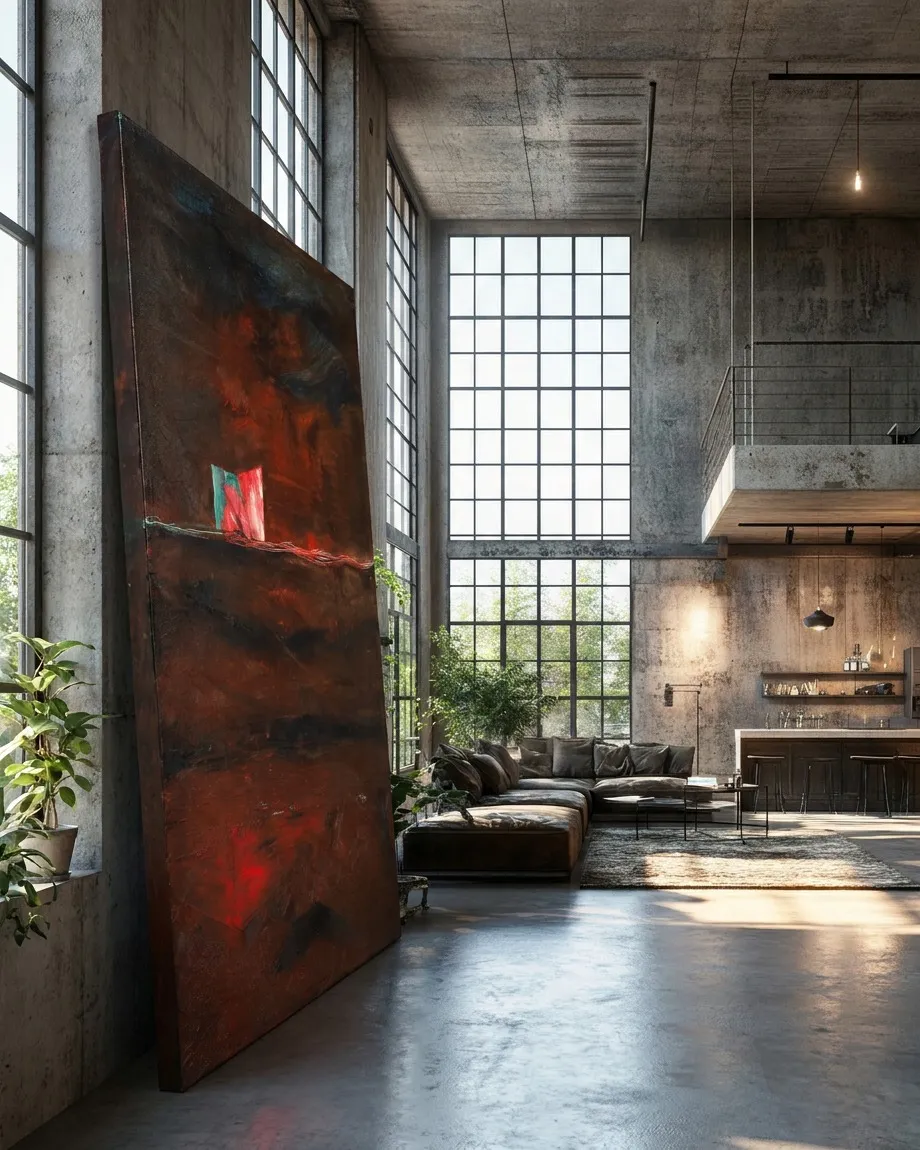
Faced with the colossal canvas resting on the cold concrete of the loft, the light from the industrial windows seems to pause, fearful of being absorbed by the gravity of the matter. Here, the painting does not decorate the space; it interrupts it, opening a pit of dark strata and suspended fire.
To unravel this geography of temperature, two opposing yet complementary gazes halt before the work: Paul Dirac, a man who sought truth in the silence of perfect equations and understood that absolute nothingness is always a vibrant field of latent possibilities, and Leonard Cohen, an alchemist of imperfection who knew that the human soul only reveals itself when the night begins to crack, showing its wounded reverse.
I still feel on my shoulders the weight of accumulating those first layers of telluric darkness, dragging the dense pigment like someone trying to consolidate ground that is sinking beneath their feet. There was no precise map; only the physical suspicion that, as I added thicknesses of shadow, the painting began to refuse my will, demanding a gravity of its own that escaped my control, a density that demanded to be purged before receiving the light.
At the base of the canvas, the matter behaves like a devastated geological plain. Dirac steps forward, adjusting his glasses with an almost clinical gesture. His gaze does not seek drama, but broken symmetry. For him, this lower mass of charcoal and asphalt is not empty; it is a sea of negative energy, an infinite density where particles await the impact of a photon to leap into existence. "It is the density of collapse," Dirac murmurs, his voice devoid of sentimentality. "Heavy matter interacts with the vacuum not as an absence, but as a pressure pushing space upward. It is a thermodynamic equilibrium on the verge of rupture."
Cohen, however, leans on his cane and smiles with a weary melancholy. He does not see physical pressures, but the sediment of unredeemed hours. "No, Paul," he says, in that voice that seems to scrape the bottom of a well. "That's what's left in the kitchen when everyone has gone to sleep and the day's mistakes cool on the table. It is the weight of what we could not save, accumulated layer upon layer until it turned to stone."
Between that geological base and the upper penumbra that threatens to close off the painting, an anomaly erupts: a thin horizontal line, a horizon of fire where incandescent red and a cold green flash coexist. It holds, right at its center, a quadrangular block burning like a watertight compartment in the middle of the void.
If that line were a pulse, Dirac mentally calculates its frequency: a peak of ultra-peripheral energy, a quantum transition vibrating on the border of terahertz, where matter ceases to be solid to become pure radiation. For the physicist, the block is a localized fluctuation, a packet of energy trapped in a metastable state. Cohen, on the other hand, closes his eyes to listen to the chord emanating from that same crack. He hears a suspended D minor, played on a keyboard out of tune from the dampness of a wet basement; a liturgical chant insisting on standing while the temple crumbles.
"What burns inside there, Leonard?" asks the physicist, fascinated by the precision of the boundary holding the burning block.
"A testament is burning," replies the poet. "Or perhaps the memory of an inheritance that no longer has heirs. It is not the night that burns; it is the last room of the house where a witness still stays awake. That structure floats because grief makes it light."
Listening to these two men measure my work with the precision of numbers and the whisper of ballads, I realize that both touch the extremes of a truth that eludes even me. There is a zone in that suspended block, right where the green bites the red over the dividing line, that resists my own memory; a space of pure combustion that I painted with my eyes half-closed and that today looks back at me like an alien and sacred territory, a residue that survived the burning of the canvas and refuses to be translated by either physics or poetry.
In the end, in front of What the Night Left Burning, both men fall silent. The red vibration of the painting projects onto the polished concrete of the floor, creating an illusion of warmth rising toward the industrial ceiling. There is no possible reconciliation between Dirac's equation and Cohen's song, but in that insurmountable tension lies the strength of the work: in the fact that, in the midst of the densest and most geological night, something—a line, a block, a suspicion—insists on staying lit, consuming itself without ever being entirely extinguished.
- Original artwork
- What the Night Left Burning
- Actual dimensions
- 47.2 × 63 in / 120 × 160 cm
- Presentation
- Digital contextual visualization
Context references
large painting leaning on floor loft · large format industrial art maurizio valch · original abstract painting industrial living room · strata artwork what the night left burning · designer paintings for modern lofts
About this visualization
This visualization places the artwork within an architectural context to help collectors and viewers imagine its presence in a real space. It is an interpretive reference, not an exact reproduction: the original work remains the sole authority for scale, color, surface and material presence.