Context study / What the Night Left Burning
What the Night Left Burning - STRATA Series | Maurizio Valch
I. FIRST MOVEMENT: THE LOWER PLANE (ACCUMULATED GRAVITY)
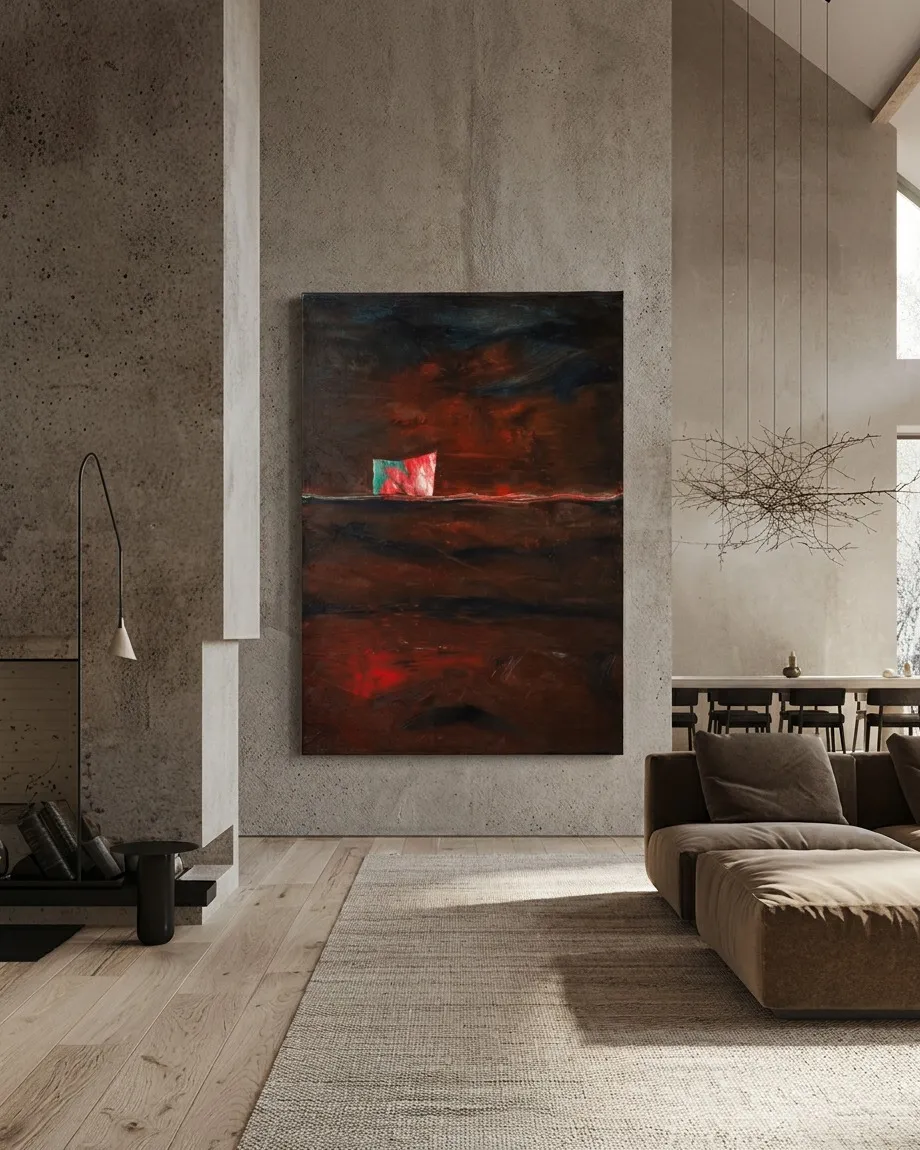
Standing in front of What the Night Left Burning, with its imposing presence of 160 x 120 cm, the viewer's body experiences a magnetic downward pull. This is not a space for light contemplation; the work's large scale places the lower half directly in front of the observer's torso and hands, imposing an almost physical, material gravity. The dark, impasto brushstrokes do not describe solid ground, but rather a dense geological stratum, perhaps stagnant water laden with ash or a telluric mud that has absorbed the light of centuries. From its depths, a reddish reverberation beats with a dull rhythm, as if the earth itself kept the echo of an ancient fire that refuses to cool entirely.
Nina Simone, a creator who managed to turn dense silence and accumulated pain into a physical vibration that shook the listener's body, helps us understand this lower plane not as an inert void, but as an accumulation of contained energy. Her voice, capable of modulating from a wounded whisper to the most harrowing cry of protest, finds a direct echo in the chromatic temperature of this canvas. The blackness here is not the absence of color; it is a tone charged with history, a mass vibrating with the same intensity with which Simone held a note on the piano, tensing the air before revealing the wound. Is this background a latent lament, a vibration of resistance beating beneath the weight of the night?
At first, the canvas was an untamed mass of accumulated darkness threatening to devour everything. But in a moment of pure physical tension, I felt the need to slash that density; it was then that I drew the horizontal line, an almost violent cut seeking to suspend the collapse of matter. Then the two-toned block appeared, not as a calculated element, but as an accident of resistance, a fragment of matter that emerged from the scrape of the palette knife and refused to merge with the background, claiming its own floating space.
II. SECOND MOVEMENT: THE SCAR OF THE HORIZON (THE LINE AND THE BLOCK)
At the exact center of the work's bodily experience, where the viewer's chest aligns with the canvas, space is torn by a thin, incandescent horizontal line. This mark acts as a scar of light, a border separating the abyssal from the atmospheric. Just above this tense filament sits the enigmatic two-toned block. Its left half, washed in a pale, cold turquoise, functions as a visual breathing space, a breath of fresh air in the midst of chromatic suffocation; its right half flares with a burning red.
Barnett Newman, the artist who saw in the pure line a way to declare human presence and dignity before the abyss of the primordial void, invites us to question this horizon. For Newman, his famous vertical lines (the zips) were flashes of self-awareness in chaos. In Valch's painting, however, that line has lain down, becoming a tightrope holding up a wounded monolith. If this geometric block were a musical instrument, what sound would it emit as it scrapes against the incandescent horizon? Would it be the metallic screech of metal suddenly cooling, or the sustained vibration of a cello string about to break? This volume does not rest; it resists, suspended over the scar, reminding us that stability is always a temporary truce.
III. THIRD MOVEMENT: THE UPPER PLANE (THE BURNING SKY)
Lifting the gaze to the upper third of the painting, the gravity of the lower plane dissolves into a volatile, nocturnal atmosphere. Here, the darkness is no longer geological, but aerial; it is a sky covered in chromatic smoke where red disperses and floats like suspended ash. The brushstroke becomes looser, less impastoed, suggesting a celestial vault that has witnessed a silent catastrophe. The air in this upper space feels warm and dense, laden with the residual oxygen of whatever burned before we arrived.
Naming this painting What the Night Left Burning was an act of surrender to the finished canvas. As I contemplated the vibration of that red suspended in the atmospheric blackness, I understood that there are fires that occur without visible flames, cold embers that continue to beat in the absolute darkness. What exactly the night chose to save from the fire and what continues to burn in that gloom remains, even for me, under an undecipherable veil of mystery.
Before the immensity of this burning sky, the viewer is stripped of certainties. There are no figures to offer comfort, nor safe spatial references. Only the temperature of that bright line remains, the enigma of the two-toned block, and the suspicion that, after the passing of the night, what remains lit is not destruction, but the stubborn trace of a strange and mysterious form of life.
- Original artwork
- What the Night Left Burning
- Actual dimensions
- 47.2 × 63 in / 120 × 160 cm
- Presentation
- Digital contextual visualization
Context references
abstract painting minimalist concrete living room · maurizio valch strata abstract art · dark and red textured painting · original large scale artwork for living room · minimalist decor with abstract art
About this visualization
This visualization places the artwork within an architectural context to help collectors and viewers imagine its presence in a real space. It is an interpretive reference, not an exact reproduction: the original work remains the sole authority for scale, color, surface and material presence.