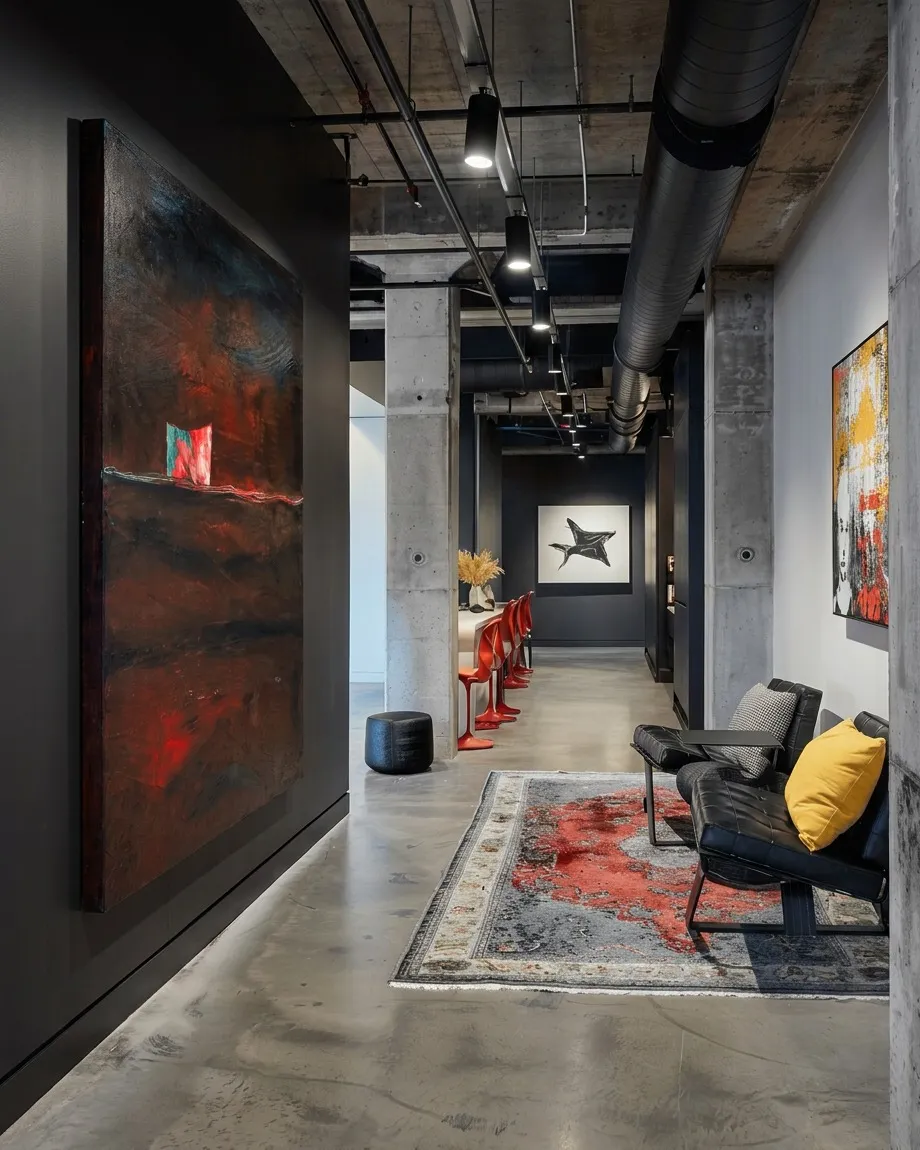
Context study / What the Night Left Burning
What the Night Left Burning - Maurizio Valch | Contemporary Abstract Painting
Phase 1: Descent into the Upper Darkness
To enter What the Night Left Burning, the viewer must first school their breath. The upper half of the canvas does not offer a sky, but an atmosphere that weighs upon the eyes with the physical gravity of old smoke. It is a telluric mass of blackness and muted violets, where darkness is not a passive void, but a material accumulation that seems to advance toward the body of the viewer. Stepping back, the eye perceives that beneath this apparent night beat buried embers, glazes of an injured red struggling to emerge through the dense pigment.
> Maurizio Valch's Voice:
> Confronting the canvas in those early hours, I felt the physical urgency to close the space, to force the gaze to halt in a territory where light no longer had the final word. Painting the night has not been for me an exercise in emptying or absence, but an almost geological accumulation of layers, a muted combat where color seeks its own oxygen under the pressure of a black that threatens to bury everything. I wanted the viewer to feel that primordial suffocation, the vibration of matter resisting before being definitively consumed by the shadow.
Before this penumbra stands Diego Velázquez, the Baroque painter who revolutionized the canvas by demonstrating that air and invisible distances can be painted so that the unfinished vibrates with the force of the real. Velázquez narrows his eyes, seeking that aerial perspective he masterfully commanded, but here he encounters an atmosphere that devours its own metric space. Air does not separate forms; it absorbs them. Beside him, Dōgen, the Japanese Zen master who taught that time is not a straight line but a dynamic instant where ash and fire coexist absolutely, contemplates the same dark plane. For Dōgen, this blackness is not the loss of day, but the manifestation of a complete reality where what burns and what has already been extinguished occur simultaneously.
Phase 2: Encounter with the Fissure
Descending through the density of this upper atmosphere, the gaze abruptly strikes a boundary. It is not a natural horizon, but an extremely thin horizontal line, a vibrant seam of reddish light cutting the canvas from side to side.
Does this dividing line have real weight, or is it merely a taut thread preventing the great mass of the upper night from collapsing and crushing the lower half? Approaching, the viewer notices the fragility of this border: it is not a firm stroke, but a suture through which the internal temperature of the painting seeps. If this painting were a sound, at what frequency would the silence surrounding this thin crack vibrate? It is a low-frequency hum, the tension of a canvas resisting being torn in two.
Velázquez leans in, fascinated by the audacity of this stroke that cancels classical depth but, strangely, generates a new dimension of pure distance. "It is not a line," the Sevillian murmurs, "it is the edge where air becomes fire." Dōgen, however, smiles at the idea of division. For him, this fissure does not separate top from bottom, but demonstrates their interdependence: the night above is only night because it rests on the abyss below, and that line is the point of contact where both states recognize and cancel each other.
Phase 3: The Habitability of the Boundary
Just above that thin horizontal line, shifted to the left, rests the only recognizable volume of the work: a small three-dimensional structure, an open-sided room or cube glowing with a contained violence. Its inner face shines with a cold, clean turquoise, while its outer edges flare into an incandescent red.
What is the temperature of this turquoise compared to the fire pressing against its limits? A physical paradox is generated for the viewer: the cold blue seems to protect a sacred void, a stronghold of absolute silence in the midst of combustion. Is this a beacon in the storm, the remnant of a cosmic shipwreck, or an open wound in the body of the night?
Velázquez observes this volume with suspicion and admiration; it challenges the laws of courtly lighting that he knew so well. The light here does not come from an invisible window or a candle; it is born from the object itself, as if geometry itself were the source of combustion. Dōgen intervenes to remind the Spanish painter not to seek the origin of fire outside the wood: "The flame does not travel from one place to another," the Zen master suggests, "this small cube is the entire fire occurring at a single point, immutable and eternal."
Phase 4: The Echo in the Lower Darkness
Beneath the line of the fissure, the gaze finally slides toward the lower half of the canvas. Here, the matter becomes more terrestrial, denser and more visceral. The brushstrokes are broader, loaded with a dark sediment that seems like the residue or ash of what has burned above. Yet, it is not a static territory: in the bottom-left corner, a patch of intense, diluted red flares up again, as if the fire from the central structure had dripped down and were melting the ground beneath our feet.
> Maurizio Valch's Voice:
> I don't know for certain what that two-toned volume is that insisted on appearing on the midline. While painting, it emerged as an inexplicable resistance on the canvas, a geometric boundary that I myself did not know whether I was protecting something sacred or simply letting it slowly burn away. Seeing the lower part of the painting, I realize that structure is a sluice gate: what burns inside leaks downward, staining the dark matter with a residue that is not dead ash, but a latent ember refusing to cool under the gaze of others.
At the end of the journey, the conversation between the two minds quietens before the material evidence of the canvas. Velázquez recognizes that, even if the laws of perspective have dissolved, the vibration of space is as real as the air in his Las Meninas. Dōgen contemplates the lower red patch and invites us to avoid closed interpretations: the painting is not remembering a fire that has already passed, nor is it prophesying a future destruction; it is keeping alive, in this precise moment of observation, a fire that will never be entirely extinguished.
The viewer withdraws, but the two-toned vibration—the cold turquoise surrounded by fire—remains floating on the retina, forcing them to look back once more into the darkness of What the Night Left Burning.
- Original artwork
- What the Night Left Burning
- Actual dimensions
- 47.2 × 63 in / 120 × 160 cm
- Presentation
- Digital contextual visualization
Context references
large scale abstract painting for hallway · black and red abstract painting maurizio valch · strata series contemporary art · original artwork what the night left burning · modern hallway decoration with art
About this visualization
This visualization places the artwork within an architectural context to help collectors and viewers imagine its presence in a real space. It is an interpretive reference, not an exact reproduction: the original work remains the sole authority for scale, color, surface and material presence.