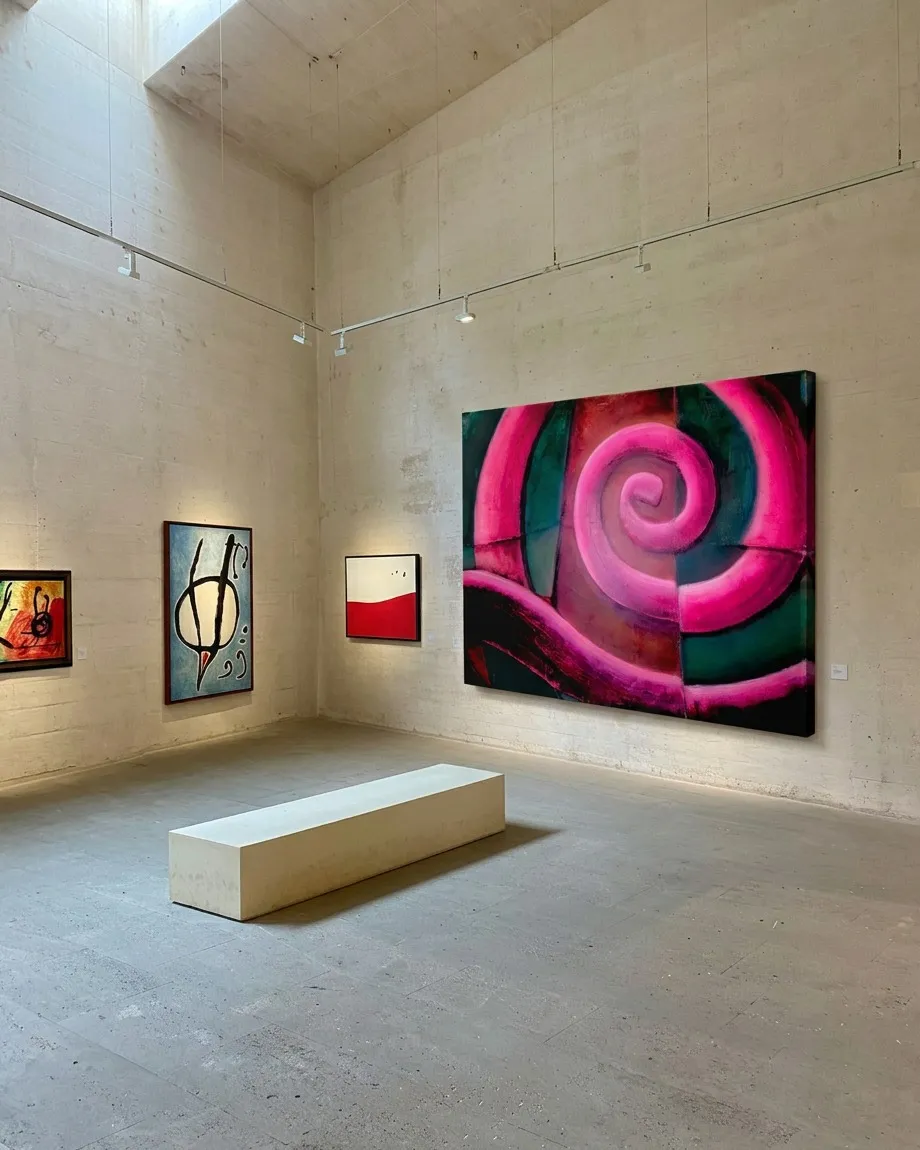
Context study / VORAGO
VORAGO by Maurizio Valch - Abstract Painting from the VORTEX Series
On the outer edge, the fuchsia curve already seems to exceed the rectangle containing it. It does not enter docilely into the 210-centimeter width: it occupies, presses, and claims an extension out of sight. Its thickness does not have the transparency of a line or the lightness of a stroke; it has something of a tube, of a muscle, of a soft object that has decided not to yield. The gaze tries to follow it from above, but quickly encounters a dark green intercepting it, a black band pushing it back, an embedded red that seems to heat up beneath the surface. The painting does not offer a clean entry. One must skirt it first, like skirting a door that is too narrow while carrying something in one's hands.
The question begins there: what kind of thought can occur when a shape apparently turned inward forces one to feel, first and foremost, the position of shoulders, neck, eyes, and distance. The spiral does not pull away from the world toward an abstract idea; it makes the place from which it is viewed uncomfortable. Its outer arc pulls the vision to the right, then returns it downward, grazing a thick black that does not function as a background. That black blocks. The fuchsia does not float above it: it seems to push it, to receive its push, to remain slightly bruised by its proximity.
Teresa of Ávila was a writer and mystic who turned the inner life into a territory of rooms, thresholds, and difficult-to-name movements. Her presence here does not make the spiral an allegory of the soul, nor does it open a staircase to a hidden truth. Rather, it demands slowness before access. The center could be a room that refuses to receive anyone arriving in too much of a hurry. Entering the image is not possessing it: the difference is felt the moment the eye wants to hasten the next turn and, yet, must stop before a joint, a visible seam between color fields, a change in density that promises no continuity.
I approach this resistance and discover that it does not match what I thought I was looking for. I feel the pink attracting and simultaneously repelling me, as if its volume had its own temperature. I cannot turn the curve into a clear decision. The more I follow it, the more I notice a distance between my desire to recognize something and that which begins to appear without obeying me.
Then a dry and precise child's question arises: why does that pink thing weigh so much and not fall? It requires no explanation. It remains next to the lower band, where the fuchsia seems to bend over a deep black and yet retain an almost suspended tension. There is a strange pleasure in looking at this obstinacy: the band looks inflated but not light; it looks fleshy but not alive; it seems capable of touching, though it is frozen on a flat surface. Each of these impressions contradicts itself as soon as attention is fixed on the cuts traversing the shape.
David Hume was a philosopher who doubted solid certainties and looked at how sensations, habits, and imagination construct what we call reality. His intervention opens a useful annoyance: what is actually before the eyes? Perhaps not a continuous whirlpool, but bands of pink, green-bluish zones, blacks, reddish tones, interruptions, glints, and joins. The supposed turn could be an operation of the eye, accustomed to sewing together the discontinuous to produce a unified figure. Where there seemed to be an absorbing force, small perceptual decisions appear: a curve ends, another approaches, a dark edge fills the distance, and the imagination declares that everything keeps spinning.
The room that Teresa allowed us to perceive then becomes less secure. Perhaps there is no stable interior to reach; perhaps the center is only the effect of having successively joined the fragments. But doubt does not cool the painting. It makes it more sensitive. If the whirlpool depends in part on a visual habit, each friction gains importance: the green does not simply surround the pink, at times it sinks it; the red does not accompany, at times it burns like a friction zone; the black does not hide, at times it separates two parts that the desire for continuity wants to weld. The painting offers itself as a series of proximities that never quite coincide.
In the core, the curve narrows without resolving. There is no revelation or rest. There is a small pressure chamber: a lighter pink folding back, a purplish edge, a concavity that draws the gaze only to leave it without support. The eye arrives expecting a final point and finds a kind of knot it cannot untie. Teresa would prevent us from confusing this arrest with an inner conquest; Hume would prevent us from claiming that the knot exists as a closed entity, independent of the gaze that constructs it. Between the two remains a less triumphant attention: to remain before the center without demanding a confession from it.
I no longer feel that the painting belongs to me entirely, because the spiral continues to produce trajectories I do not control. I cannot fully accept that it is just a whirlpool, but neither can I hold that it keeps an interior available to me. I recognize a zone that remains unknown even as I look at it: that tiny turn where the pink becomes almost grey and seems to withdraw without leaving.
The return does not undo the immersion. Leaving the core, the outer bands no longer seem like the walls of a closed figure, but forces brushing against each other without merging. The gaze steps back because it needs air, though it retains a slight sensation of twisting, as if the body had accompanied the curve with a minimal tilt. The green-blue, which at first seemed to retreat into the background, now appears as an active resistance; the black, which seemed a void, reveals itself as a direction that cuts and deflects; the fuchsia loses its appearance of pure expansion and shows its pauses, its areas of fatigue, its changes in pressure.
On the edge where the journey began, there remains a dark joint, near the great pink arc, which can no longer be read as a simple boundary. It seems like an interruption, but also a place from which the curve learns to change direction. The spiral does not close itself off there: from that incomplete friction between black, green, and fuchsia, it begins to look outward in a different way.
- Original artwork
- VORAGO
- Actual dimensions
- 82.7 × 63 in / 210 × 160 cm
- Presentation
- Digital contextual visualization
Context references
fuchsia pink spiral abstract painting · large format abstract painting · original oil and acrylic painting · maurizio valch vorago vortex · brutalist contemporary art · abstract artworks for modern living rooms · painting with spiral relief and texture
About this visualization
This visualization places the artwork within an architectural context to help collectors and viewers imagine its presence in a real space. It is an interpretive reference, not an exact reproduction: the original work remains the sole authority for scale, color, surface and material presence.