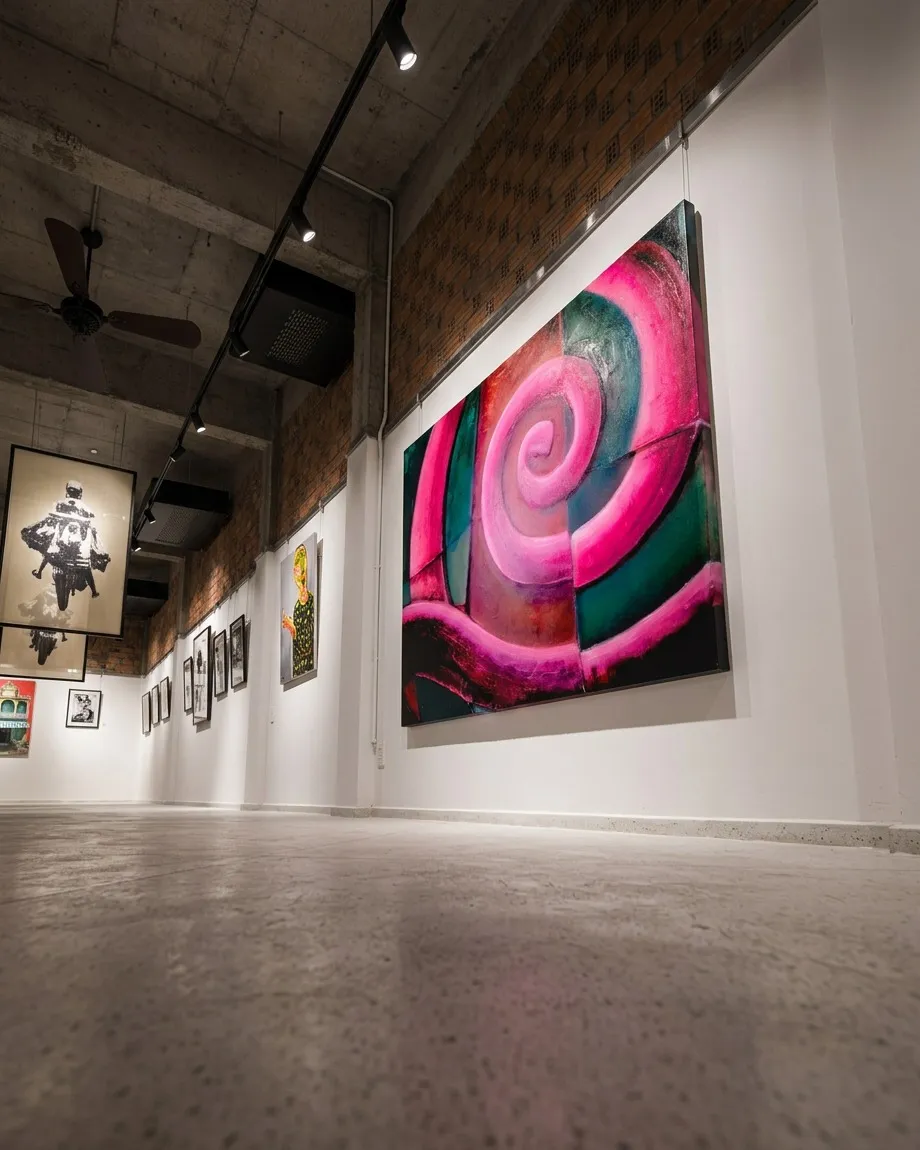
Context study / VORAGO
VORAGO Brutalist Painting by Maurizio Valch | Industrial Space
Faced with the monumental scale of "VORAGO", the pictorial plane ceases to behave like a passive surface, transforming instead into a system of centripetal forces. A massive spiral in cadmium pink and magenta tones saturates the core of the composition, exerting a physical pull that contrasts with the static gravity of the dark, green, and bluish masses flanking it at the margins. This rotation does not suggest a mere illusion of volume, but instead establishes a depth of a strictly material nature; it is a tectonic hollow that sucks the gaze into the thickness of the accumulated paint. The chromatic blocks of the background, arranged in subdivisions reminiscent of brutalist architecture or land partitioning, attempt in vain to channel and contain the organic turbulence of this whirlpool. A constant tension is thus generated between the inflexible orthogonality of the two-meter stretcher and the circular push of a matter that devours and regenerates itself, defying the immobility inherent to the physical support of painting.
When confronting the scale of this canvas, I understood that constructing the spiral could not be resolved through drawing, but rather through a physical accumulation of matter that demanded my entire body. I worked by layering thick coatings of acrylic and oil with a palette knife, modeling the relief so that each filament of pigment acquired an almost three-dimensional presence, a skeletal structure of color that responds changingly to the actual light of the exhibition space. In this process, I conceived the intensity of the pink and crimson as an exercise in absolute generosity: a chromatic overflow that deliberately breaks with the hermetic sobriety of my previous investigations into ruins and silent landscapes. I did not seek containment, but rather an unreserved material offering; a rustic, rough, and direct light that emerges from the underlying shadow of the canvas to challenge touch before reason, offering itself to the observer as a pictorial body that exposes itself completely and resists being assimilated as a simple flat image.
It is precisely in the clash between the structured background and the enveloping curve of the spiral where the painting reaches an unforeseen communion. The straight lines, heirs to a geometric rigidity that seeks to partition space, ultimately bend to the fluidity of the continuous turn, dissolving the gap that traditionally separates constructed order from organic drive. The spiral not only unifies the blocks of color that initially seemed fragmented, but also extends to the very edges of the three-centimeter-deep stretcher, neutralizing the boundary of the frame and expanding its field of influence into the surrounding architecture. By collapsing this purely analytical distance, the viewer is stripped of their role as a passive witness; they are situated on a kind of tactile shore where the boundaries of representation vanish, leaving them immersed in the raw dynamics of a matter in a permanent state of transformation and internal friction.
While the matter still retained its moisture and plasticity on the support, I made deep incisions, clean cuts, and scrapings that furrow the relief, following the inertia of the turn. These grooves, which reveal the lower chromatic layers and the original grain of the canvas, are my direct response to the unfathomable depth pulsing behind the title of this piece; a way of dialoguing with the void not from the representation of nothingness, but from the concrete wound on the pictorial plane. For me, subtracting paint through incision constitutes an indispensable structural counterweight: a tactile and austere silence that dampens the visual din of the magenta tones. It is the gesture with which I sabotage the tyranny of the perfect brushstroke and assume the vulnerability of a surface that does not hide its scars, allowing physical error and the wear of the tools to leave their mark on the final record of the work.
When contemplating the entirety of "VORAGO", the formal tensions resolve into a continuous fabric where the generosity of the pigment, the suggested depth of the abyss, and the communion of opposing geometries integrate seamlessly. The piece renounces being a mere two-dimensional ornament to assert itself as a spatial device of great physical weight that pulses and actively dialogues with the room's environment. The vortex dominating the canvas does not lead to a loss of meaning, but rather redirects the gaze back toward its own center: a core where the paint seems to fold in on itself to remind us that emptiness does not equate to absence, but to the point of origin where all forces balance. Ultimately, the work neutralizes speculative distance and confronts us with the immediacy of matter, inviting us to lay down the resistances of the intellect to fully integrate into an experience where the pictorial object and the observer form part of the same indivisible plane.
- Original artwork
- VORAGO
- Actual dimensions
- 82.7 × 63 in / 210 × 160 cm
- Presentation
- Digital contextual visualization
Context references
paintings for industrial environments · large format magenta painting · textures in abstract painting · collectible contemporary art · maurizio valch vorago painting · color fields and spirals
About this visualization
This visualization places the artwork within an architectural context to help collectors and viewers imagine its presence in a real space. It is an interpretive reference, not an exact reproduction: the original work remains the sole authority for scale, color, surface and material presence.