Context study / VORAGO
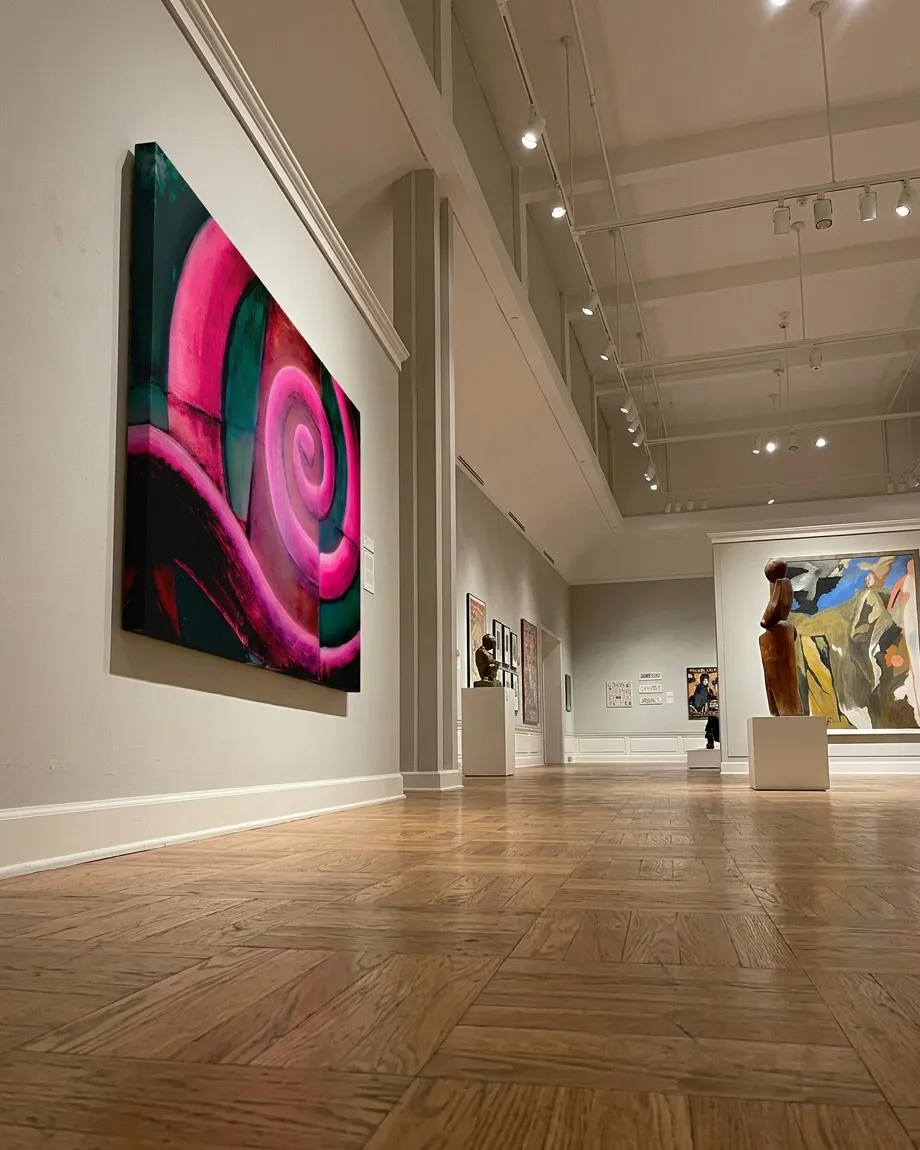
Large VORAGO Abstract Painting in Museum | Maurizio Valch
In VORAGO, the two-by-one-and-a-half-meter surface becomes a tactile geography ruled by centripetal rotation. An imposing spiral in vibrant fuchsia and pink tones unfolds and folds back on itself, breaking the apparent two-dimensionality of the support. It is not an ornamental figure placed on top, but a territory in dynamic movement that absorbs the gaze into its dense, wet core. This chromatic whirlpool, supported by a structured background of deep greens, midnight blues, and material-heavy blacks, proposes a way of listening that bypasses the auditory to operate directly on somatic perception. Stopping in front of the canvas, the viewer is invited to perceive a low vibration, a dull murmur emanating from the accumulated layers of oil and acrylic; the space of the painting seems to fold back onto its own material secret, demanding quiet attention, a physical receptivity to the push of a pictorial mass that spins slowly but relentlessly.
To build this vortex, I had to dismantle my own mental architecture and renounce the orthopedics of the incised straight line—that trench of order that served for so long to contain the uncertainty of space. Curving the material onto the canvas required an act of absolute abandonment; it meant casting off the anchors of defensive geometry and allowing the body, the arm, and the palette knife to follow the inertia of an organic rotation. Sliding the thick pigment and feeling its stubborn resistance against the surface, I understood that the only way to inhabit this whirlpool was by surrendering to its own off-center flow. I had to abandon the plastic safety of the level and the plumb line to let the fuchsia roll and fold under the impulse of a physical force that no longer responded to intellectual calculation, but to the pure urgency of bodily movement in the solitude of the studio.
The chromatic contrast of the composition articulates a tension that is fundamentally thermal. The burning, fuchsia flesh of the spiral radiates an almost physiological heat, a temperature beating with its own strength against the cold, nocturnal passivity of the surrounding dark green fields. This thermal quality shifts the painting from mere visual representation to the plane of epidermic experience: the canvas ceases to be an inert plane and transforms into a sensitive membrane, a body exposed to its own internal combustion. The heat radiating from the saturated pink areas alters the temporal coordinates of the room, forcing the viewer's body to adjust its distance and rhythm before a surface that seems to breathe and expand thanks to the accumulated density of its pigments and the physical depth of its three-centimeter stretcher.
In the silence of my studio, the spiral ended up behaving like an organic cavity, a canvas shell storing the echo of a prolonged transit. Painting this piece was an exercise in deep internal listening, where each curved trace recorded the pulse of the material and the heat retained within the successive strata of color I superimposed day after day. In this process of accumulation and drift, the need to seek or define meaning completely dissolved; it was a way of silencing the mind and simply becoming fresh earth under the pressure of the paint. By renouncing the persona of the seeker chasing a predetermined aesthetic end, I allowed the painting to inhabit an expanded present, a pure vibration where the heat of the oil and the silence of the space merged into a single material heartbeat.
In the visual resolution of VORAGO, the three cardinal forces of this journey—the abandonment of structural rigidity, the heat of the fuchsia incandescence, and the silent listening to the material—collapse into a single, unified organic movement. There are no seams or divisions in the tactile experience the painting imposes on the exhibition room. Standing before the work, the viewer, the chromatic plane, and the emptiness separating them integrate into the same web of physical relations, where the boundaries of the painting vanish before the inertia of the spin. Ultimately, this encounter reveals to us that the true destination of the gaze does not lie in conquering a summit of geometric order and control, but in the honesty of surrendering to this curved drift, letting oneself be pulled by the gravity of a center that never stops beating.
- Original artwork
- VORAGO
- Actual dimensions
- 82.7 × 63 in / 210 × 160 cm
- Presentation
- Digital contextual visualization
Context references
large fuchsia abstract painting · contemporary art decoration · maurizio valch vortex · large-scale abstract painting · art gallery interior design · original artworks for collectors
About this visualization
This visualization places the artwork within an architectural context to help collectors and viewers imagine its presence in a real space. It is an interpretive reference, not an exact reproduction: the original work remains the sole authority for scale, color, surface and material presence.