Context study / VORAGO
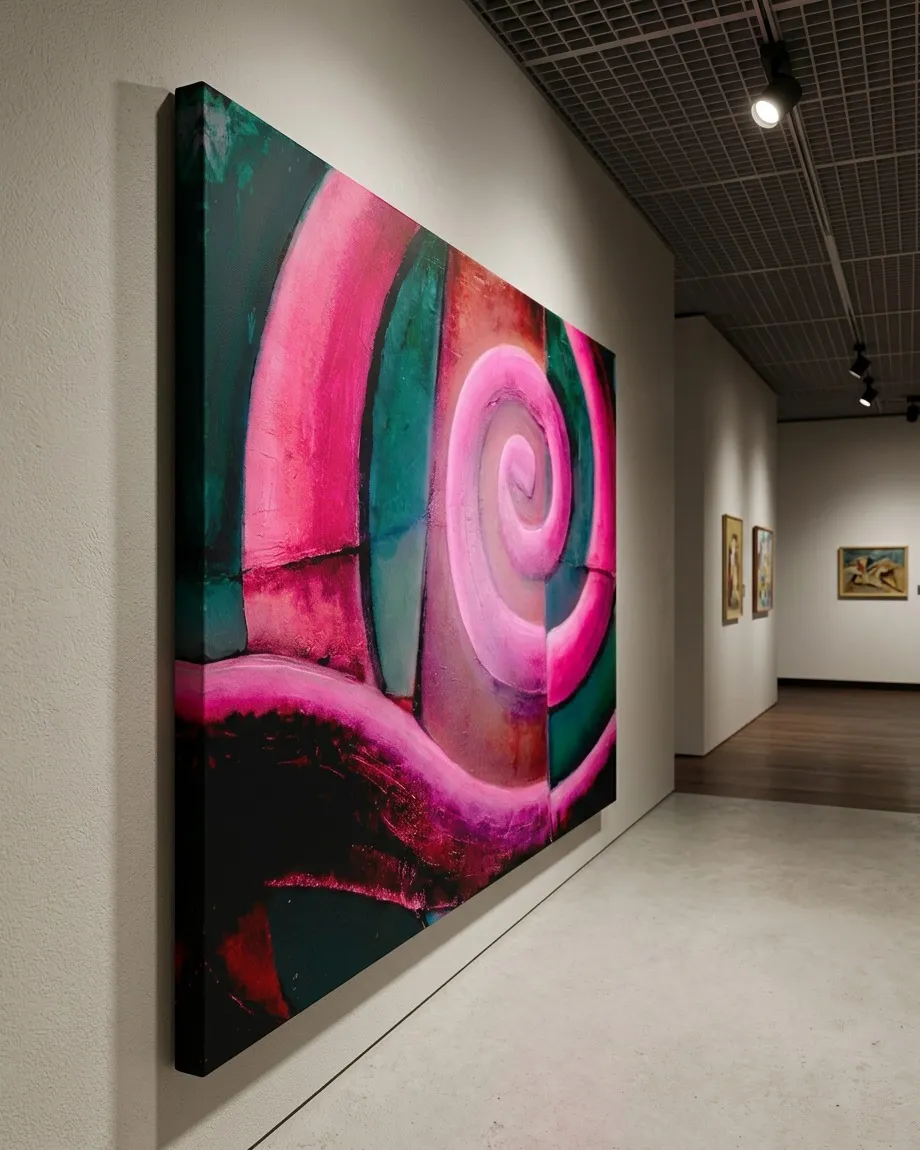
VORAGO Abstract Painting by Maurizio Valch | VORTEX Series
The monumentality of VORAGO imposes itself on the viewer not as a static surface, but as a chromatic event that profoundly alters the coordinates of the space hosting it. A magnetic, almost incandescent crimson pink endowed with a fluorescent vibration dominates the visual plane through a bold spiral that seems to emerge from the depths of the canvas while simultaneously consuming a background of dark chromatic fields, where bluish-greens and tectonic incisions suggest an ancient, stratified material in perpetual tension. This visual physiognomy unleashes a dynamic paradox in which we find ourselves before a vortex whose centripetal force concentrates our gaze toward a mysterious core, while its centrifugal inertia threatens to expand beyond the limits of the stretcher, overflowing the two-dimensionality of painting. This oscillation places us at a phenomenological crossroads where it is impossible to distinguish whether we are witnessing a primordial process of creation—such as the biological or cosmic origin latent in a Neolithic cave where the first human pigment traced the sacred turn of life—or if, on the contrary, we are peering into a zone of imminent danger, a psychic and visceral fissure that threatens to fracture the apparent stability of the conscious self, sucking it into a wild dimension of no return.
Standing before the immensity of this canvas, over two meters high, my relationship with the painting ceases to be purely conceptual and becomes a physical confrontation, a hand-to-hand combat where material dictates its own rules. Sustaining the density of oil and acrylic on such a monumental scale demands the involvement of my entire being; each curve of the spiral is not a pre-calculated stroke, but the record of a bodily movement, of a held breath pushing color across the textured surface. When I plunge the palette knife or brush to make those dark incisions crossing the pink, I am not seeking a decorative line or a compositional boundary, but inflicting a real wound upon the lower layers, unearthing the chromatic memory beating beneath the visible plane. In this process of accumulation and subtraction, my search is not oriented toward the perfection of cold geometry, but toward the construction of an elemental and organic, almost visceral structure that emulates the fleshiness of living tissue—where the crimson pink, with its weight and imposing light, establishes its own law of gravity, forcing me to follow a path I have set in motion but no longer fully control.
This visual descent into the interior of the work forces us to confront the magnetism of its spiral under a triple intellectual suspicion that subverts the idea of mere formal order. From Carl Jung's perspective, this whirlpool moves away from the balanced placidity of traditional mandalas; it is not a symbol of peaceful psychological integration, but a consuming vortex or vorago that activates the Shadow and drags individual consciousness toward the indecipherable abyss of the collective unconscious, raising the disturbing question of whether this center is a space of unification or the ultimate dissolution of the subject. Faced with this psychological abyss, George Gurdjieff's rigor warns us of the mechanical nature of human existence, suggesting that this continuous rotation could embody the hypnotic inertia of a sleeping mind blindly repeating its daily orbits; yet, the violence of the stroke and the density of the paint seem to embody that superhuman effort, that conscious shock seeking to break the automatic flow through self-remembering. It is in this gap that Osho's vitalist suspicion breaks through, finding in the overflowing intensity of the fluorescent pink and the untamable energy of the curved movement a rebellion of the body and the celebration of pure existence—an organic drive that fiercely resists being domesticated by mental structures or the conceptual cages of society, locating in the apparent emptiness of the spiral's center not a lack, but a space of absolute freedom where truth refuses to be caught.
Although the mind tends to seek comfort in theories of the psyche or the mystique of awakening, when I am in my studio in front of the painting I shed any interpretative scaffolding; for me, painting this vortex is not about illustrating a philosophical treatise or mapping the corners of the soul. Above all else, I am interested in the stark tension between the rigid, orthogonal order of the stretcher and the wild nature of a gesture that constantly seeks to overflow it, challenging the physical limits of the support. I do not intend for my painting to be a decipherable map or a closed symbol to which a single meaning can be assigned; my true purpose in tracing this curved horizon is to place a material boundary in space, a physical barrier of color and texture that halts the accelerated flow of external time and forces the viewer to confront the stubborn persistence of paint on the wall. At the end of the day, the painting is not a portal to another invisible reality, but the absolute assertion of its own three-dimensional presence—a heavy, rough, and vibrating object that demands to be contemplated for what it is and not for what it represents.
Finally, the journey through VORAGO inexorably returns us to the concrete, material surface of the work, where conceptual illusions dissolve in favor of the pure pictorial fact. Approaching the canvas, we discover that the monumental spiral does not float in a vacuum, but rests on a complex web of accumulated textures, violent scrapings, and visual seams that bear witness to the passage of time and the persistence of the creative gesture on the support. Far from being a mere passive backdrop, the dark background reveals itself as an archaeological territory of superimposed layers that support and at the same time challenge the prominence of the bright pink, creating a space of perpetual transition where the beauty of form is indivisibly bound to the threat of erosion and loss of control. By renouncing a harmonious resolution, the spiral remains suspended before us as an open question, a physical trace of time stranded on the canvas that does not seek to offer answers, but to bear witness to the inexhaustible pulse of a material that insists on continuing to spin before our eyes.
- Original artwork
- VORAGO
- Actual dimensions
- 82.7 × 63 in / 210 × 160 cm
- Presentation
- Digital contextual visualization
Context references
pink and green spiral painting · monumental abstract painting · contemporary brutalist art · maurizio valch vorago · large paintings for living room · oil and acrylic on canvas
About this visualization
This visualization places the artwork within an architectural context to help collectors and viewers imagine its presence in a real space. It is an interpretive reference, not an exact reproduction: the original work remains the sole authority for scale, color, surface and material presence.