Context study / VORAGO
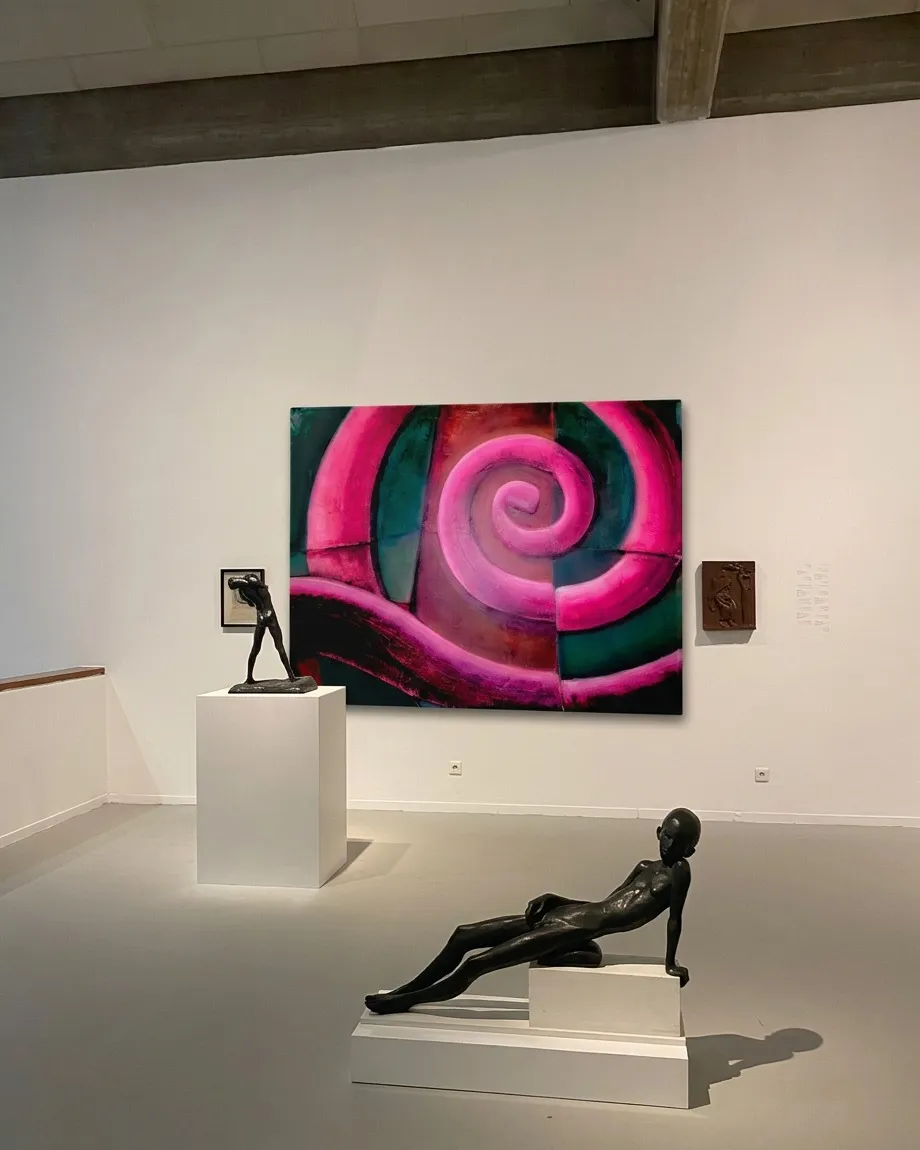
VORAGO in Museum - Contemporary Abstract Painting by Maurizio Valch
In the silent museum room, surrounded by bronze figures that bend and recline under the weight of their own dramatic posture, "VORAGO" does not tell us of a conflict nor seek to illustrate a wound. Its monumental magenta spiral does not function as the stage for an event, but as the concentration of a physical and emotional state that refuses to submit to explanation. Color here does not describe a concrete feeling; it is an atmospheric density that displaces the light of the space and alters the visual temperature of the brutalist architecture that supports it. On this canvas, emotion leaves the realm of anecdote to become a tactile and absolute presence, a block of intensity that directly confronts the viewer's body.
When I drag the palette knife loaded with pink pigment over the dark greens of the background, I am not trying to explain a loss or bear witness to an inner reconciliation. I feel only the weight of my arm, the resistance of the canvas, and the urgency of a material that demands its own structure in the face of disorder. In tracing the incisions on the fresh oil, I do not draw outlines or paths; I execute a direct cut into the surface to halt the centrifugal force of the spin and reveal the strata of color that dwell beneath. It is a way of silencing the noise in one's own head, fixing in the roughness of the pigment a heartbeat that would otherwise disperse in the futile attempt to give it a name.
By dispensing with narration, Valch's painting operates on a frequency close to the eroded walls of Antoni Tàpies or the gravity of enveloping color in Rothko, but preserving a more compact and rough territorial structure. The surface of "VORAGO" behaves like a skin under constant pressure, a map where the geometric divisions of the background attempt to box in a force that threatens to overflow the limits of the stretcher. There is no passage of time in this spiral, but a tense, accumulated stillness that contains both the impulse of movement and the resistance that curbs it. The work thus offers itself as a dry dock for the gaze, a territory where feeling is not explained through concepts, but is felt and sustained as a material truth.
I look now at the canvas suspended on the wall and perceive that strange distance that opens up when the painting begins to breathe outside my studio. I know there will be those who search this vortex for a mythical symbol, a psychological labyrinth, or a key to deciphering their own biography, but for me, the truth of the painting lies in its stubborn physical immobility. If I could translate into words the vibration of this magenta or the exact meaning of these incisions, the act of painting would have lost its original necessity. I paint precisely where the mind's explanations run out and only the mute impact of a surface that questions us without asking for anything in return remains.
Holding the gaze before "VORAGO" demands inhabiting the paradox of a dynamism that refuses to move forward. The rational grid of the background and the organic curve of the spiral do not reconcile in a peaceful synthesis; they coexist in a suspended friction that returns the viewer to their own inner silence. The image does not console with promises of overcoming or introduce us to a journey of heroic self-realization. By relinquishing the urgency to interpret what we see, the painting reveals its true power: the capacity to condense, in the simple materiality of color and cut, the thickness of an existence that needs no justification to be real.
- Original artwork
- VORAGO
- Actual dimensions
- 82.7 × 63 in / 210 × 160 cm
- Presentation
- Digital contextual visualization
Context references
paintings for museum decor · fuchsia expressive abstract painting · Maurizio Valch original artwork · magenta spiral oil · Spanish contemporary art
About this visualization
This visualization places the artwork within an architectural context to help collectors and viewers imagine its presence in a real space. It is an interpretive reference, not an exact reproduction: the original work remains the sole authority for scale, color, surface and material presence.