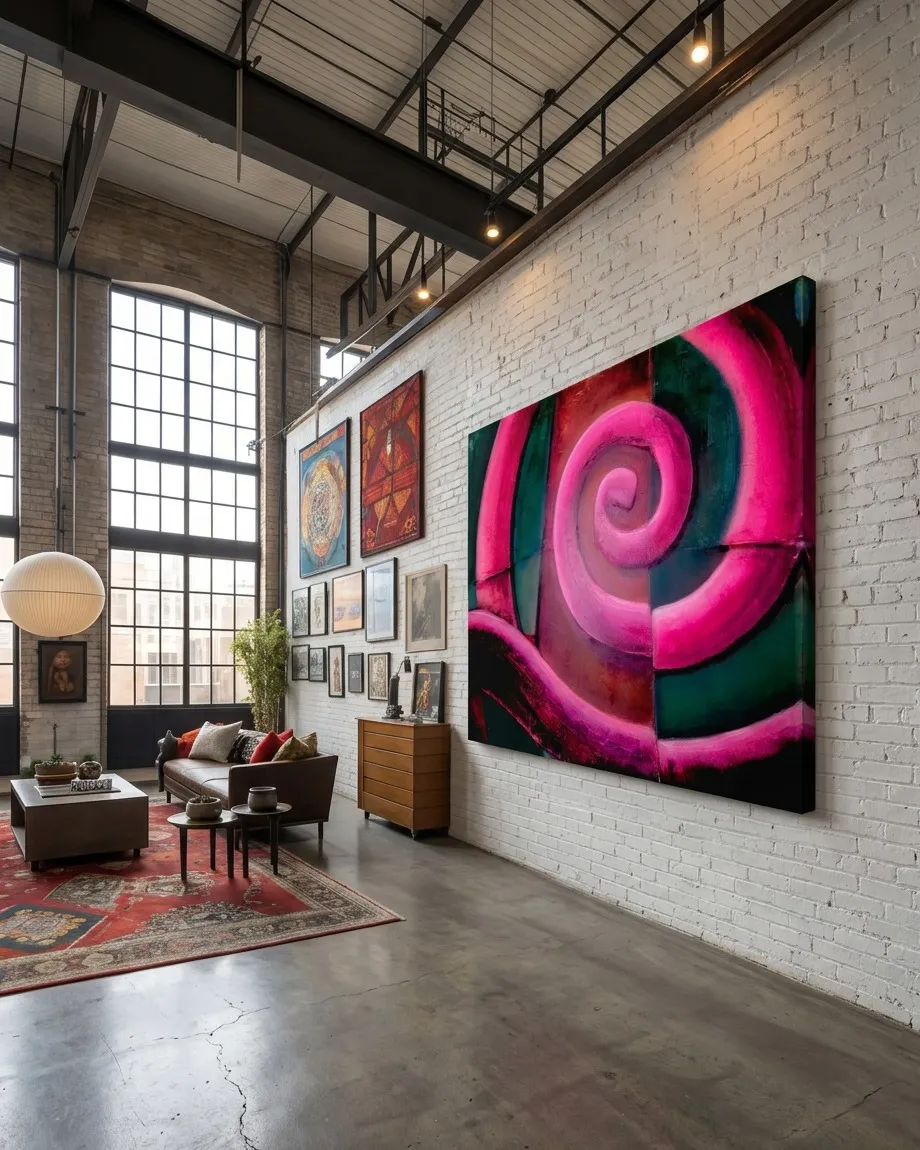
Context study / VORAGO
Contemporary Artwork VORAGO in Modern Living Room
Someone, from the other side of the room, might ask why that pink doesn't fall out of the painting. It looks heavy: a thick mass, folded over itself, with the weight of something that has grown too large. But it also looks fast. It swirls, pushes, gets ahead of the gaze and forces it to chase it. Is it coiling or uncoiling? The answer changes depending on where the eye stops: on one curve, the pink tightens; on another, it opens as if it had just released an old pressure. The deep greens, the blacks, and the dense reds are not a quiet background. They are resistance. They hold the spiral without immobilizing it, cool it without putting out its temperature, give it walls that do not quite finish being walls.
The surface of VORAGO, wide as an extended body—210 × 160 cm—does not allow an innocent look. The pink curve presents itself first as a visible shape, yes, but immediately begins to behave as a force that alters the distance between the spectator and the painting. At what point does this spiral cease to be a visible shape and begin to modify the body of the one looking at it? What part of us wants to reach the center, and what part suspects that the center is watching us return?
Antonio Damasio has insisted that the body feels before words can order what is felt. With him, the question changes: not what this spiral represents, but where it begins to alter the rhythm of whoever follows it. The eye accelerates at the edge of the widest pink bands; breathing can hang suspended before the sections where the curve cuts off and reappears displaced. There are areas where the pink seems to approach like soft, warm, excessive matter, almost too close. Then the dark blocks intervene: they contain, separate, cool things down a bit. But they do not conquer. Damasio might propose that the body recognizes there a signal of approach and defense, a small map of tensions. The painting accepts this hypothesis only to a certain point. Then it contradicts it: where the body expects to close, a curve invites it to continue; where it expects to enter, a black edge turns the gaze back outward.
I do not feel that the spiral leads me obediently toward a center. Sometimes it seems to allow me to get closer and, just when I think I have understood its direction, it turns away from what I expected to find. The shape has become physically strange to me: it retains a pressure I recognize, but not an answer. There is something in it that insists without asking permission, as if the surface had decided to keep open a question that is not mine to close.
∿
Now the scale is disrupted. The spiral stops being merely a movement seen from the outside and begins to seem like a place one could enter, even though no one has provided an entrance. Its bands could be corridors, its cuts could be abrupt changes of level, its green areas could be rooms in shadow. But the imagination immediately stumbles: that place does not let itself be ordered.
Charles Eames understood that playing with scale and the use of things could reveal new ways of inhabiting them. His test here would not be interpretative but practical. One would have to walk the spiral as if it were an interior without doors, a model without a ceiling, a toy that has grown too large for the hands. Where would you place your foot? On which curve would your shoulder brush against too close a wall? Which fold would offer shelter, and which would expel the visitor toward a red or black band?
The experiment begins with enthusiasm and fails with precision. A pink band seems promising: wide, enveloping, almost gentle. But it is crossed by a joint. Higher up, a dark mass cuts off the path and makes it impossible to decide whether there is depth or blockage. The rectangles do not cooperate; they introduce a dry logic within the rotation, like poorly placed planks on a staircase that does not want to lead to any floor. Eames would try to adjust the experience, invent a rule of use, imagine a way to traverse the space without being expelled. Damasio, from the other side of the painting, would insist that the body has already registered the danger and desire before designing a solution. But the spiral grants victory to neither: feeling is not enough; constructing a test is not either. Each attempt to inhabit it alters its limits.
∿∿
The center returns.
Not as a destination. As a twist.
A pink curve enters toward it, but arrives divided. There are lines that look like seams; others, flaws; others, floodgates that do not quite open. Perhaps they are changes of time within the same curve: a pink that was pressure and is now a memory of pressure; a turn that wanted to stop and could not; an area where the gaze learns to fold in on itself in order not to fall. Nothing forces a single reading. The divisions do not explain the spiral: they make it waver.
And this wavering matters. The pink, which from afar looked like a continuous ribbon, reveals itself to be composed of fragments that do not fit together docilely. Each cut interrupts, but also delivers momentum. The gaze jumps the joint and, in doing so, returns to the movement with more force. As if the interruption were the secret engine of the turn.
The center, of course, resists solemnity. Perhaps it is not an abyss or a revelation, but an obstinate little animal that has coiled up to avoid answering questions. It remains there, pink, compressed, with a kind of charming bad mood. It does not want to be conquered. It barely wants to keep turning.
Now I see that the center is not an arrival, nor even a goal that the painting must grant. It returns a look that I do not know how to translate and that I prefer not to domesticate with explanations. There is a movement in the work that I no longer feel as mine: not because it is alien to me, but because it has found a way to continue without asking my permission. When I return to it, I do not find the same shape; I find the shape's decision not to stand still.
∿∿∿
Damasio would have to modify his map. The body knows many things before explaining them, but here a knowledge appears that does not quite settle into any recognizable sensation. There is acceleration, tension, desire to approach, desire to retreat; yet none of those signals is enough to possess what is happening. The spiral does not let itself be fully translated into pulse, respiration, or reflex. Something remains outside the corporal map and, even so, affects the body.
Eames would also have to abandon part of his project. This space will not be comfortable. There will be no efficient layout, clean path, or stable enough rule of use. The painting offers surfaces that seem habitable and renders them unstable a moment later. The curve protects, but also edges. The black limits, but also opens up a distance. The green does not necessarily calm: it can be a lateral pressure, a reserve of shadow against which the pink becomes more insistent.
Thus, the spiral no longer leads only inward. It can expel. It can surround something absent. It can guard a lack without turning it into a solemn secret. It can turn around an area that does not need to be revealed to exert its force.
Turn your gaze back to one of the joints crossing the pink, near the central turn. It no longer seems like a minor interruption. It seems like the exact place where the curve catches its breath, changes direction, and forces the entire image to keep moving.
- Original artwork
- VORAGO
- Actual dimensions
- 82.7 × 63 in / 210 × 160 cm
- Presentation
- Digital contextual visualization
Context references
large painting for white brick wall · living room design with abstract artworks · contemporary art for spacious living rooms · wall decor with large scale paintings · pink and dark green abstract painting
About this visualization
This visualization places the artwork within an architectural context to help collectors and viewers imagine its presence in a real space. It is an interpretive reference, not an exact reproduction: the original work remains the sole authority for scale, color, surface and material presence.