Context study / VESTIGIA
Maurizio Valch - VESTIGIA | Contemporary Abstract Art
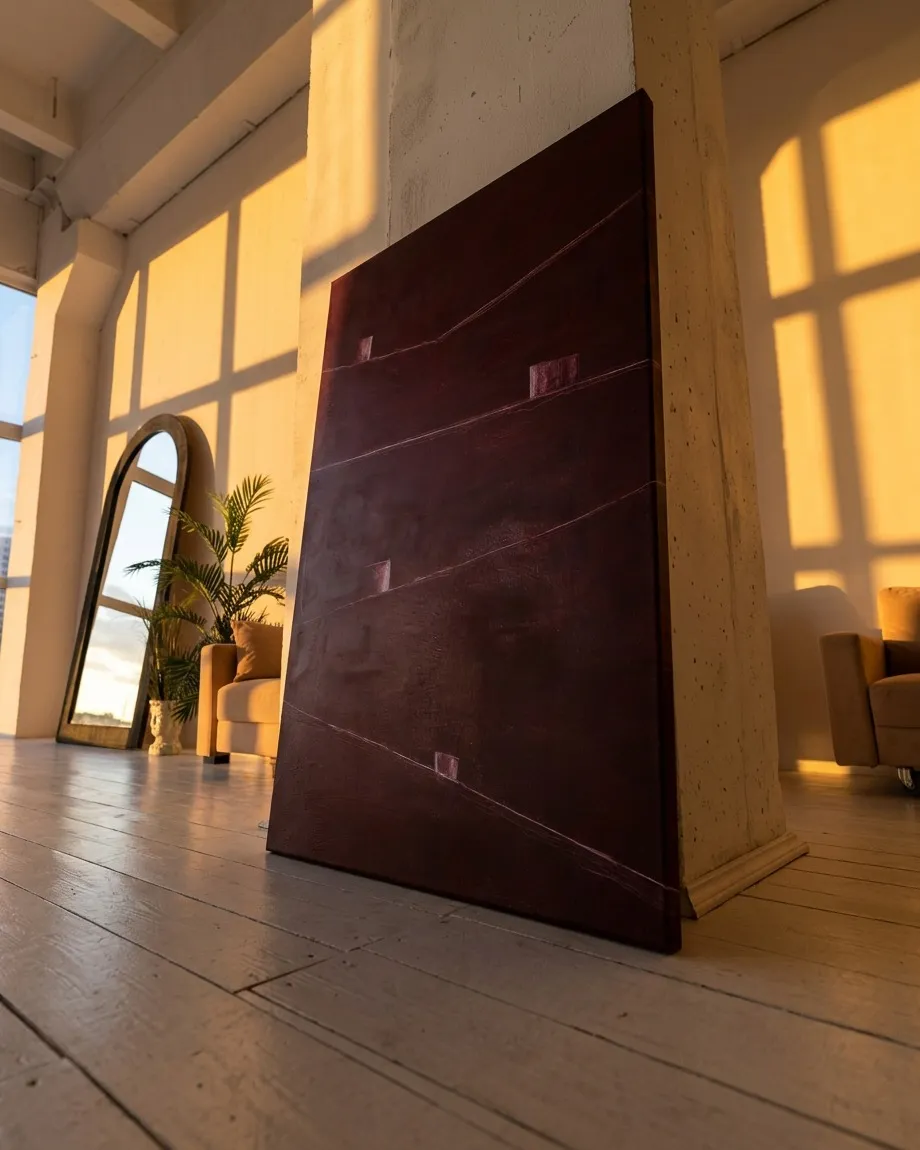
At a certain distance, VESTIGIA seems like a landscape that has decided to withdraw the ground. The vertical rectangle concentrates a reddish darkness —retained wine, muted garnet, earth that still keeps its warmth— and does not offer a place to rest the gaze. The eye searches for a base, a plain, an edge that allows one to say: here begins stability. It does not find it. The surface has density, but that density does not equal firmness; it looks more like an expanse seen at the instant it begins to tilt.
The four pale lines cross this field without fully obeying the idea of a horizon. They are not straight, though they do not seem to want to be free either. Tense, irregular, almost cautious, they divide the space and throw it back into disorder at the same time. The first, at the top, could separate two zones; an instant later it seems like a thread suspended between two points that are no longer there. Beneath it, a clear form remains. A small house? A fragment of a wall? A tooth of light embedded in the shadow? It stays there with a slightly comical seriousness, like a minuscule object that has received an excessive responsibility.
Rumi was a poet who turned loss, desire, and separation into ways of listening to what cannot be possessed. At first, the lines might offer him an easy path: a here and a there, a distance between what is set apart and what waits to be reunited. But the painting denies that consolation. No line promises arrival. Each curves slightly, turns away, loses its poise. Separation does not open a path: it modifies the weight of whatever is near. The small upper form does not seem situated beyond the line, but rather held by a gravity that does not coincide with ours.
A brief test: first, look at the work as if you were standing very far away, at the end of a room. Let the dark field be only a silent territory. Then approach with your eyes as if you had to cross the first line without touching it. You will notice that you do not know which side to pass on. Not because the line blocks the way, but because it changes the tilt of the space before you can cross it.
I discover that a minimal line can shift the entire weight of a space. I observe it and feel my own balance adjusting, slightly, as if one shoulder had to drop so that the painting does not spill over. I do not know if the line holds something or is about to give way; I know it alters the breathing of what surrounds it. When a clear presence stands beside it, my attention finds no rest: I look at the form, return to the line, and the distance between them no longer remains the same.
The second line descends with a tilt that complicates rather than guides. It does not delimit a territory: it seems to have disobeyed it. Near it appears another clear body, somewhat more visible, though no more explainable. It could be a stone with a flat face, a tiny construction, a mark someone left to return to, or the most obstinate part of an absence. It does not fall. That is the first thing that matters. The reddish world seems to tilt beneath it, but the small volume preserves a posture that no one has granted it.
A child might look at the painting and ask: “Who told those four things they could stand up?” The question forces us to remove the word “symbol” from the room. If they have permission, someone would have had to give it; if they do not, they remain on their own. Then they stop being signs placed to clarify the space. They become witnesses. They have remained after something, but they do not relate what happened. Their silence is not solemn: it has the stubbornness of a crumb that does not leave the table even if the table moves.
Diane Arbus was a photographer who looked at those who disordered comfortable ideas of normalcy and returned to each presence its irreducible strangeness. She would not allow these small bodies to be evaporated too soon into an idea of ascension or consolation. They are there. They occupy little, but they occupy. They have an edge, shadow, orientation; they seem to know something about the framing that the viewer still does not. The third form, next to the intermediate line, does not ask for compassion or high interpretation. It plants itself with a kind of quiet bad mood.
Try again, now with the body: try to decide if the lines rise, fall, or simply escape. Observe what happens in your breathing. Perhaps it becomes shorter. Observe also the shoulders: one might want to compensate for the tilt that the eye cannot resolve. The painting does not move, but it forces the body to negotiate with it. Its horizons do not lead far away; they shift the center of gravity at every step.
Here Rumi can no longer treat distance as a promise of union. The third line neither unites nor separates: it leaves a suspension. The small form next to it gains weight, an almost tactile gravity. It seems to have a base, though no base is visible. The dark stain surrounding it could swallow it, and yet the form persists, as if it had learned a secret physics. Rumi learns to look at it not as a flash, but as something heavy. Diane Arbus, meanwhile, has to admit that this concrete presence harbors a lack that no image could completely fix. Its outline is precise; what is missing around it is not.
I return to one of the clear forms and can no longer recognize it as something that obeys me. I look at it completed and discover that it demands a position I had not given it: it does not want to be a house, stone, or sign, nor does it accept being just a stain. I wanted it to remain near a line; now it seems the line has tilted to answer it. I cannot decide which of the two supports the other.
The fourth line arrives at the bottom with a different fatigue. It stretches, thins, insinuates itself again. It does not quite become a border or a relief; it seems a trajectory that has lost its destination and, even so, continues. Beside it, the last clear form acquires a special discomfort. The others could still seem like remnants; this one begins to look like an interruption. A small volume against the dark field. A pale edge that accepts no name.
If it is called a stone, it seems to look. If it is called a house, it seems too lonely to shelter anyone. If it is called a mark, it preserves a thickness that a mark should not have. If it is called a remnant, it forces us to ask from what the rest of the world withdrew. None of this exhausts it. The difficulty of naming it makes the other three presences and, suddenly, also the lines, strange: they are no longer paths, or separations, or cracks, but the visible consequences of that form having decided to stay.
Below, very close to the edge, the pale line tilts slightly towards the small clear presence, without actually touching it.
- Original artwork
- VESTIGIA
- Actual dimensions
- 31.5 × 47.2 in / 80 × 120 cm
- Presentation
- Digital contextual visualization
Context references
large format red abstract painting · minimalist abstract painting · Maurizio Valch artist · living room decor red abstract painting · original abstract wall art
About this visualization
This visualization places the artwork within an architectural context to help collectors and viewers imagine its presence in a real space. It is an interpretive reference, not an exact reproduction: the original work remains the sole authority for scale, color, surface and material presence.