Context study / VERSUM
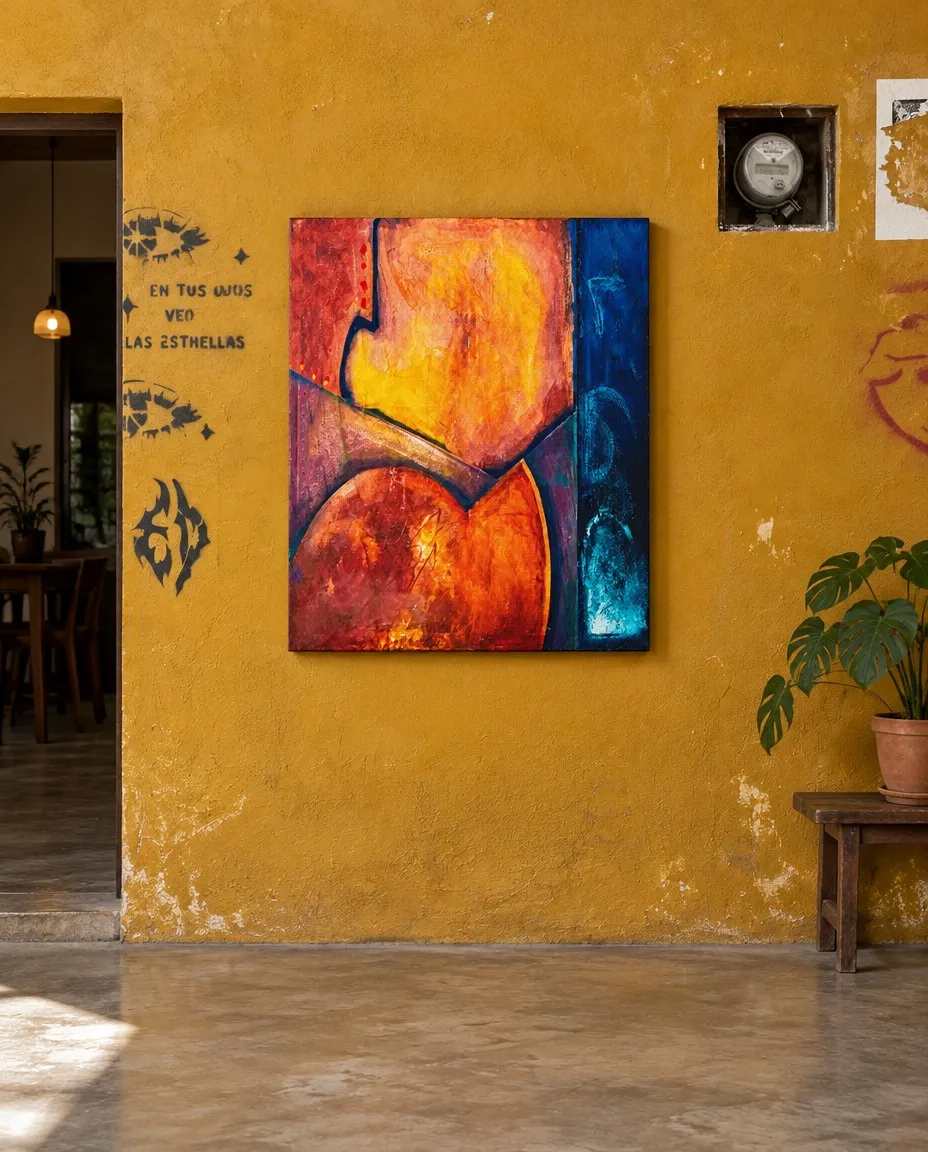
VERSUM by Maurizio Valch in an Urban Space with a Yellow Wall
Cold That Arrives First
To the right, the blue does not wait. It was already there when the yellow began to push, when the oranges swelled, when the red ceased to be a spot and took on weight. It does not seem like the edge of a scene: it seems like that which arrived before the scene and has, nevertheless, decided to stay to watch it.
It is a vertical, thick blue, almost blue-black in certain stretches. It has something of a side camera: it does not enter the fire, it does not mix with it, but it receives its glow as one receives news that was not asked for. There are lighter marks on this band, areas that seem to have retained a graze, a dampness, or a figure that fails to fully appear. There are no eyes. Even so, it is hard to avoid the feeling of being observed from there.
Nisargadatta Maharaj was a spiritual master whose way of turning attention toward the perceiver, rather than the perceived, is significant before this painting.
His discomfort would enter through the blue. He would not immediately ask what those warm masses are or what they represent; he would suspect that the true event happens in the place from which they seem to be seen. If the gaze fixes on the blue band, the heat loses its protagonist status for a moment. It keeps burning, yes, but it is exposed to a presence that neither celebrates nor condemns it. Who needs the fire to be explained? Who insists on turning that orange pressure into a recognizable story?
Then appears the question that this painting slowly sharpens:
> What is this painting tuning in the viewer's body: a heat leak toward the blue, or a form of attention that the heat does not yet know how to name?
At first, it seems that the blue withdraws heat from the painting. Later, something more uncomfortable is noticed: perhaps the blue withdraws nothing; perhaps it forces us to see how much the eye needs something hot to overflow.
The Seam That Does Not Close
Between the warm field and the blue is a dark, irregular line, firm without being straight. It descends from the upper part, breaks, widens near the reds, accompanies a curved edge, and tightens again. It does not divide two territories at peace. Rather, it verifies that they cannot touch completely.
It is a seam that fails in a productive way. If it closed, the blue would remain outside and the oranges inside. But the line fails to impose that separation: the blue seems to listen to the heat behind the edge; the reds seem to push against that dark reserve. The painting keeps both climates together without reconciling them. The cold does not cool the fire. The fire does not melt the cold. The seam only manages the proximity.
Here it is useful to perform a precise test. Fix your gaze on the dark line for one full breath, without tracing it. Then, without moving your head, let your eyes slide very slowly toward the orange and return to the blue. Do it a second time, a little faster. On the first crossing, the border seems a defense. On the second, it seems a membrane. Your posture shifts slightly: your shoulders may lean forward as if the body wanted to listen through a wall.
I look at this division and cannot obey it. Part of me believes that the blue contains the warm; another feels that the heat is forcing the blue to reveal itself. The painting has become independent of my intention and now places me before a physical doubt: I do not know if I am looking at a separation or a pressure that has not yet found a way to pass through.
Nisargadatta might insist: the seam is not in the painting, but in the viewer's need to have one side and another. But VERSUM resists this lesson. The line is there, too concrete, too heavy with visual weight to be just an interior division. There is no need to turn it into a symbol to notice that it is working. It makes the eye stop. It makes the heat lose its comfort.
Heat with No Metaphor Available
On the other side, the yellow, orange, and red masses do not behave as a simple source of light. They are accumulated. They rub against each other with difficulty. There is a large yellow-orange plane, high and central, which seems pressed from within, as if its surface needed to open up space but could not find enough air. Below, a curved reddish shape occupies the lower section: it does not rest, it does not fall, it does not advance. It settles.
The yellow has denser zones and others more scraped by sight, as if the gaze could not rest in the same way everywhere. The orange appears in layers of unequal temperature: one section seems almost hard, another seems to dissolve, another pushes toward the red without giving itself over entirely. There is no single emotion to obey. There is not enough "fire" to explain such variation.
A child's question cuts through the impulse to interpret: Why doesn't the orange lump spill?
The question is exact. That large lower curve could weigh down, slide, fall. But it remains held by dark edges and by the tension of what lies above it. Suddenly, the painting ceases to be a composition of colors: it becomes a situation of forces. Something holds. Something insists. Something cannot leave its place.
The upper plane, too, seems to have a forehead, a surface exposed to a pressure we do not see. It is best not to humanize it too much; it is enough to note that it presents itself as a body rather than a landscape. It is a form that does not represent a recognizable thing and yet forces us to measure its volume with our eyes.
The initial question shifts in temperature. It is no longer just a matter of knowing if the heat escapes toward the blue. Now something else matters: whether the heat learns, within its own deadlock, to produce attention. Perhaps that attention is not calm. Perhaps it is the way of not spilling.
Three Drips Out of Tempo
In the upper left margin of the warm field, small red drips descend next to a vertical edge. They are tiny against the large masses, yet they interrupt the order. They could be punctuation: three or four marks that prevent the painting from speaking too quickly. They could be an escape: something has broken away from the red zone and no longer finds a way back. They could be the beginning of a rhythm that has lost its origin.
Atahualpa Yupanqui was an Argentine composer, guitarist, and poet whose sensitivity to the terrestrial pulse, the pause, and the dignity of the minimal makes his presence significant before this work.
He would not need to turn colors into sounds. He would listen to something else: the obstinacy of those drips. They are neither ornament nor accident. They turn the edge into a count, a delay, an interrupted breath. The great lower orange, with its sustained curve, no longer seems like an explosion: it seems like a breath trying to find its tempo. The dark line marks a cut. The drips respond with small beats. And the blue, motionless on the right, could be a drone: not silence, but a prolonged note that does not abandon the painting.
That corrects Nisargadatta. The blue stillness would not only be the place from which one looks; it would also be that which sustains the pulse without participating in it. But Nisargadatta would return the objection: who listens to that drone? Isn't rhythm a form that attention invents so as not to be left alone before the motionless?
The discrepancy leaves the drips working. They are no longer just red. They are small delays that force the eye not to resolve the painting with a single glance. Looking at them for too long produces a strangeness: they seem to be on the verge of descending, yet they also seem to have stopped long ago.
The Blue After the Passage
Upon returning to the right band, it is no longer possible to see it as at the beginning. It has received the weight of the curves, the tempo of the drips, the pressure of the yellow plane, the dark cut that fails to close the scene. It remains cold relative to the oranges, but now its coldness has a vibration. It is not an absence of heat: it is the way heat is registered without conquering the place that registers it.
It no longer seems enough to say that the blue watches. Perhaps it watches, but it also endures. It must remain vertical next to a mass that insists on expanding. It must admit, in its lighter and deeper zones, that something of that fire has already touched it, even if it has not penetrated it.
I am not sure that the blue looks, nor that it holds a drone. Perhaps those ideas give too much work to a band that simply refuses to disappear. But the more I return to it, the less I can call it a limit: it appears as an unknown part of the painting, even to me, a part that neither retains the heat nor rejects it, but lets it reach a point I cannot see.
There, the initial question no longer demands an answer. The heat leak and the form of attention have contaminated each other without merging. Nisargadatta has had to admit that the body marks a rhythm before attention names it. Atahualpa has had to hear that no tempo exists without someone—or something—remaining before it. Neither is entirely right.
In the blue band, a small, lighter zone remains, almost a vertical trace suspended in the darkness. After crossing the oranges, the seam, and the drips, this mark does not seem like an exit or a sign. It seems like the exact place where the blue continues to watch, without eyes, what has not yet finished happening.
- Original artwork
- VERSUM
- Actual dimensions
- 39.4 × 47.2 in / 100 × 120 cm
- Presentation
- Digital contextual visualization
Context references
yellow wall decor with abstract art · brutalist urban style interior design · contemporary art paintings in bohemian settings · abstract painting on textured yellow background · color contrast on walls with original paintings
About this visualization
This visualization places the artwork within an architectural context to help collectors and viewers imagine its presence in a real space. It is an interpretive reference, not an exact reproduction: the original work remains the sole authority for scale, color, surface and material presence.