Context study / VERSUM
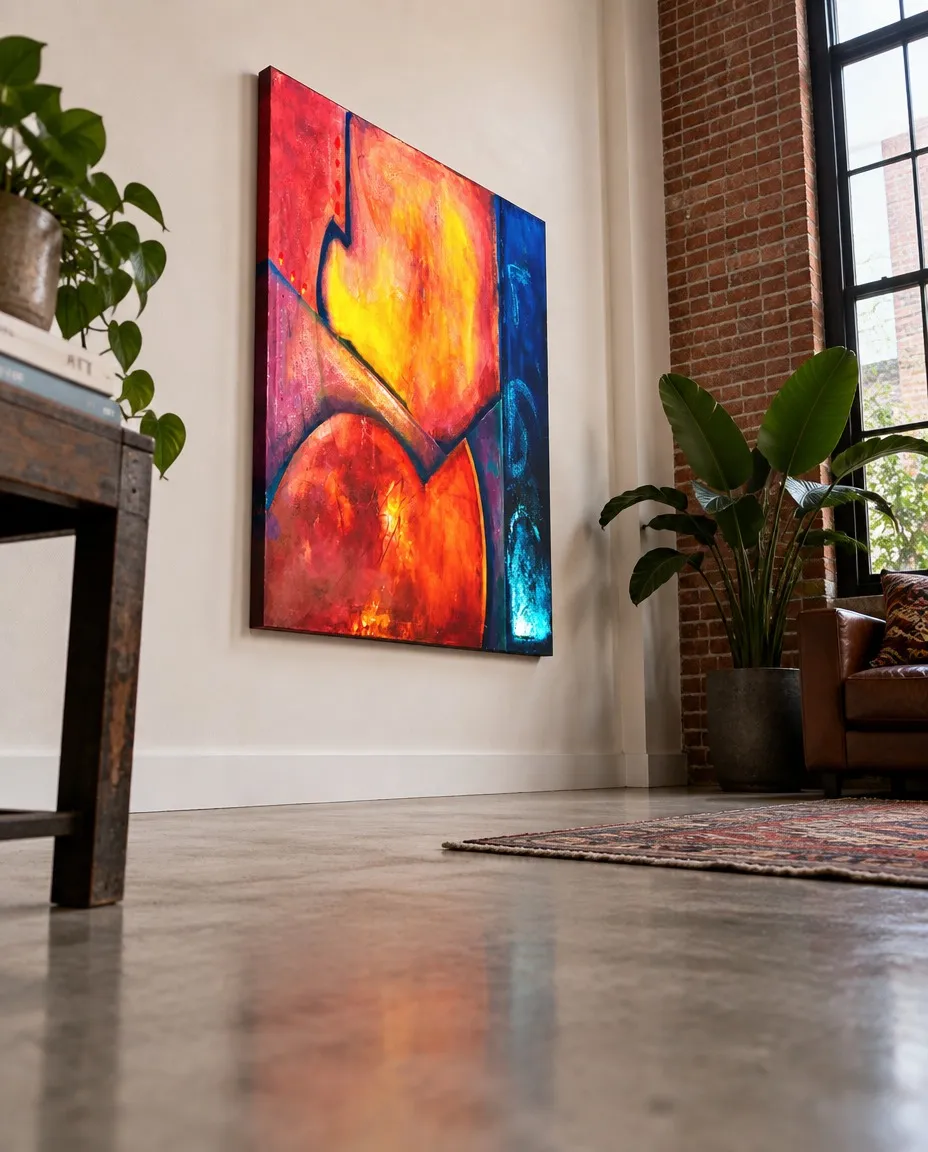
VERSUM by Maurizio Valch — Abstract Painting for Modern Loft Living Room
From a distance, VERSUM does not present itself as an image: it seems like a wall that has retained an improper temperature. The eye reaches the center and lingers there, drawn by the yellow that does not illuminate so much as it pushes. Around it, coral, orange, and red overlap like layers of air too close to one another. There is no rest. The gaze attempts to traverse this mass and turns back, halted by thick, irregular black lines that do not order the field: they hold it tight.
The dark edge descending from the upper left seems to have been placed there just before something gave way. Near it, the red drips do not decorate; they are minor losses of pressure, or the appearance of a loss that has not yet found an outlet. Lower down, the great orange arch concentrates another force. It does not seem to support the central body: it seems to receive its weight. Between the two, a black line works like an overly narrow joint. If you look at it long enough, it ceases to be a line. It becomes a seam. It becomes the place where a surface might open up.
The warm core can then be perceived as an enclosed body—not because it represents a recognizable body, but because it occupies space with the obstinacy of something breathing against a limit. Proximity alters the physical relationship with the painting. Drawing closer does not produce intimacy; it produces caution. The yellow seems to touch first, before the hand even reaches the surface. And if that which is at the center is contained, the question is no longer whether it is alive, beautiful, or has a name. The question begins to press in a different way: where would the heat of this painting escape if, for a minute, it ceased to be an image and one had to prevent its inner world from spilling over the body of the viewer?
Maurizio Valch: I look at the finished work and find a distance between what is before me and what I was perhaps searching for when I could not yet see it like this. Now, the center does not seem like a calm decision: it feels like a presence demanding space even beyond its limits. As I draw closer, my breathing shifts slightly, as if the temperature were in the gaze rather than on the surface. I cannot say for certain that this luminous body is enclosed, but neither can I see it as a simple extension of color. There is a resistance at its edges, a refusal to be immediately traversed, and this resistance makes the painting stand before me like something that does not entirely obey.
The first crack of inquiry does not open in the yellow, but between two ways of looking at it. Rosalind Franklin is a scientist whose attention to visual traces invisible to the naked eye allows us to think of an image as a register of forces rather than a still surface. Socrates is a philosopher who turned persistent questioning into a way of dismantling answers that seemed too secure.
Franklin does not begin by asking what the warm mass is. She observes where it concentrates. She examines the apparent red glazes, the yellow accumulations, the way one coral zone seems to press against another without fully blending. The black edges seem like clues to her: not the outlines of a figure, but signs that there are regions of differing densities. Under this attention, the painting acquires an imaginable internal structure. The center pushes. The lower arch receives. The blue band on the right contains or cools. The dark column on the upper left seems to be the descent point of a force that fails to distribute itself.
Socrates soon interrupts. If those edges are evidence of pressure, he asks, what exactly would they prove? That the painting has an interior? That the eye needs to invent one to avoid accepting a field of color without obedience? And what if the idea of an escape were merely a convenience, a way of turning visual discomfort into a resolvable problem?
The objection does not empty the observation. It makes it more dangerous. Franklin then focuses on a detail that insists without needing a theory: the red drips near the dark column. They are not identical. They do not fall with a regularity that would allow them to be treated as ornament. They seem to pause, to separate, to remain suspended at an uncomfortable distance from the great nucleus. This irregularity does not prove that something is escaping, but neither does it allow us to say that everything is perfectly sealed. There is evidence, though not a domesticable one.
Socrates asks if a stain can be evidence of something that does not exist outside the stain itself. Franklin responds with the surface, not with a definition: the problem is not to prove a hidden exterior, but to admit that certain visible relationships force us to think of invisible forces. The philosopher insists: do they force or do they seduce? The question also reaches the viewer. The central yellow seems to advance. But perhaps it is the body in front of the painting that retreats and attributes advancement to the surface.
There, the conversation ceases to clarify. The intensity of the image resists the idea that a good series of questions would suffice to make it transparent. Socrates can dismantle a quick answer—"it is heat", "it is matter", "it is confinement"—but he fails to cool the red accumulating beneath the arch or to make the blue turn neutral. Franklin can recognize distributions, tensions, zones of greater or lesser apparent permeability, but the painting refuses to be reduced to a register. Its clues shift when the gaze moves. What seemed like a limit behaves as a passage; what seemed sealed begins to look like a reserve.
Maurizio Valch: I am not sure that the blue band is an exit, even if from afar it seems to offer one. Nor do I see it as a simple opposite to the warm center. It is too close to it, too committed to the dark limits that separate them. Franklin may be right to suspect a zone of containment, but that containment does not feel stable. The blue seems to keep something without saying what it keeps; the dark edge seems to guard it and, at the same time, fail to close it off. The orange lower section does not settle as a support either. A more precise uncertainty remains: not knowing whether the pressure comes from the center toward the blue, or if the blue, silently, is pushing back.
Then comes the test that a specialized adult might avoid for shame of its precision: does the blue know that the yellow wants to burn it?
La pregunta no pide símbolo. Pide comportamiento. Si la franja azul sabe, debe tener alguna forma de defensa. Parece fría, profunda, vertical, casi mineral frente a la expansión de los rojos y naranjas. Pero también parece extrañamente expuesta: una pared angosta colocada junto a una zona que no deja de expandirse visualmente. Tal vez sea el único rectángulo de la pintura que sabe guardar un secreto sin quemarse. Or perhaps it is precisely the place where the secret accumulates because it can go nowhere else.
The eye wants to touch that band. It also distrusts it. Tracing it downward, it discovers glints and depths that do not function as an open door. To its left, the black edge separates, but not cleanly. In some sections it seems a firm joint; in others, a line fatigued by the pressure it must contain. Below, where the orange meets the blue, the painting concentrates its most severe difficulty. Neither territory wins. The orange does not completely invade. The blue does not impose a sufficient distance.
There, the leak test fails, though not in any spectacular way. There is no explosion. No visible spill. There is a border that seems to hold only because the viewer cannot decide what is happening within it. The lower zone burns without advancing; the blue vertical cools without guaranteeing refuge; the dark line contains without quite convincing. The gaze returns to the edge, expects a leak, and finds something more uncomfortable: a surface that remains closed while making us feel, with absolute insistence, that perhaps it is not.
- Original artwork
- VERSUM
- Actual dimensions
- 39.4 × 47.2 in / 100 × 120 cm
- Presentation
- Digital contextual visualization
Context references
large paintings for modern loft living room · industrial style decor with abstract art · interior design ideas with colorful artwork · abstract painting on white wall · contemporary art for spacious living rooms
About this visualization
This visualization places the artwork within an architectural context to help collectors and viewers imagine its presence in a real space. It is an interpretive reference, not an exact reproduction: the original work remains the sole authority for scale, color, surface and material presence.