Context study / VERSUM
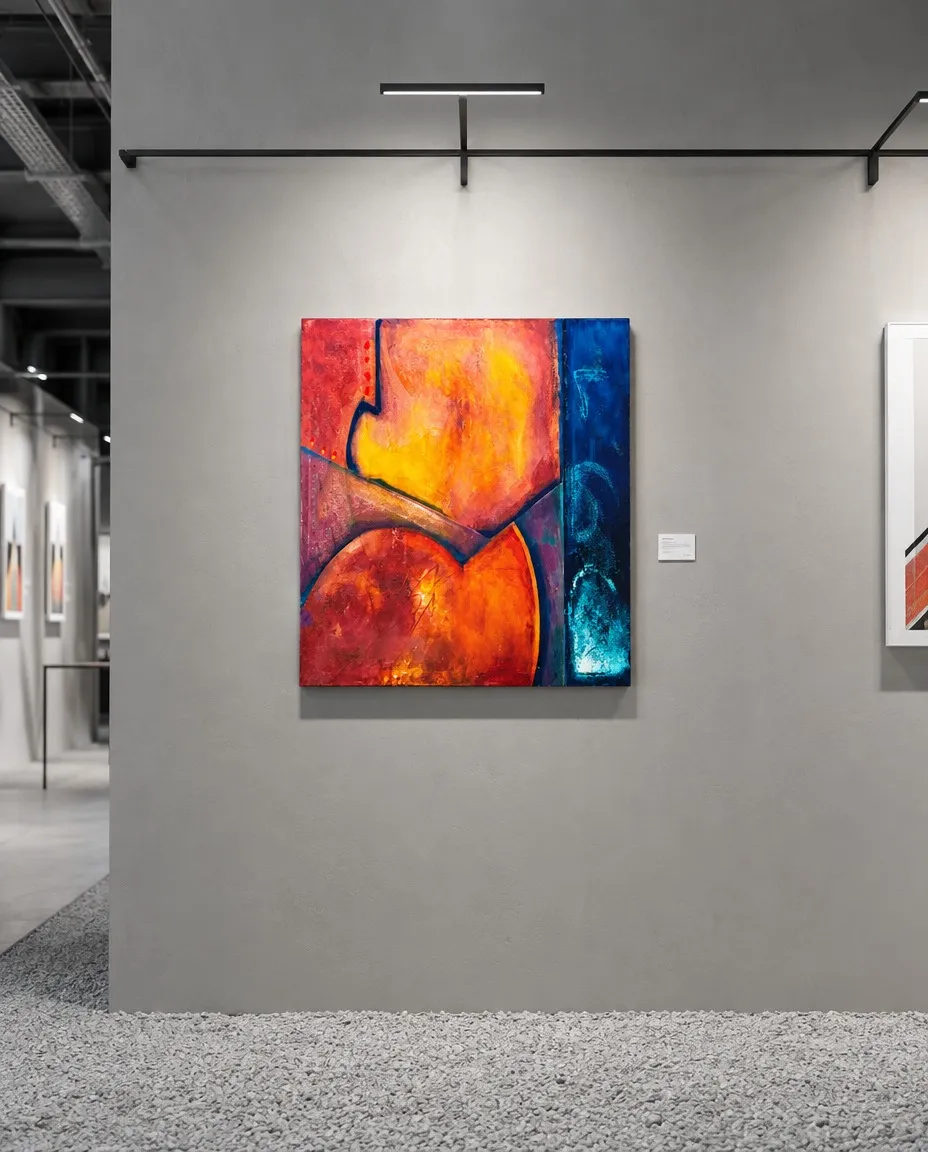
VERSUM, VORTEX Series – Maurizio Valch | Original Abstract Painting
Before crossing, make a test: cover the blue strip on the right with one hand. The painting swells, becoming almost too warm; the masses of yellow, coral, orange, and red no longer seem to advance but to press against a missing wall. Then cover the warm colors. The blue stops being a color: it becomes a situation, a chamber where the eye lowers its voice and waits for an authorization that does not arrive. This customs checkpoint begins right there: in the difference between covering an area and discovering that the temperature of the entire room has been altered.
CONTROL POINT 1 — Dark Access Edge
The first barrier is not in the blue. It is already inside the fire. A dark edge runs, cuts, bends: it separates an expansive upper zone from another heavier, curved, concentrated lower mass. The eye stumbles on these seams like a foot finding an uneven surface in a darkened room. These are not lines that explain form; they are thicknesses of prohibition and contact. The painting regulates the circulation of heat through them.
Rembrandt van Rijn. He was a painter capable of making light seem to think, hide, and reveal all at once.
Here he does not let the central yellow offer reassurance. He turns it into an interrogation spotlight. The luminous zone, wedged between reds and oranges that seem to breathe under pressure, asks the gaze what it wants to touch first. The brightness that promises closeness? The lower curve where color seems to have accumulated until thickening? Or the blue strip which, still at a distance, already withdraws its body?
The light forces the eye to confess a physical preference. The gaze behaves like someone bringing a finger close to a cup that is too hot: it approaches, calculates, retreats a little, returns. But the dark edge does not allow for an innocent inspection. Each time the eye enters the yellow, an angle deflects it. Each time it wants to traverse the red, a seam makes it fall toward a region that feels neither interior nor exterior.
The customs question changes shape: perhaps it is not about what wishes to cross into the blue. Maybe something was already trying to leave the yellow, and the edges were raised to prevent the heat from spilling out until it lost its condition as fire.
CONTROL POINT 2 — Upper Warm Mass
Above, the warm field is not a described flame: it is a visual pressure. Yellows that glow from within, oranges that seem to rub against each other, corals that grow denser where the eye expects transparency. There are apparent layers, visual glazes, areas that seem to have been pushed against one another even though the surface does not reveal the procedure of that pressure. The temperature does not come from an anecdote; it comes from the impossibility of looking at these zones without the gaze heating up.
The central yellow does not occupy the painting as a stable center. It widens and, at the same time, seems hemmed in. Above, it receives the containment of an almost vertical dark line; below, a diagonal or crevice forces it to fold. It does not simply illuminate: it is forced to negotiate its own expansion.
A child's question breaks into the checkpoint: if that yellow part wants to pass into the blue room, why does it have to be cut in two first by that black line running down beside it?
The question casts suspicion on a small red intrusion near the upper left edge of the yellow: it is not just an accent within the warm field. It seems to be a point where something is attempting an escape, only to be held back by a wall that is not entirely straight. The customs point stops seeming built between the heat and the blue. It is built inside the heat, where each intensity needs to prove it can retain its shape before crossing anything.
CONTROL POINT 3 — Central Crevice
The crevice dividing the hot masses functions as a border prior to all borders. It is a dark, irregular opening with hard contours and changing breath. It does not separate two recognizable figures: it manages two densities. Above, the yellow and orange push toward an almost frontal expansion; below, the reddish-orange curves and concentrates as if it had weight.
In this area, a strange rule is discovered: the hot is not necessarily what advances. The lower mass seems closer, more corporeal, yet also more arrested. Its large curve occupies the low edge with a presence that might seem like an entrance, a back, a closed floodgate. The eye tries to follow its arc and encounters an interruption: another seam, another dark pressure, another place where movement remains incomplete.
Then the blue on the right no longer seems like an exit. It begins to act as a retention chamber. Whatever reaches it will not be liberated; it must drop in temperature, lose speed, learn another kind of depth.
I look at the separation between the orange and the blue and realize I can no longer think of it as an obedient limit. It seems to me that the blue watches the heat, but also that the heat forces the blue to stay awake. I do not recognize a shape I wanted to fix: I recognize a distance that has become more alive than that which it keeps apart.
CONTROL POINT 4 — Large Lower Curve
The red curve of the lower register rewrites what was understood by fire. From afar, it could be taken for a compact, almost round accumulation, sheltered beneath the central crevice. Up close, visually, it does not close. There are variations of orange, zones of more opaque red, small glints that do not illuminate the whole but render it unstable. The curve seems to contain energy, but also to receive it from above, as if the yellow were falling toward it without ever fully touching it.
Here the gaze warms up more slowly. It does not receive the frontal impact of the yellow; it is held in a graver temperature, closer to the body. The surface seems to say: do not advance on impulse, go around. And in going around, the eye discovers that the curve does not lead to the blue directly. It is deflected by a dark band and by a lateral zone where the red cools toward violets and colored shadows before reaching the blue threshold.
Annie Ernaux. She is a writer who has turned intimate memory into a precise tool to discover how the personal is traversed by time and by others.
She disorganizes the suspicion that yellow is a sovereign presence, a spotlight dominating everything else. What kind of memory does a blue wall need in order not to disappear? Not a memory with a scene, characters, or plot, but the imprecise instant when the body knows something occurred because it still retains a temperature, even if it can no longer tell what it was.
The lower warm mass then behaves like that persistence. It does not "represent" a memory; it preserves a difficulty of reconstruction. Something has been compressed between the curve and the seam, not to be deciphered, but to continue altering the way the eye breathes. The overly dramatic light becomes suspicious: it may be covering up the inability to name a sensation without distorting it.
And yet, memory begins to illuminate. Not through a narrative, but through an orange zone that grows more intense the less it can be explained. The yellow, which was interrogating, now admits a reservation: not everything it makes visible has the right to be possessed by the gaze. The light uncovers a kind of shame, a refusal to fully display what it has heated.
I feel the distance between my eyes and that blue strip like a resistance in my breathing. I can follow the pulse of the reds, linger on the yellow, graze the dark seams with my gaze, but I cannot fully translate the cold region that receives them. I know that zone remains in the painting as a temperature that does not enter into my words.
CONTROL POINT 5 — Blue Territory, Conditioned Transit
Now the ultramarine strip can never be just blue again. After covering the warm tones with a hand, it became a situation: a vertical, narrow, deep enclosure, with turquoise spots or breaths that do not relieve its density but make it more mobile. There are dark zones that seem to retract, others that advance toward the surface, and a light vibration near the lower edge that does not illuminate like the yellow: it cools the desire to touch.
The blue does not absorb the fire. Nor does it oppose it as a simple opposite. It makes it visible. Without that cold band, the warm masses could expand across the entire field and lose the condition of pressure. Without the heat reaching its edge, the blue would be just a lateral strip. Together they build a transit regime where no temperature gets the final word.
The initial question has become harder to sustain. Perhaps it does not attempt to cross a form. Perhaps it attempts to cross a way of seeing: the impulse to turn brightness into possession, the need to give the curve a name, the habit of believing that a line divides solely because it is dark.
The customs post retains its stamps: the central seam, the lower curve, the narrowing near the right edge. But in the end, the detail that prevents one from looking away is not the grand yellow or the wide red curve. It is that tiny turquoise vibration trapped inside the ultramarine, near the border, as if the blue strip had begun to respond from within without yet saying what has set it in motion.
- Original artwork
- VERSUM
- Actual dimensions
- 39.4 × 47.2 in / 100 × 120 cm
- Presentation
- Digital contextual visualization
Context references
original painter paintings · contemporary abstract art · large format abstract painting · blue and orange color fields · buy original abstract art
About this visualization
This visualization places the artwork within an architectural context to help collectors and viewers imagine its presence in a real space. It is an interpretive reference, not an exact reproduction: the original work remains the sole authority for scale, color, surface and material presence.