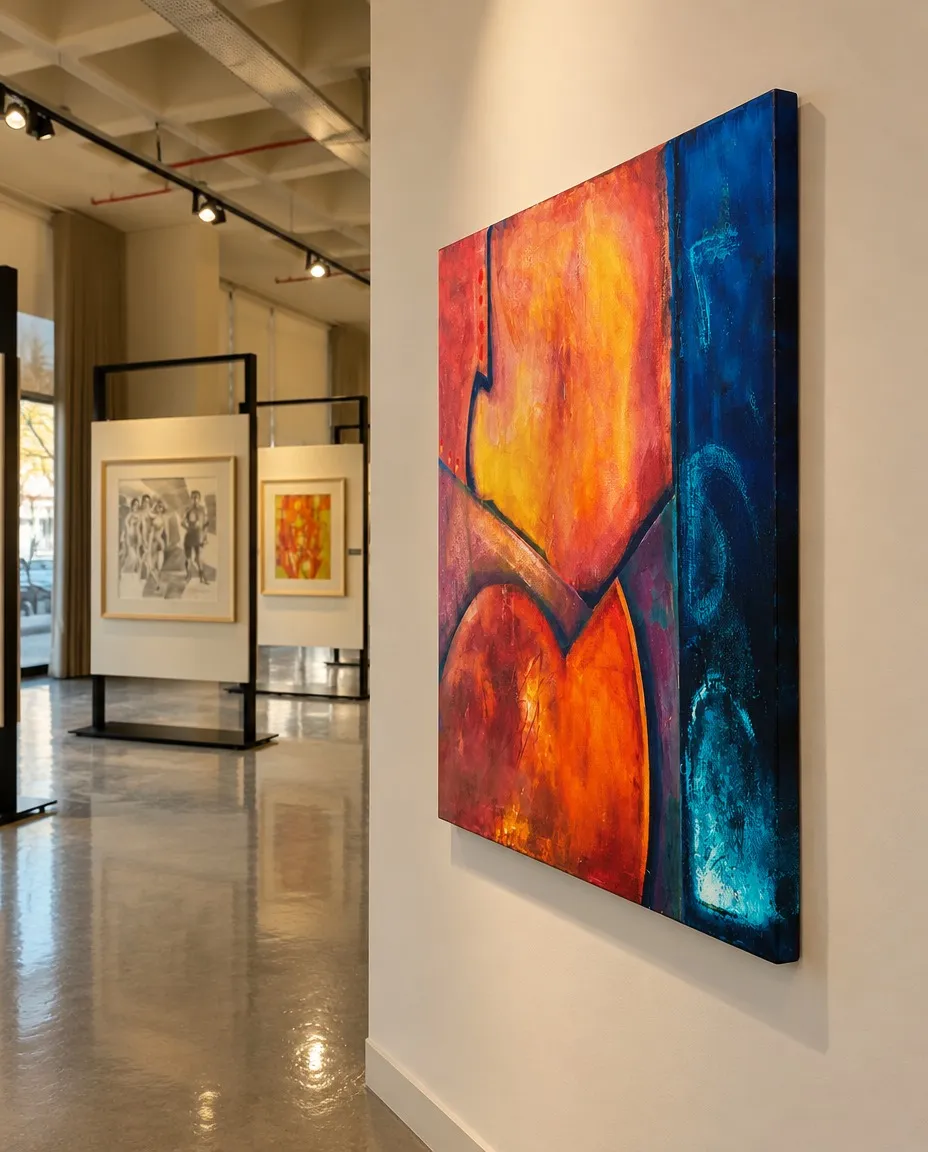
Context study / VERSUM
VERSUM Abstract Painting | Maurizio Valch – VORTEX Series
VERSUM
The Hand Test
Mentally covering the blue strip on the right does not simplify VERSUM. On the contrary: the image loses its pressure edge, and the heat begins to misbehave. Reds, pinks, yellows, and oranges no longer seem contained within a field; they expand as if they had discovered that no one is watching the wall. The central yellow—so luminous it almost seems inflamed from within—ceases to be a center: it becomes an escape. The two lower curved masses lose their mutual friction, their uncomfortable fit, and begin to rise visually, as if weight had evaporated.
Without blue, the dark contours do not hold up the same way either. They seem less like lines and more like the remnants of an incomplete architecture: a curve falling from above, an edge crossing the center, an interruption that fails to bring order to the expansion. The painting's breathing accelerates. Everything pushes to the right, precisely toward the place the hand has just erased. The heat is not distributed: it rushes forward.
Then the blue strip is returned.
It does not return as a complementary color or a resting place for the eye. It returns like a wall that arrived too late—when the fire had already begun to occupy everything—or too early, before the warm zone had finished deciding what shape it could take. Its presence does not cool the orange or extinguish the yellow. It squeezes them. It makes them burn brighter because now they have something to burn against.
At the center of that tension, a voice appears that does not seem to speak from the security of having mastered the painting, but from the surprise of seeing it resist:
I do not know if balance was ever under my control. The warm zone grows, and as I look at it, I feel my will barely gave it a provisional edge. There is a physical pressure in that yellow, in those reds that refuse to stay still; the lower curves seem to push from a place that does not obey. The blue contains, yes, but it also provokes. Sometimes I think the painting holds; other times, that it is about to claim more space than it was granted.
The blue wall does not pacify: it concentrates. It makes the warm field seem like something forced to halt, and for that very reason, it accumulates greater force. The image begins to pose a strange difficulty: what happens when the cold does not reduce the temperature of what it touches, but forces it to burn with greater precision?
The Line That Refuses to Obey
The dark contours could be given quick names: border, figure, pipe, wound, ladder, creature, limit. But each name arrives late and falls short. The profile that descends from the upper edge, shifts toward the center, and curves over the orange zone seems to want to impose a rule. Not an elegant rule. Rather a somewhat blunt, perhaps nervous rule: this far, through here, no further.
But the visible matter does not entirely obey.
The line offers itself as structure and, at the same time, seems to have been displaced by that which it intends to delimit. In some places it separates; in others, it barely grazes. Sometimes it gives the impression of protecting a form; other times, of having left a mark after the form escaped. It does not quite manage to be the skeleton of anything. It is a presence searching for a body.
Joan Miró was an artist capable of turning seemingly naive signs, lines, and shapes into visual organisms of enormous freedom. Here, his intelligence forces us not to treat those contours as mere compositional devices. The upper curve could be emerging, playing, stumbling against the yellow, trying to build a body with very little certainty. The large lower masses could be two forms pushing against each other, yes, but also two signs still rehearsing the possibility of touching without merging.
However, that freedom runs into an objection.
Ludwig Wittgenstein was a philosopher who pushed language to its limits to discover what can be said, shown, or left in silence. Faced with the ease with which the gaze calls a curve a "creature" or a strip a "landscape," he introduces an uncomfortable delay. Before naming, we must verify. What actually occurs on the surface? A dark line falls. A luminous zone accumulates. A blue edge interrupts. Two curved masses weigh downward. Everything else may be necessary, but it has not yet been proven.
Such caution would irritate Miró: if too much proof is expected, the sign remains on the threshold and never gets to play. But Miró must also correct himself. Not everything here can become a cheerful creature or a small domestic constellation. The painting has too much density, too much pressure against its own limit. Play exists, but it is not innocent. The dark contour does not only liberate; it also polices.
From that friction, another reading is born: the orange demands a rule because it seems excessive, and the blue sparks imagination because it prevents the rule from fully closing.
The Blue Room
Look first, for a few seconds, only at the border where the red meets the blue. Do not traverse the rest of the painting. Leave out the yellow, the lower curves, even the full height of the strip. Look at that junction as if it were an overly tight seam.
When returning to the whole, the blue no longer seems like a lateral band. It feels like a room.
Within that room, the speed of the gaze changes. The deep blue zone holds glazes, luminous marks, accumulations, and areas that seem to recede into a thicker darkness. There is a high glow, almost suspended; further down, a light shape gathers near the bottom edge as if emitting light or retaining it. It does not quite offer an exit. Nor does it behave like a background. It has depth without opening a landscape, and density without becoming an object.
Then a child’s question alters the entire painting: why does the blue seem cold if it is surrounded by so much fire?
It is not a question about emotions assigned to colors. It is a question about contact. The blue is pressed against the hot field, yet it retains a different temperature, a different physics. It does not melt. It does not turn orange. It remains dark and, precisely by remaining, makes the other colors seem closer to bursting.
Now the blue no longer feels like an outer limit. It has its own distance, as if within it there were a part of the painting that refuses to come forward. Miró might want to give it movement, to let its traces invent a being; Wittgenstein might ask us not to say so much. But that strip does not fully obey either. I look at it and do not entirely recognize what it is doing: it does not just contain the heat, it also returns it altered, like a gaze that does not respond and yet changes whoever receives it.
The blue room is perhaps a witness. Perhaps a doorless chamber. Perhaps a surface looking out at the rest of the painting with an almost mineral patience. But even these phrases begin to tighten too much around what they see. The blue does not demand an interpretation; it demands that one remain a little longer in its slowness.
The Return of the Fever
Stepping back until the two large lower curves stop looking like potential objects and become solely weight, the painting changes once more. The orange is no longer at the bottom as a stable base: it pushes upward, receives the dark curve crossing it, and approaches the central yellow without ever merging with it. The yellow, previously expansive, now seems held back by a double pressure: that of the contours and that of the blue keeping silent on the right.
The fever of VERSUM does not consist of a formless explosion. It consists of having to burn inside a structure that cannot manage to dominate it. The blue watches, but its surveillance does not calm. The contour orders, but it curves, hesitates, lets itself be dragged along. The lower masses fit together, but they also seem to dispute which of them supports the other.
What remains, in the end, is a small and persistent area: the lower edge of the blue strip, where the luminous form seems to graze the darkness without fully illuminating it. It is impossible to tell if that light is emerging, sinking, or getting trapped. When looking again, it is still in the same place, but it no longer seems motionless.
- Original artwork
- VERSUM
- Actual dimensions
- 39.4 × 47.2 in / 100 × 120 cm
- Presentation
- Digital contextual visualization
Context references
brutalist abstract art · contemporary abstract painting · large minimalist paintings · maurizio valch painter · interior decoration with art
About this visualization
This visualization places the artwork within an architectural context to help collectors and viewers imagine its presence in a real space. It is an interpretive reference, not an exact reproduction: the original work remains the sole authority for scale, color, surface and material presence.