Context study / VERSUM
VERSUM – Maurizio Valch | Contemporary Abstract Painting
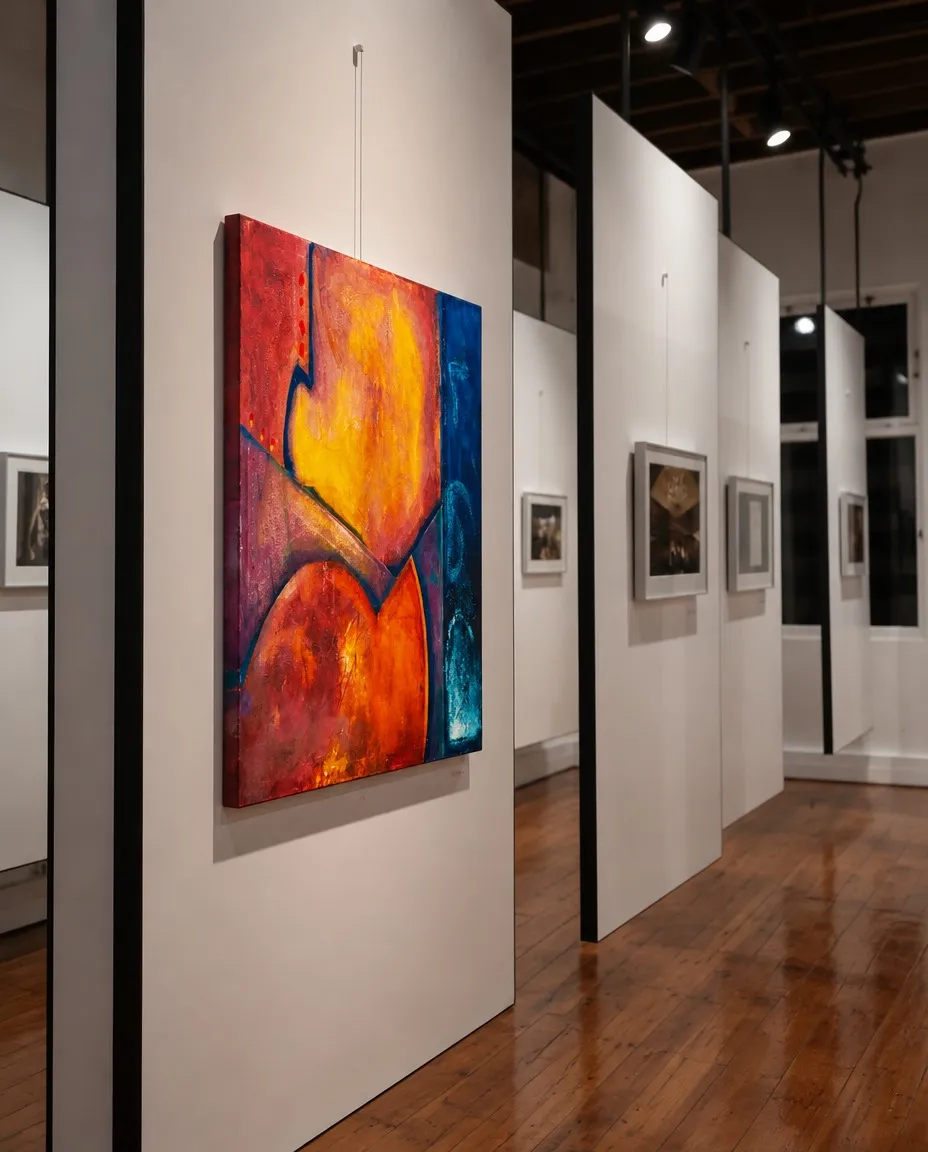
The blue strip on the right does not wait for the rest of the painting: it blocks the way. It does not function as a background against which the other areas are revealed, but as a vertical presence that receives the pressure without clearing it. It has the density of an adjoining room, a damp storage space, a wall that perhaps is not a wall. The eye arrives there looking for rest from so much yellow, orange, and red, but the blue does not rest: it absorbs, barely cools, guards something. Its border with the warm mass is not clean; it looks like a seam at work. Before looking at the center, it is worth lingering for a few seconds on that line and keeping your gaze still. Your breathing tends to shorten slightly: on one side there is expansion and push; on the other, an arrest that yields no way out.
Samuel Beckett. He was a writer who knew how to listen to what persists when words can no longer complete a sentence. Faced with VERSUM, he would be suspicious of the great yellow clarity. He would not take it as a triumphant appearance, but as a burning sentence left half-said, a matter that wants to make itself present but stumbles over its own dark outlines. There is something in that high, yellow, and reddish form that seems luminous and yet heavy: it does not illuminate the space, rather it occupies it. It bulges toward the blue, leans without falling, held back by lines that seem too thin to support it. The childhood question then appears with a strange gravity: who is holding that sun's belly so it doesn't fall into the blue corridor?
At the point where the light stops seeming light, the voice of Maurizio Valch enters without resolving anything:
I look at this warm zone and do not fully recognize the obedience I expected from it. I feel that the light has gained weight and that its weight no longer depends on me. I see a form I wanted to bring together, but now it seems to push from its own need, as if it were looking for a place that the surface does not quite grant it. I cannot say it is still: I feel it contained, and that containment makes what I thought I had delimited more uncertain.
Vincent van Gogh. He was a painter capable of treating color as pulse, temperature, and physical contact with the world. His attention would go first toward the warm tremor: the yellows not as an idea of light, but as a localized fever; the oranges and reds as zones of friction, of an intensity that seems to ask for touch and, at the same time, push the hand away. He would want to follow that vibration down to the lower curves, where the hot field splits into two rounded, thick, almost breathing bodies. But the blue band interrupts that enthusiasm. It does not let the warm color become a celebration. It forces it to recognize its limit, its imbalance, even its fatigue.
As it descends, the painting stops offering anything resembling a landscape. The two curved volumes below do not quite become objects or organs or stones; they act as if they were pushing from behind a skin. One receives more red, the other more orange, and both are cut, tensed, crossed by the same dark edges that previously seemed to support the great upper mass. Now those edges no longer support with certainty: they squeeze. Beckett would detect here a kind of effort without an outcome, a breathing that does not know if it is drawing in or out. Van Gogh, on the other hand, would find movement where the former hears a jam: the curves are not completely enclosed, because the warmth moves through them, accumulates, escapes in small surface variations. The stable form begins to lose its name. The eye no longer knows if it is looking at something being born, something resisting, or something held back just before opening.
The blue strip, seen after those bodies, changes function. It no longer seems solely the cold edge containing the fire. Beckett insists it is not darkness: it is attention. It remains there, narrow and deep, listening to the effort of the warm masses without returning an easy answer. Van Gogh resists; in the blue he still finds vibration, living matter, an activity that does not belong to pure silence. Perhaps both are only half-right. The blue seems still because it refuses to imitate the movement of the other colors; it seems active because that refusal modifies the entire pressure of the painting. It does not cool completely. Nor does it yield.
When the gaze returns to that limit, another distance appears, less comfortable than the first:
I return to the blue and discover that I do not know which side it belongs to. I do not feel it as an area I can call external, but neither can I pull it toward the warm mass. It forces me to maintain a distance I had not foreseen. The more I look at the lower curve next to it, the more I notice that this curve does not advance alone: something in the blue stops it, or lets it breathe without allowing it to escape.
The bodily test then becomes more precise. Keep your gaze on the line where the reddish yellow meets the blue, and let your eyes slide down, without jumping, to the lower orange curve. Do not seek to interpret: notice if the air enters with the same ease when your path falls through the heat as when it grazes the cold strip. The difference is not in a general emotion; it is in the sensation that one zone pushes your chest outward and the other asks it to stay inside. Thus, the blue stops being a safe wall and the warm matter stops being a safe expansion. Each depends on the resistance of the other.
In the end, the blue strip remains pressed against the side of the great luminous mass like a surface that does not quite open; below, the orange curve seems to lean toward it, stopped a millimeter from entering that blue which continues to guard its cold without putting out the fire.
- Original artwork
- VERSUM
- Actual dimensions
- 39.4 × 47.2 in / 100 × 120 cm
- Presentation
- Digital contextual visualization
Context references
abstract paintings for gallery · contemporary art maurizio valch · orange and blue abstract painting · large format abstract canvas · decorating with gallery art
About this visualization
This visualization places the artwork within an architectural context to help collectors and viewers imagine its presence in a real space. It is an interpretive reference, not an exact reproduction: the original work remains the sole authority for scale, color, surface and material presence.