Context study / VERSUM
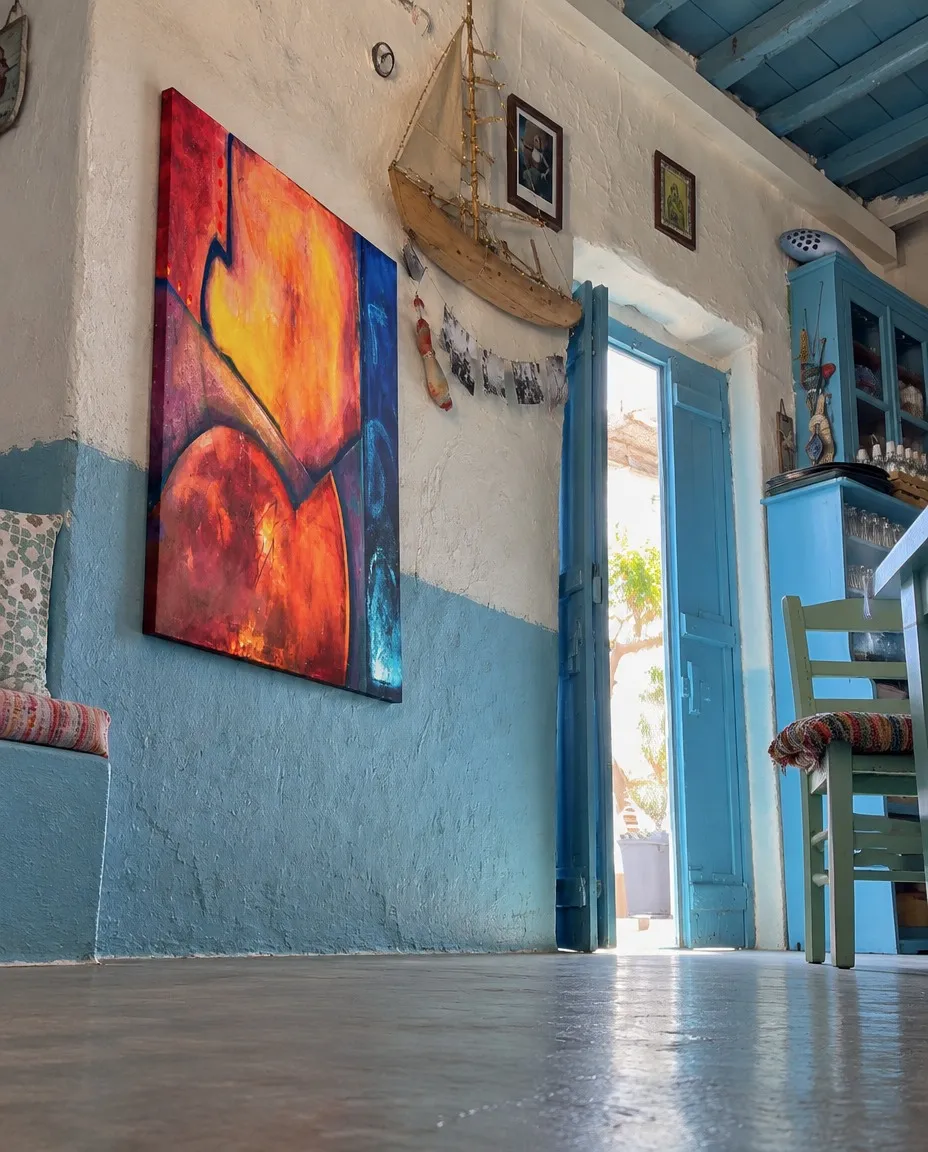
VERSUM por Maurizio Valch | Series VORTEX – Territorial Abstract Painting
The test of the two thermometers. The first registers the obvious: an accumulation of reds that is not quite red, oranges thickening downward, yellows that seem to hold a light too heavy to remain suspended. The second thermometer, however, is placed in the blue strip on the right edge. It marks cold, yes, but a strange cold: not that of something kept away from the fire, but that of a wall that has been too close to the flames and has learned not to betray them.
The gaze first arrives at the hot center and is almost deceived by its expansion. The great yellow mass seems to swell between veiled reddish areas; below, the orange arc has the weight of something that could roll, collapse, or suddenly rise. But the dark outlines do not allow the forms to spill freely. They cross, cut, retain. In some places they are lines; in others, they seem like ribs, dikes, a seam that has been stretched until it becomes visible. Nothing is still, and yet, nothing quite falls.
Archimedes was a man who learned to distrust everything that seemed balanced.
William Shakespeare was a man who knew that a voice can change an entire room without moving from its spot.
Archimedes observes the lower arc and suspects a problem: that curve holds too much pressure. It should not hold up like that, so close to the edge, without shifting downward or pushing the yellow form until it is disordered. He looks at the accumulated reds, the dense transparencies, the small marks that appear like the residues of an arrested boiling. He assumes a force that wants to expand and another that forces it to return. For him, the painting becomes a test of containment: something filled to the limit, maintained by dark lines that work like dikes that are too thin.
Then the blue appears again, but no longer as a contrast. It is a side chamber: narrow, vertical, cold in appearance, made of very dark blues that seem to contain the remains of other temperatures. Its edge touches the fire without mixing with it. It watches it. It receives it. Perhaps it threatens it. The first thermometer drops; the second rises. The eye seeks relief in that strip, like someone opening a hallway door to breathe, and discovers that the air there is more compressed than in the orange center.
I cannot look at this tension from afar for very long. I draw closer and the intensity becomes resistance; I move away and something continues to push from the surface. I need to let what seems enclosed breathe, but I also need to stop it before it occupies the entire image. The blue gives me no rest: it forces me back to the heat with a different uncertainty.
Shakespeare distrusts calculation. He says—without making it a solemn phrase—that Archimedes is too quick to want every mass to answer to a law. Here there is no single weight: there are late entries, pauses, zones that break off before completing what they promised. The yellow occupies the center like a voice that has spoken too loudly; the orange arc underneath does not reply: it endures. The lateral reds pull away and return as if they had changed their minds mid-sentence. And the blue arrives without introducing itself, narrow, almost rude, but it manages to quiet the others down a bit.
Archimedes retorts that this is not drama, but visual tension. Shakespeare insists: what difference would it make, if a tension makes the eye hold its breath? Neither manages to prevail. The lower curve can be both support and threat. The black lines can be limits or wounds of separation. The small splatters and marks can be residues, signs of a pressure that has already found an escape, or simply proof that the surface does not want to behave like an obedient surface.
A child might ask: why does the blue, being so narrow, seem to have room to hide the entire painting?
The question does not ask for an answer; it changes the scale of things. Suddenly, the yellow mass no longer seems huge: it seems to approach something that cannot fit inside it. The orange arc no longer seems like a base: it seems like a form that has stopped its rolling exactly before touching the blue strip. The dark outlines cease to be simple divisions; they are the places where the heat, unable to continue, learns to bend. Even the veiled reddish areas seem to look toward that edge, as if the hottest part of the painting suspected that its destiny lies in the least flammable place.
I did not expect the blue strip to end up separating itself from me in this way. I had felt it as a necessary limit, but now I cannot be sure it limits anything. Sometimes it seems to hold pressure; other times, to be the pressure itself, motionless and nameless. The more I try to approach it, the more it throws me back toward the yellow and the orange, as if the unknown were not behind the edge, but in that which the edge forces to remain together.
Archimedes measures again and finds an anomaly he cannot correct: the heat does not rise. It concentrates, curves, darkens at the boundaries, and seems to lean toward the blue. Shakespeare hears the same anomaly as a scene without a resolution: no one leaves the space, no one gains ground, but each area modifies the breathing of the other. The painting remains suspended between both hypotheses, about to fall, boil, speak, and fall silent all at once.
And the right strip remains there: vertical, dark, apparently cold. No longer as the margin of VERSUM, but as the place where the fire, perhaps, has begun to learn to take shape.
- Original artwork
- VERSUM
- Actual dimensions
- 39.4 × 47.2 in / 100 × 120 cm
- Presentation
- Digital contextual visualization
Context references
mediterranean abstract painting · maurizio valch paintings · blue and orange abstract art · territorial abstraction · rustic decor with art · modern living room paintings
About this visualization
This visualization places the artwork within an architectural context to help collectors and viewers imagine its presence in a real space. It is an interpretive reference, not an exact reproduction: the original work remains the sole authority for scale, color, surface and material presence.