Context study / VERSUM
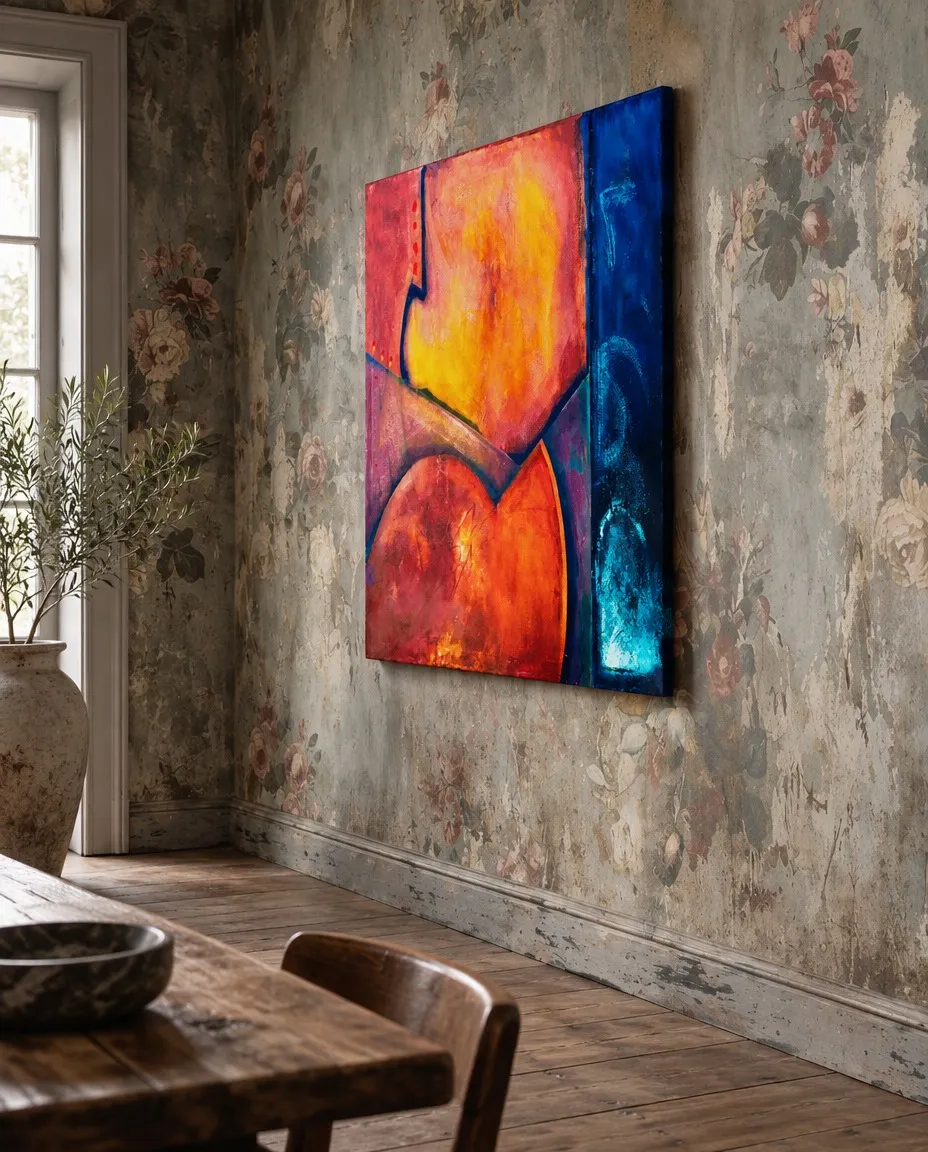
VERSUM Artwork by Maurizio Valch in Rustic Dining Room
The lower orange seems to weigh more than the surface can support. It swells, pushing forward like an overripe fruit pressed against cold glass. To its right, the blue column does not yield or allow itself to be infected: it remains vertical, dense, almost obstinate. Before looking at the colors as territories, it is worth following the dark outline that sews and wounds them. It descends from the upper area, veers, rounds a glowing curve, and tenses again next to the blue. Is it a seam? A crack? The profile of an unnamed thing, seen too closely?
The warm mass does not behave like a light flare. The yellow, concentrated in the upper center, seems to burn without consuming itself; the surrounding red does not merely encircle it, but compresses it, keeping it alive. There are areas where the color gives the impression of having thickness, of having accumulated as if it were still searching for a stable form. Lower down, the orange-red curve bulges with an almost physical presence. It does not necessarily represent a body, but it demands that the eye treat it as something that could resist touch.
Clarice Lispector. She was a writer capable of discovering abysses, strangeness, and revelation in the secret life of apparently ordinary things. Faced with this warm pressure, her suspicion would not be that forms imitate objects, but that they are on the verge of acquiring consciousness. Perhaps that lower curve already knows something. Perhaps it knows that it is not a spot, nor a fragment, nor an incomplete figure, but a presence halted just before speaking.
The dark line does not completely enclose it. Rather, it forces it to bend. The orange form seems to want to slide beneath that line, shifting toward the blue territory, but something keeps it on its side. The border does not divide two pure substances: it records a friction. Like when a refrigerator door is opened in a dark kitchen and the cold air does not erase the warmth of the hand that opens it, but rather makes that hand more conscious of itself.
The pressure between the warm mass and the blue edge has already appeared: one insists on expanding, the other on not yielding. There, the gaze stops moving at ease. It becomes slower, almost tactile.
I bring my hand close without touching and notice that the distance changes: the orange curve seems to advance toward me, while the blue stays where it is and, nevertheless, weighs more. I expect the yellow to open up like light, but it resists; it does not behave like a spilling clarity, but like something held back inside a form. When I follow the dark seam, I discover that I do not know if it separates two bodies or if it is the tension of a single body that cannot manage to become whole.
Then a child's question appears, precise and disarming: why doesn't that blue part melt if it is joined to all that fire?
The question alters the scale. It is no longer a matter of interpreting colors, but of observing an impossible coexistence. The blue on the right looks wet, but it is not water; it shows glints, depths, and areas that give the sensation of containing moisture, though nothing flows. It is a vertical container where something has been suspended. It does not function as a background for the warm forms. It watches them. It retains a memory that is not surrendered all at once: a trapped clarity, a shadow that does not go out, a surface that seems to have absorbed an ancient pressure.
Only after crossing that strip can the title, VERSUM, enter as a word that forces a turn. It does not clear up the scene. It could be a command, a reverso, a direction spoken in an undertone. Upon reaching the blue, the eye discovers that it has not escaped the fire: it has entered another temperature, one measured not in degrees but in concentration. The blue does not cool the orange; it holds something of its violence and makes it less visible.
J. M. W. Turner. He was a painter who pushed light, atmosphere, and visible matter to the threshold of disappearance. His sensibility would want to let the yellow and orange dissolve into a glow, letting the form yield to a kind of luminous air. But this painting contradicts him: here, light does not evaporate bodies; it makes them denser. The yellow is not lost; it coagulates visually. The red does not turn to mist; it seems to gain weight. And the real difficulty arrives at the right edge: why does the blue zone seem to hold a more compressed light than the incandescent center?
For Turner, that blue could be a phenomenon of luminous accumulation: not absence, but light folded over itself until it acquires density. Clarice, on the other hand, would detect an unsettling intimacy. She would not see a compressed atmosphere, but a silent creature holding the edge of the painting and refusing to explain what it contains. Where he seeks the behavior of clarity, she finds a mute will. Where she imagines a room that watches, he finds a chamber of arrested light.
The child's question returns, but it is no longer the same size. Perhaps the blue does not melt because it is not next to the fire: perhaps it is what allows the fire to remain lit without overflowing. Or perhaps the orange does not burn outward, but against a wall that receives it. The dark seam changes function once more. It can be a limit, a nerve, a hinge, the edge of a closed door. It may be holding back the blue as much as it holds back the orange.
I do not fully recognize any part when I look back at the finished painting: the blue strip can seem like a place that guards, but also like that which expels; the orange mass might push, but perhaps it is being pushed from behind. Not even the dark line allows itself to be fixed as a separation. Sometimes I see it supporting the forms; other times, I see them trying to escape it. I am left with an area I do not know how to name without making it too obedient.
Clarice would not easily accept that the blue is only a condition of light: she insists that there is a trapped intimacy there, something that has learned to remain still. Turner would not accept that this stillness is a secret life: he sees a visible intensity, a light that refuses to expand. Neither resolves the other. Between both, a third question appears, unique to this painting: if the blue strip were a narrow room and the orange field a presence trying to enter, who is outside and who is trapped?
The answer is not in the bright center, but near the blue base, where an almost wet clarity seems to rise from below and meet the orange curve without fully touching it. The dark line passes close by, as if it could support this encounter or split it once and for all.
- Original artwork
- VERSUM
- Actual dimensions
- 39.4 × 47.2 in / 100 × 120 cm
- Presentation
- Digital contextual visualization
Context references
decorating rustic dining room with abstract art · vintage floral wallpaper ideas · large paintings for dining room walls · interior design with antique textures · rustic wooden dining tables
About this visualization
This visualization places the artwork within an architectural context to help collectors and viewers imagine its presence in a real space. It is an interpretive reference, not an exact reproduction: the original work remains the sole authority for scale, color, surface and material presence.