Context study / VERSUM
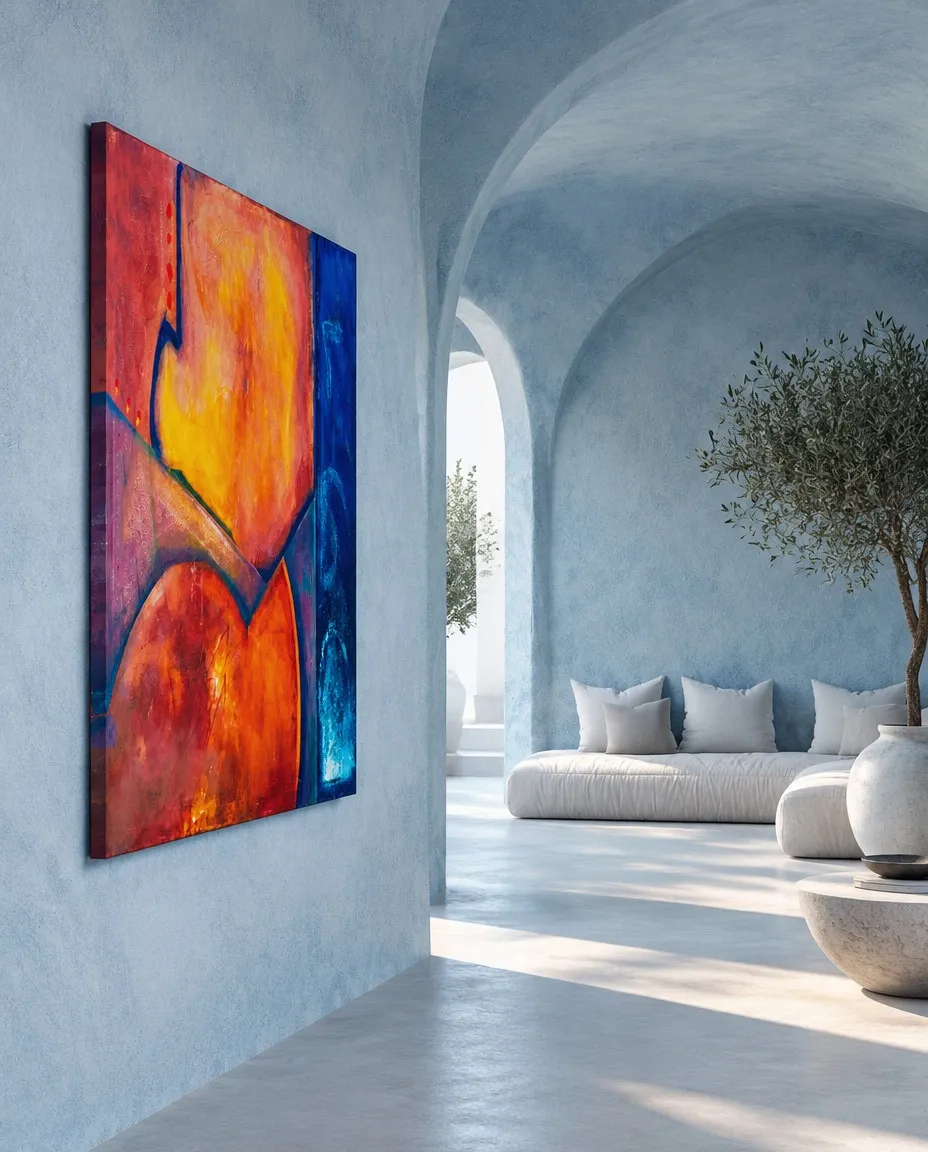
VERSUM Abstract Painting in Minimalist Blue Living Room
VERSUM — The Experiment of the Two Edges
Before looking for a figure, suspend interpretation. Look first at the painting as one looks at a temperature: enter through the red surface on the left, let the eye graze its pink glazes, its denser zones, its small accidents of light. Then move toward the central yellow. Notice if your breath warms there. Then shift it, slowly, to the vertical blue strip: check if something in your chest cools, restrains itself, or becomes more attentive. Finally, observe which edge seems to look back at you.
Entry seems easy. On the left, the red does not offer itself as an emblem but as matter that occupies, presses, and extends. It is not a uniform surface: it has changes in intensity, pink passages, areas that seem pushed forward and others that recede under a more opaque layer. The yellow, in the center, receives this advance and makes it harder to measure. There, the warmth does not expand smoothly: it is traversed by dark, thick, slanted lines that at once separate and sew two large rounded bodies. The eye wants to call them shapes. Then it wants to call them volumes. But each name arrives too late: the junctions have already altered what seemed visible.
Lynn Margulis was a biologist who transformed our idea of life by proposing that living beings can emerge from intimate alliances between different organisms. Her intelligence forces us to scale down the view of VERSUM until the distance between composition and organism becomes uncertain: those warm masses could be host and host, membrane and content, two parts that have learned to carry on together without merging into one. The blue band, then, would not be the exterior of that body but a difference that must be preserved for something to go on living. But the painting quickly discomforts this possibility: here the alliance does not seem peaceful. It seems tense. What is joined does not rest; it presses against its own limits.
I feel that the warm zone wants to advance beyond what I can contain with my gaze, but the blue strip does not accept receiving it or disappearing before it. I do not quite feel that the painting belongs to me: one part demands expansion and another imposes a distance I cannot domesticate. When I follow the dark lines, I notice that the heat is not free and that the edge is not still either; both seem to decide something without asking my permission.
The dark lines complicate the hypothesis of coexistence. They are not simple perimeters. In some sections they fall like a cut; in others, they support the contact between a lower reddish mass and a yellow presence leaning over it. There is a line that seems to have arrived too late to separate. There is another that seems to prevent one shape from completely invading the next. Right there enters Fernando de Rojas. He was a writer whose La Celestina turned desire, negotiation, and contradictory voices into an intensely alive human machinery. Under that pressure, the junctions stop looking like innocent membranes: they are places where something is agreed upon, withheld, or betrayed without words. The warm shapes do not simply cooperate; they negotiate space, heat, and visibility.
A child, facing this encounter, might ask: why doesn't the blue burn on the side that touches the yellow? The question disarms the convenience of calling the right-hand strip a border. If the blue were only outside, perhaps it would have to pull away. If it were only a wall, perhaps it would have to halt the fire more clearly. But it remains pressed against it, vertical, dark, irregularly alive. Margulis finds here a condition for survival: certain life needs to preserve within itself what it cannot assimilate. Rojas interrupts: preserving is not the same as caring; it can also be a way of watching, delaying, demanding.
Now it is best to reverse the path. Step out of the blue. Do not abandon it, but let its darkness return your gaze toward the center. From there, the warm masses no longer seem solely expansive: they seem illuminated by contrast, bounded by a presence that forces them to take shape. A faint glow seems to peer out from the blue background, not as a promise but as a reserve. The vertical rectangle can be night, vessel, wall, wound, distance; none of these possibilities manages to pin it down. Each leaves a remnant that the other contradicts.
Returning from the edge, the two large rounded shapes are no longer complete bodies. They become territories that depend on their cuts. The lower red and orange mass seems to weigh more, to come closer to the spectator; the yellow one, above, seems to advance in another way, as if its intensity were sustained by an inclination. Between them, the dark line does not join after separating: it performs both operations at the same time. Margulis cannot turn this into a stable alliance. Rojas cannot reduce it to a dispute between rivals either. The painting preserves a pressure without a resolution.
Seeing it arrested, I discover that my desire to order the relations between the zones cannot govern the life that each one sustains. The coexistence one might imagine is not a peace between colors, and the negotiation one might attribute to the lines does not explain their mute insistence. I perceive, rather, that the blue keeps something of the heat without becoming warm, and that the burning masses depend on that rejection so as not to dissolve.
Return now to the blue strip and look at it as if it were not on the margin. Then review the two warm masses, one above and one below, and follow slowly their lines of contact until you see that the nocturnal edge does not only limit what happens: it participates in the way the interior holds together. Leave, however, a small blue area unnamed, especially where its depth seems to graze the yellow without touching it entirely.
- Original artwork
- VERSUM
- Actual dimensions
- 39.4 × 47.2 in / 100 × 120 cm
- Presentation
- Digital contextual visualization
Context references
minimalist blue living room decor · art for interiors with arches · modern mediterranean interior design ideas · how to hang a large painting in living room · decorating with red and blue abstract art
About this visualization
This visualization places the artwork within an architectural context to help collectors and viewers imagine its presence in a real space. It is an interpretive reference, not an exact reproduction: the original work remains the sole authority for scale, color, surface and material presence.