Context study / TRIA
TRIA — Context Study
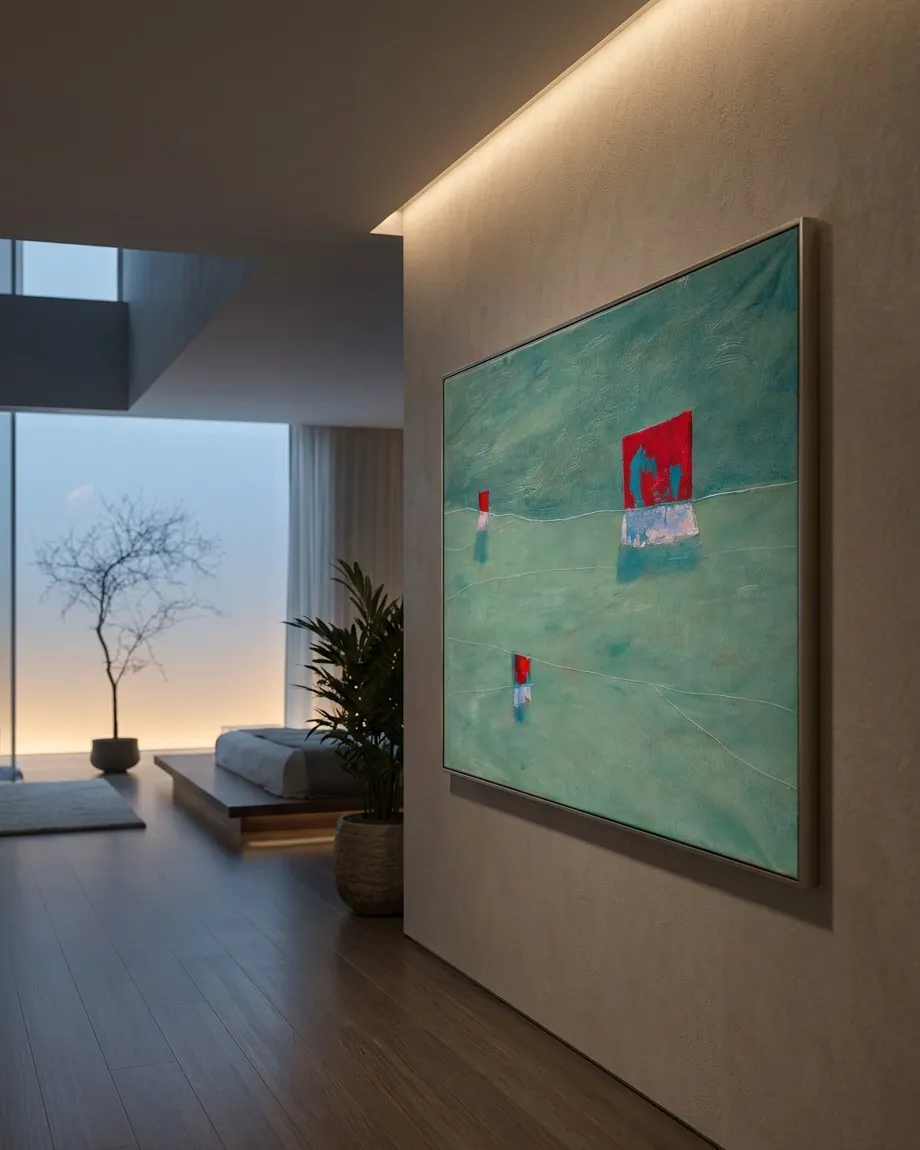
Unlike figurative representations that define space with concrete references, in this painting, spatial tension arises from the contrast between a vast emerald color field and the compelling presence of red geometric forms that, like monoliths, seem to float or take root in a subtly incisive horizon.
The work's materiality is built through a combination of acrylic and oil on canvas. Valch's process is evident in the rich surface textures, dense impasto in the upper area, glazes that give depth to the lower field, and incisions that traverse the plane. This results from successive applications with a palette knife, scraping, and layering, evoking a geological landscape or a worked hide.
Within the 'STRATA' series, this piece aligns with Maurizio Valch's exploration of territory as a surface of origin and memory. Here, suspended blocks and horizontal lines function as 'strata' and 'spatial divisions' that do not illustrate, but rather construct a space for contemplation, order, and fracture, inviting an open interpretation of matter, body, or place of appearance within a sober and melancholic atmosphere.
- Original artwork
- TRIA
- Actual dimensions
- 47.2 × 31.5 in / 120 × 80 cm
- Presentation
- Digital contextual visualization
Context references
Original abstract painting by Maurizio Valch · Contemporary horizontal abstract art · Minimalist artwork for collectors · Textured acrylic and oil painting · Brutalist art with monolithic forms · Territorial abstraction with incised horizons · XL painting in blue-green and red tones · Modern painting for interior design · Acquire unique original abstract art · Artwork with strata and spatial divisions · Contemporary color field painting · Abstract art for collectors and interior designers · Horizontal acrylic oil painting blue-green · Textured contemporary art for modern spaces · Buy Maurizio Valch STRATA series artwork · Brutalist XL abstract painting
About this visualization
This visualization places the artwork within an architectural context to help collectors and viewers imagine its presence in a real space. It is an interpretive reference, not an exact reproduction: the original work remains the sole authority for scale, color, surface and material presence.