Context study / TRIA
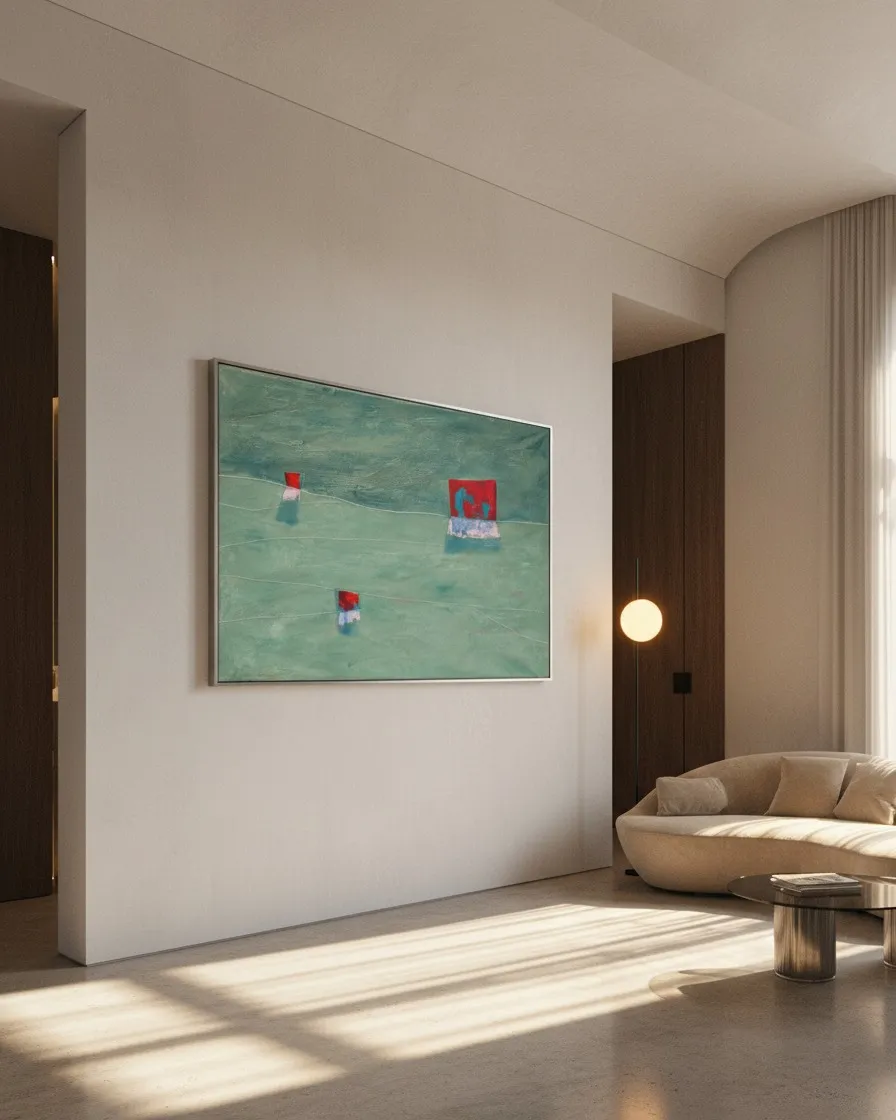
Large Format Painting TRIA Hanging in Living Room - Maurizio Valch
Observed in the solitude of this neutral wall, where the sunset light grazes the emerald surface, the painting seems to claim an absolute sovereignty, a stillness sufficient unto itself. Yet, this isolation is a fiction refined by the architecture of domestic space. By breaking away from the STRATA series, the work loses the geological pressure of its dark and crimson companions, and that surrounding emptiness alters its gravity. What in the studio was a transit station, one more stratum of a continuous territory subjected to collisions, is presented here as a suspended event, forcing the viewer to interrogate a fragment as if it were the entirety of the map.
When I worked on the canvas, accumulation was my only rhythm; I was not painting a picture, but scratching a ground that extended far beyond these wooden edges. The three red shapes floating over the green field were not born to be admired from the refined distance of a living room, but as remnants of a material shipwreck that shared the same air with other wounded surfaces of the series. Seeing this piece detached from its sequence produces an almost physical strangeness in me: it is as if a precise word had been extracted from a long sentence to examine its individual sonority, losing in transit the breath of the narrative that sustained it.
In this large-scale individual format, the contrast between the green background and the irruption of the red acquires a vibration that the homogeneity of the series used to mitigate. The horizontal incisions are no longer merely cartographic journeys within a process of erosion; here they act as a single horizon dividing the plane with a severity that evokes the formal refinement of Barnett Newman. Without the vicinity of the other pieces from STRATA, which contextualize the incision as a mark of time and somatic wear, these lines risk being read as pure geometry, demonstrating how the viewer's gaze tends to aestheticize what has been orphaned of its original context.
Are these red blocks three wills trying to assert themselves on the plain, or are they the same self unfolding so as not to have to look at itself head-on? I have always mistrusted closed explanations, but seeing the painting like this, outlined against the silence of this room, I recognize the temptation to construct a heroic theory about these monolithic forms. Thought rushes to find an order, to crown one of these blocks as the protagonist of a visual feat, forgetting that the true force of matter lies in its resistance to being translated.
The work ultimately sustains itself in that unresolved tension between its decorative destiny and its processual origin. Inhabiting this shore of light and shadow, TRIA proposes an exercise in attention that goes beyond the mere contemplation of its chromatic fields. It confronts us with the suspicion of our own fragmentation: the possibility that what we call identity is nothing more than an individual canvas exposed to the gaze of others, while the true series of our experiences, with their covered layers, their cuts, and their silent shifts, remains hidden in the twilight of the abandoned studio.
- Original artwork
- TRIA
- Actual dimensions
- 47.2 × 31.5 in / 120 × 80 cm
- Presentation
- Digital contextual visualization
Context references
large painting for over the sofa · living room decor with contemporary art · green and red abstract painting living room · buy original large scale painting · home decor ideas with original artwork
About this visualization
This visualization places the artwork within an architectural context to help collectors and viewers imagine its presence in a real space. It is an interpretive reference, not an exact reproduction: the original work remains the sole authority for scale, color, surface and material presence.