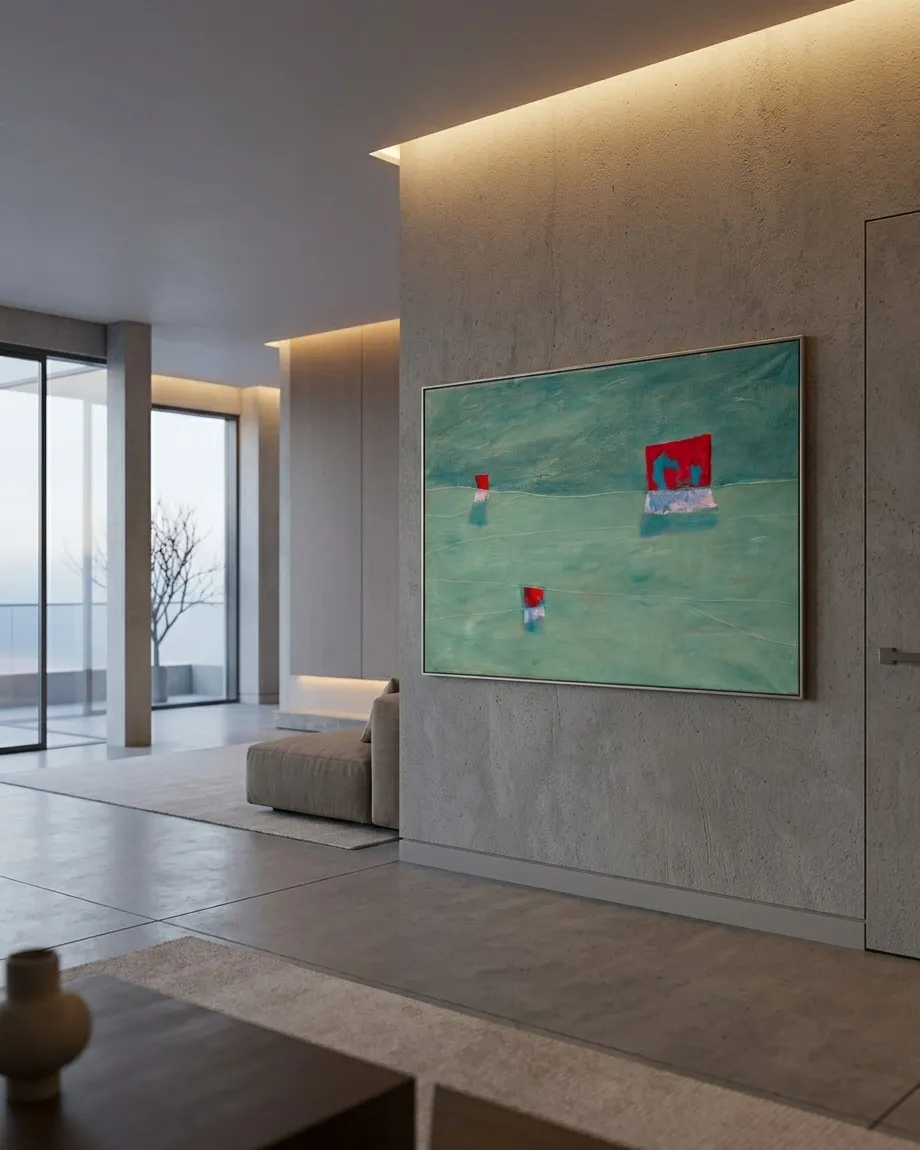
Context study / TRIA
TRIA Painting on Concrete Wall - STRATA Series
Hanging TRIA on the raw bareness of a concrete wall exposes the painting to a scale that dispenses with justifications. There is no frame here to bound the fiction, but a material object coexisting with the architecture. Contemplating that vast emerald field, traversed by incisions that rip the surface without any apparent destination, the eye instinctively searches for an exit, a narrative, or a key to order the three suspended red blocks. Yet, the painting resists the haste of decipherment. Those monoliths do not function as letters of an extinct alphabet awaiting translation; they are silent presences, masses of dense pigment claiming their right to occupy space without explanation.
At times, as I apply the oil with the palette knife or cut an incision into the wet matter, I find myself trying to manufacture a theory to justify what the hand has already resolved. It is a familiar trap: the anxious mind needing to turn a field of color into an existential conflict in order to feel safe. But in TRIA I sought precisely to dismantle that suspicion. I scraped the red surface of the blocks, unearthing the green stratum beating beneath, not to reveal a hidden truth, but to dwell on the physical fact of the cut. In the end, painting is this silence where words wear out; a space where the hand falls quiet and the canvas simply remains.
The contemporary obsession with concluding, with sealing every experience under the label of a diagnosis or a concept, founders before the immobility of this work. The incised lines traversing the green do not shape a useful cartography or a way back; they are traces of a subtractive gesture, marks of an action that has already occurred and does not need to be psychologically prolonged in the viewer's mind. The room's atmosphere, tempered by overhead light that caresses both the relief of the canvas and that of the concrete, invites a suspension of analysis. Understanding the work does not demand resolving its mystery, but accepting the interval of its silence, allowing the tension between the emerald calm and the crimson weight to hold itself without the urgency of a resolution.
For years I conceived my own life and my painting as a constant quest, a succession of battles where each work had to be the trophy or conclusion of a long interior Camino de Santiago. I expected to reach a place where everything would finally be explained and validated. Looking now at these three red blocks floating in the green, I understand that such a harbor is an illusion of thought. These forms do not need to win any battle or reach the other edge of the stretcher to be complete. They are there, suspended in their own density, and their stillness is my own renunciation of continuing to push the rock up the hill.
The integration of the piece into this warm minimalist space, set against the outdoor mist glimpsed through the window, underscores its character as a threshold. The work does not decorate the wall; it interrupts it, opening a crack in the predictable order of the room. There is no message to decode, no moral to take home upon walking away from the canvas. By laying down the weapons of interpretation, the viewer discovers that the true encounter with TRIA does not happen when its structure is deciphered, but when its unfinished presence is accepted. The fact of painting survives its readings, and it is precisely at this limit, where explanation surrenders, that space truly begins to breathe.
- Original artwork
- TRIA
- Actual dimensions
- 47.2 × 31.5 in / 120 × 80 cm
- Presentation
- Digital contextual visualization
Context references
paintings on exposed concrete · warm minimalist living room art · strata collection by maurizio valch · decorating concrete walls with art
About this visualization
This visualization places the artwork within an architectural context to help collectors and viewers imagine its presence in a real space. It is an interpretive reference, not an exact reproduction: the original work remains the sole authority for scale, color, surface and material presence.