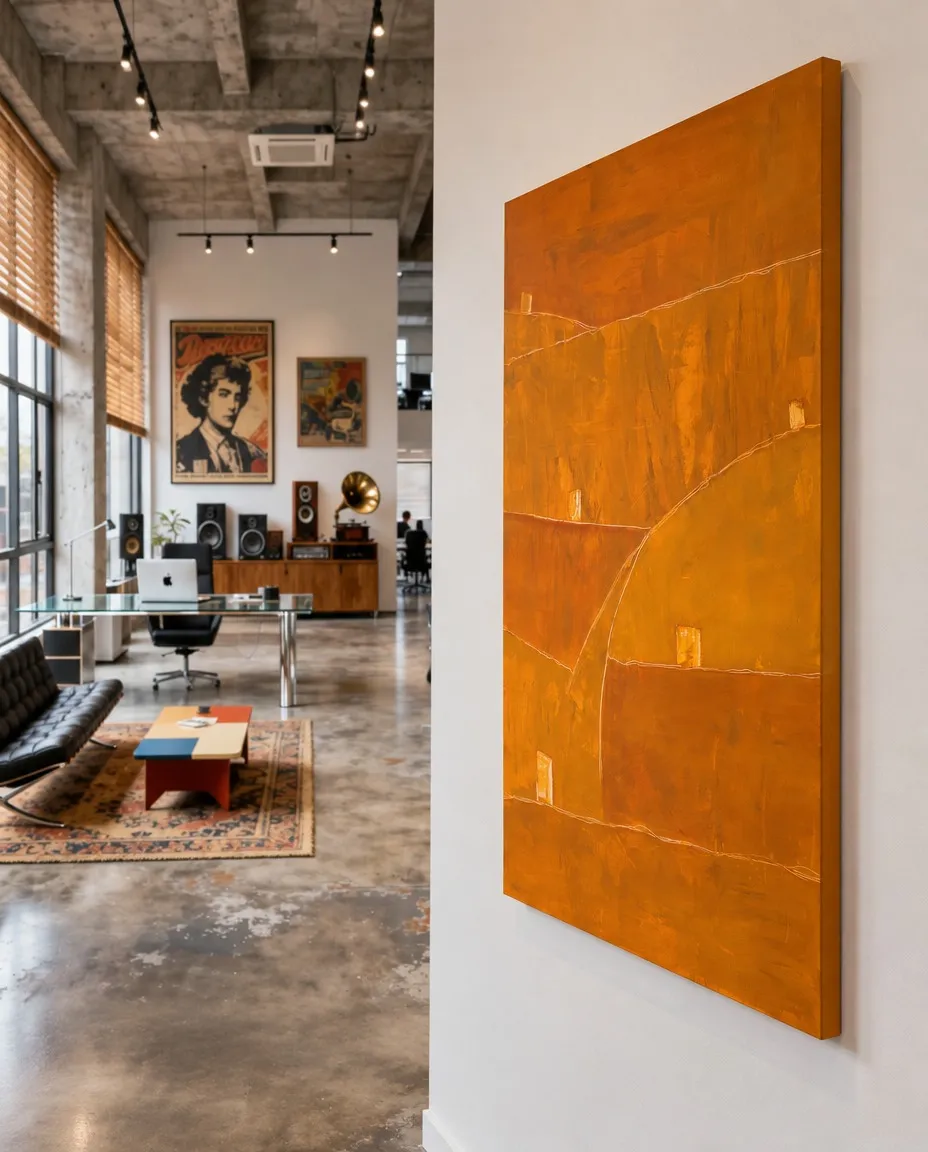
Context study / TESSERA
TESSERA by Maurizio Valch (STRATA Series) | Orange Abstract Art
In TESSERA, pictorial space is not governed by the laws of traditional perspective, but by a geological density that appeals to the stratification of matter. The burning orange color, saturated with ochres and ambers, does not recede toward a vanishing point, but emerges toward the viewer through cumulative depth, where each stratum of oil and acrylic reveals the memory of its own superimposition and tactile scale. This chromatic topography is crossed by sharp incisions, subtractive lines that act as tectonic faults on the plane. Far from breaking the unity of the canvas, these wounded lines articulate a particular form of communion: a spatial nexus that does not seek to merge scattered elements, but to sustain the exact distance between the small quadrangular tesserae that mark the path. Thus, communion in this work is defined as a respectful neighborliness, a pact where separation and connection coexist under the vibration of the same warm horizon.
When I face the canvas, I understand that painting does not consist in accumulating layers until the plane is deafened, but in knowing when to remove material so that the territory can breathe. The physical gesture of incision—that deliberate scraping that wounds the still-fresh pigment—is not an act of violence, but of material generosity. By subtracting the oil, by opening these fine cracks that traverse the mass of ochre and amber, I am releasing tensions and offering a resting space for the eye. This orange territory, with its rough relief and tactile warmth, behaves before my hands like exposed skin, a living tissue surrendering to the touch of time and the light of my studio. My generosity as a painter lies in this detachment: I do not seek to impose a closed image, but to leave the support open, vulnerable, allowing the material to speak from its own stripping away and its own silence.
The small quadrangular blocks, the tesserae suspended over the fracture lines, function as conceptual anchors within this immense chromatic field. Their presence reveals a crucial tension between the individual isolation of each niche and their alignment with the incisions running across the plane. It is precisely in this shared crack that communion acquires its most physical dimension: the blocks are not isolated in a void, but sheltered in the folds of a common wound that gives them meaning and tactile scale. Valch designs a cartography of care here, where the paint behaves as a tactile shore that softens the rigidity of geometry. These small monoliths of rustic light, far from being mere ornaments, become shelters that suspend the hostility of open space, demonstrating that union does not require the loss of identity, but the acceptance of a shared boundary in relief.
Contemplating these tesserae aligned on the boundaries I have drawn, I often wonder if these geometric niches are the steps of an invisible ascent or rather the silent ruins of a previous home, buried in the territory of memory. The depth of my search does not pursue a mystery hidden behind the painting; I know well that the enigma is not in the invisible, but fully exposed in the scars and reliefs of the surface. When natural light enters my studio and bathes the canvas, it falls on the strata of warm ochre and crimson, transforming the incisions into grooves of shadow and making the small blocks cast a changing relief. In that instant, the painting ceases to be a static plane to become a breathing organism, revealing that the mystery resides in the honesty of the worked material, in that physical vibration that changes with the hours and holds my own questions without pretending to resolve them.
Ultimately, TESSERA succeeds in subverting traditional conceptions of connection and generosity in contemporary art. Valch shows us that true depth is not an illusory abyss, but the surface itself when it has been worked with honesty, patience, and respect for its own strata. Likewise, the generosity of the work does not reside in decorative complacency, but in its material resistance: the painting refuses to be a passive background and imposes itself as a textured body demanding an attentive gaze. The definitive communion then occurs in the silent confrontation between the viewer and the canvas; in that space of resonance where the burning orange survives its own cuts and wounds, offering a visual refuge where silence and chromatic vibration merge into a single act of tactile contemplation.
- Original artwork
- TESSERA
- Actual dimensions
- 31.5 × 47.2 in / 80 × 120 cm
- Presentation
- Digital contextual visualization
Context references
orange abstract painting · modern ochre painting · textured contemporary art · maurizio valch strata · tessera maurizio valch · paintings for modern offices · warm minimalist decor
About this visualization
This visualization places the artwork within an architectural context to help collectors and viewers imagine its presence in a real space. It is an interpretive reference, not an exact reproduction: the original work remains the sole authority for scale, color, surface and material presence.