Context study / TESSERA
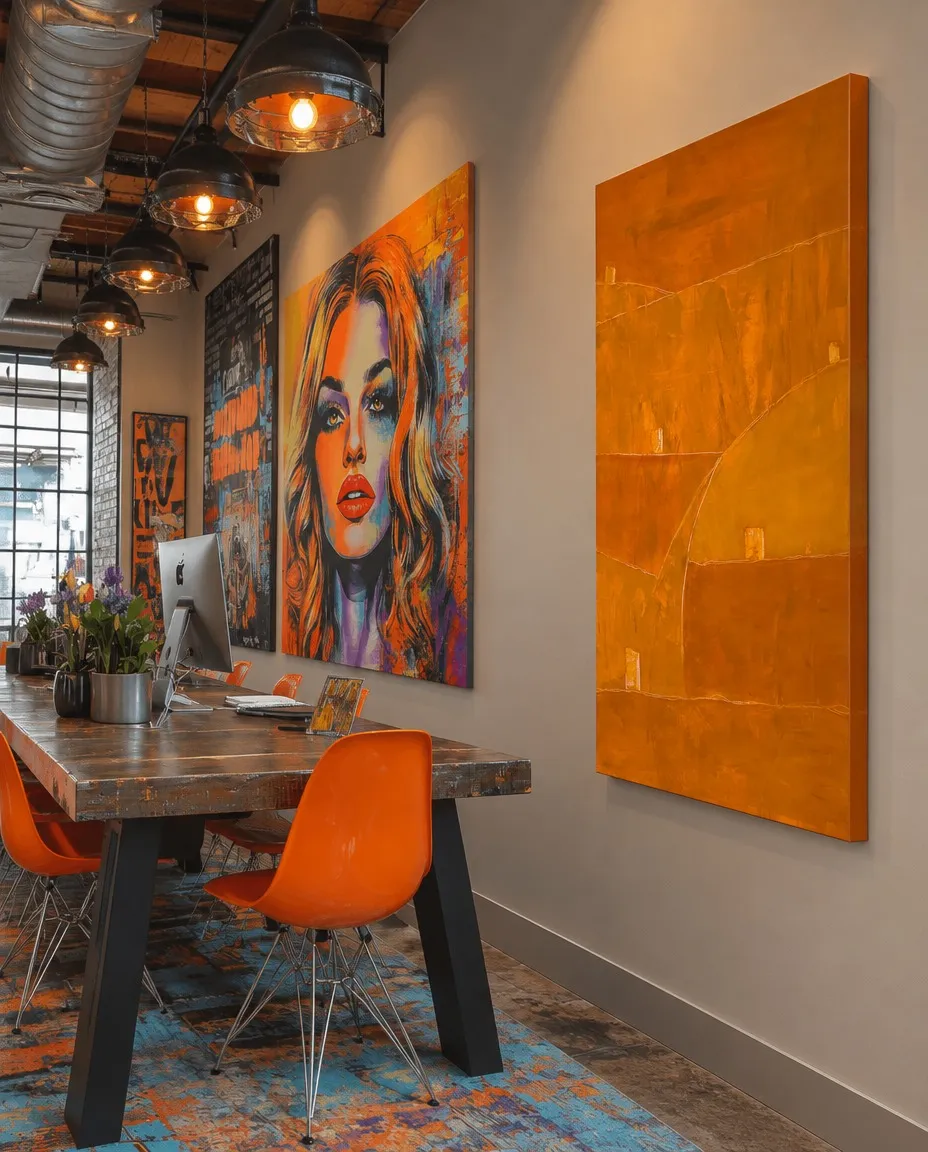
Orange Minimalist Painting TESSERA in Workspace
Hung on a side wall, flanked by the haste of a meeting table and the strident magnetism of a pop-style portrait, TESSERA acts as an unusual visual brake. In an environment designed for productivity, decision-making, and the constant exchange of arguments, this large orange canvas by Maurizio Valch proposes a space of suspension that challenges the logic of the workspace. Color does not function here as a corporate accent or a complementary color scheme for design chairs; it presents itself as dense matter, accumulated in strata that seem to absorb ambient noise. Faced with the contemporary need for every object to serve a function and every meeting to yield a result, the work imposes a disconcerting quietude: there is no message to decipher or goal to reach, but a rough surface that simply demands time.
When working on these oranges and ambers, I am often tempted to push the material toward a resolution, to add a definitive element that fully justifies the painting to the viewer. However, the true effort consists in stopping before thought turns the painting into a closed theory about myself. These fine incisions scoring the surface do not seek to build a useful map or point to an exit path; they are physical marks, subtractive gestures that interrupt the continuity of color, which I accept without claiming to explain them. At first, one paints to prove something, to sustain a kind of personal quest on the canvas, but over the years you discover that the maturity of the mark lies in allowing the painting to remain unfinished, free from the tyranny of a final brushstroke that explains everything.
The ancient word that gives the work its title, tessera, refers to a mosaic fragment, a piece that presupposes a whole or a split token waiting to be completed to reveal its identity. However, in this composition the small luminous blocks do not seem to seek a perfect fit in a larger system, but float in the vastness of the ochre and crimson as exceptions defending their isolation. There is no design to unify them or geometric structure to force them to coordinate. By renouncing symmetry and cartographic order, the painting detaches itself from the classical references of geometric abstraction to propose a purely somatic experience, where understanding is born not from fitting the pieces into a logical explanation, but from holding one's gaze before their dispersion.
I often find myself caught in the habit of watching my mind, searching for a deep reason for every discomfort or shift in direction, as if life were a psychological problem requiring an urgent solution. But in front of the canvas, that need for self-analysis crumbles and I realize that the fact of the painting is far simpler than any of the interpretations I try to overlay upon it. I do not need these chromatic fields to represent my memory or the blocks to simulate shelters against uncertainty; it is enough for me that the color resists the pressure of the palette knife and that the incisions show the support without destroying it. Silence arrives precisely when the mind understands its own noise and renounces fabricating a doctrine for every small action, letting the surface exist in its own right, without the weight of my justifications.
In the end, the physical presence of TESSERA in this transitional room reveals that painting is not a conceptual bunker designed to protect a meaning, but a tactile shore where verbal explanations become insufficient. Those who pause before it under the cool light of industrial lamps do not find an answer to the day's questions, but a threshold inviting them to lay down their resistance to the present. In the vibration of its glazes and the fragility of its marks, the work suggests that to understand a territory is not to map it to its last corner, but to inhabit it with enough honesty to stop needing a conclusion.
- Original artwork
- TESSERA
- Actual dimensions
- 31.5 × 47.2 in / 80 × 120 cm
- Presentation
- Digital contextual visualization
Context references
office decorative paintings · orange and wood abstract art · modern office decor · large format modern art · maurizio valch strata · collaborative workspace design
About this visualization
This visualization places the artwork within an architectural context to help collectors and viewers imagine its presence in a real space. It is an interpretive reference, not an exact reproduction: the original work remains the sole authority for scale, color, surface and material presence.